⏱ Word-count reading planner
Novella Reading Time Calculator
Estimate a novella by word count, page density, WPM, reading mode, notes, rereads, daily sessions, active reading days, start date, and deadline pressure.
Load a real planning scenario, then tune the word count, page density, pace, notes, reread share, and deadline to fit your book.
| Story length category | Word count band | Novella relevance | Planning note |
|---|---|---|---|
| Short story | Up to 7,500 words | Below novella range | Usually one sitting for most adult readers. |
| Novelette | 7,500 to 17,500 words | Just below novella range | Can feel novella-like, but time math is lighter. |
| Novella | 17,500 to 40,000 words | Primary calculator band | Use word count first; pages depend heavily on format. |
| Novel edge | 40,000 words and up | Beyond novella range | Deadline math starts to behave like a short novel. |
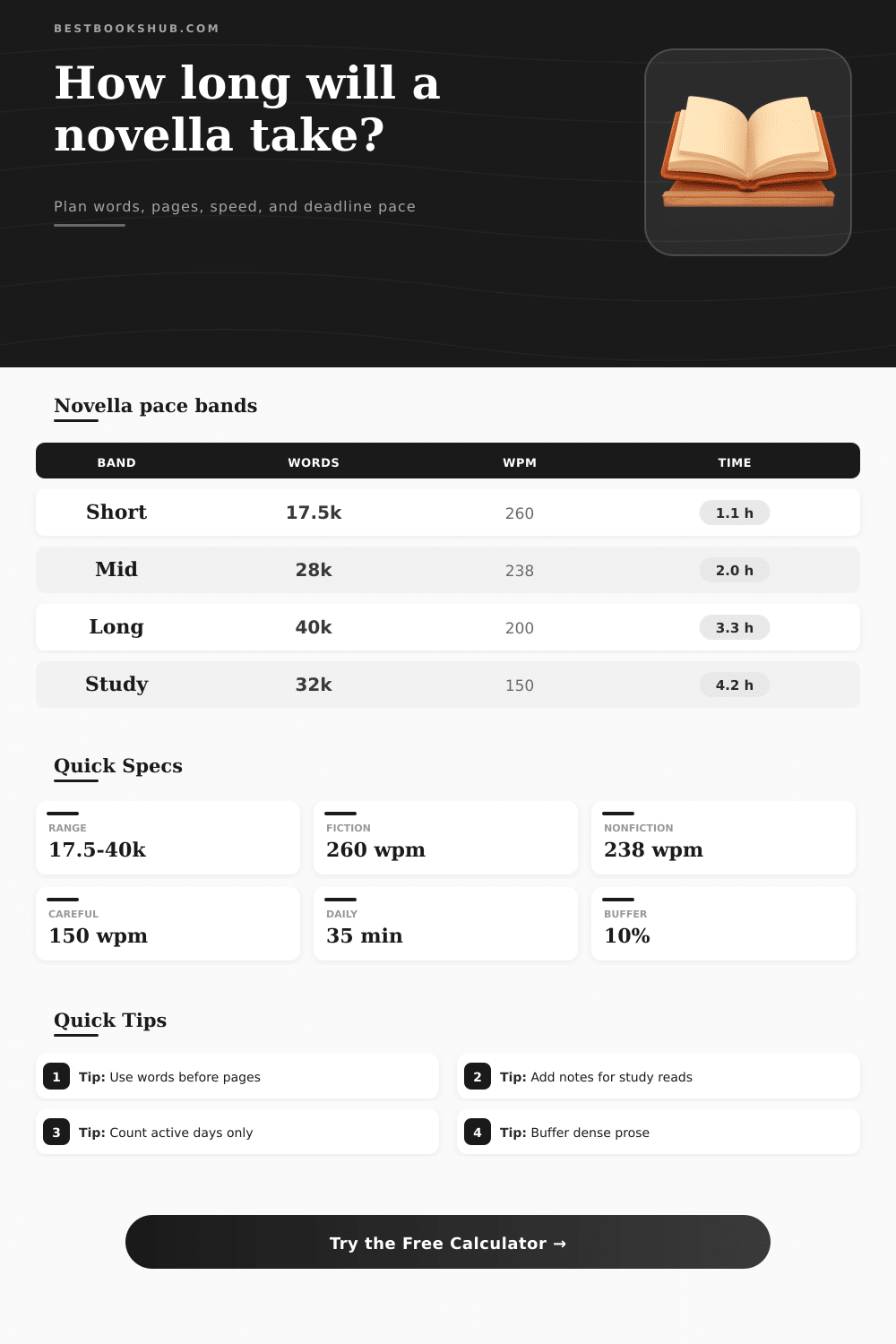
| Reading speed profile | WPM basis | 28,000-word novella | Best use |
|---|---|---|---|
| Read aloud | 183 WPM | About 2 h 33 min | Shared reading, recording practice, or dramatic aloud work. |
| Careful study | 150 to 190 WPM | About 2 h 27 min to 3 h 7 min | Annotations, recall questions, dense classics, or assigned reading. |
| Adult nonfiction average | 238 WPM | About 1 h 58 min | Essayistic novellas, introductions, notes, and hybrid nonfiction. |
| Adult fiction average | 260 WPM | About 1 h 48 min | Most leisure fiction when the prose is not unusually dense. |
| Fast fluent fiction | 300 to 320 WPM | About 1 h 28 min to 1 h 33 min | Familiar genres, rereads, and high-momentum scenes. |
| Novella size | Word count | Estimated pages | At 260 WPM |
|---|---|---|---|
| Short novella | 17,500 to 24,000 | 70 to 96 pages at 250 words/page | About 1 h 7 min to 1 h 32 min. |
| Middle novella | 24,000 to 32,000 | 96 to 128 pages at 250 words/page | About 1 h 32 min to 2 h 3 min. |
| Long novella | 32,000 to 40,000 | 128 to 160 pages at 250 words/page | About 2 h 3 min to 2 h 34 min. |
| Dense page edition | 32,000 to 40,000 | 80 to 100 pages at 400 words/page | Same words, fewer pages, slower-feeling pages. |
| Format setting | Words per page | Common match | When to choose it |
|---|---|---|---|
| Airy trade or YA | 200 to 240 | Large type, dialogue, generous margins | Known pages look high for the word count. |
| Standard novella paperback | 240 to 290 | Most standalone fiction editions | You need a practical default for page targets. |
| Compact literary edition | 300 to 360 | Smaller type or denser paragraphs | The book is slim but the prose is substantial. |
| Magazine or anthology layout | 450 to 650 | Columns, small type, issue pages | Use word count if available; page count can mislead. |
| Deadline window | 28,000-word novella | Active days assumed | Pressure signal |
|---|---|---|---|
| One evening | About 110 to 160 minutes | 1 active day | Works for leisure pace, less ideal for notes. |
| Three days | About 9,400 words per day | 3 active days | Comfortable if sessions are planned. |
| One week | About 5,600 words per active day | 5 active days | Easy for most steady reading habits. |
| Two weeks | About 2,800 words per active day | 10 active days | Relaxed, with room for notes or rereading. |
DISCLOSURE: This post may contain affiliate links, meaning when you click the links and make a purchase, I receive a commission. As an Amazon Associate I earn from qualifying purchases.
The experience of picking up a novella differs from beginning a novel. You’re not committing hours of your life (well, maybe, but it’s a short enough distance that we’ll set that aside for now). You can read it in an afternoon or split it over the course of a week. You won’t feel like you’re giving up a grand endeavor.
That flexibility, however, is what trips us up on the planning front. It’s tempting to underestimate amount of mental overhead involved in reading a dense, short book as opposed to a long, sprawling one.
Why Scheduling Your Reading Helps You Enjoy It
Page counts are lies. Most people use them as a measure of reading time, but they’re wrong. A book can have a hundred pages of lightweight text if its pages is big, its margins wide, and its font size large. Another book could fit that same number of words onto half a dozen page thanks to smaller type, tighter margins, and columnar layout. It doesn’t matter what the physical object looks like; it matters how much it makes your brain work. Only word count is an honest way to estimate reading time: it’s blind to any formatting trickery.
Switch from pages to words when scheduling your reads, and you won’t be caught off guard by how thick or thin a book seems anymore.
The reason you pick up the book makes a huge difference in reading speed. When you’re flipping through a familiar book in your favorite genre just to see what happens next, you could be moving along at a rate of three-hundred words per minute. On the other hand, if you’re reading a complex novel for school that requires annotation of themes and style, or if you’re tackling a dry-as-dust classic for class, then you’ll have to slow way down.
Once you input your desired reading speed and mode into the calculator, it do all the work for you. Why? Getting behind on deadlines is a great way to get used to treating books like casual fiction. You won’t do that when you need to account for active recall, backtracking, and notes. A study read requires more careful processing of each sentence as well as stopping to reread a difficult paragraph or jotting down ideas.
The second part of the equation is scheduling. The common assumption is that you’re going to read every day. Life’s not like that! Maybe you have a crazy week at work and all you have is the weekend to really get some deep focus time in. Instead of planning based on calendar days, plan around your active days.
If you tell yourself “I’ve got 30 days to finish this book,” chances are you don’t have 30 separate sessions of full-on focused attention. More likely you’ve got ten or even a dozen solid chunks of time over the course of that month. Being aware of this gap lets you set reasonable goals each day. It’s much easier to commit to reading five-hundred words on a hectic Tuesday versus cramming yourself into finishing fifty pages when your brain is already cooked from working all day.
The other way that deadline changes things is reading. How do you set a goal if you want to complete a book in a certain amount of time? How do you make sure you hit it? Well, you don’t just say: I’ll try and read as much as I can between now and X date. You need some kind of number… Something tangible and concrete that you are working towards.
That’s why you turn reading from a passive thing into an active project. It takes away the stress because you know what success means every single day, and not hitting one day isn’t the end of everything.
That’s what the extra 10% is for in these planning tools. You’re going to get sick. You’re going to go out of town. You’re going to not feel like reading on any given night. Having the buffer lets you keep your plan running smoothly despite real life getting in the way of your schedule.
These are broken down nicely into bite-sized pieces on the page as well, with reference tables that allow you to see at-a-glance what the time commitment will be between a short novella and a long one. Before you pick up the book, you get to set your expectations accordingly. Will you guess, or will you set yourself up for success?
You’re here to enjoy it, not battle against your calendar. In the end, scheduling your reading time isn’t about depriving yourself of fun; it’s about eliminating friction. If you’ve got a clear idea for how long a book will last and how to work it into your schedule, then you can unwind into the story. No more clock-checking: just sink into the plot.
And that feeling, that freedom, is absolutely worth spending some minutes up front figuring out. You want reading to be something you look forward to, not another task to cross off your checklist. Honor both the words and yourself by creating habits that stick.