🔢 Written number analyzer
Number word counter
Find cardinals, ordinals, fractions, scale words, hyphenated compounds, digit groups, and number-word density in chapters, notes, captions, and study text.
| # | Match | Class | Estimate | Context |
|---|---|---|---|---|
| Load a preset or paste text to see detected number words. | ||||
| Phrase chain | Words | Estimate | Role |
|---|---|---|---|
| Phrase chains appear after calculation. | |||
| Class | Examples | Counted when | Common use |
|---|---|---|---|
| Cardinal | one, twelve, forty | Cardinal or all scope | Quantities in prose |
| Ordinal | first, third, fiftieth | Ordinal or all scope | Rank and sequence |
| Scale | hundred, million | Scale or all scope | Large amounts |
| Fraction | half, quarter | Fraction or all scope | Partial measures |
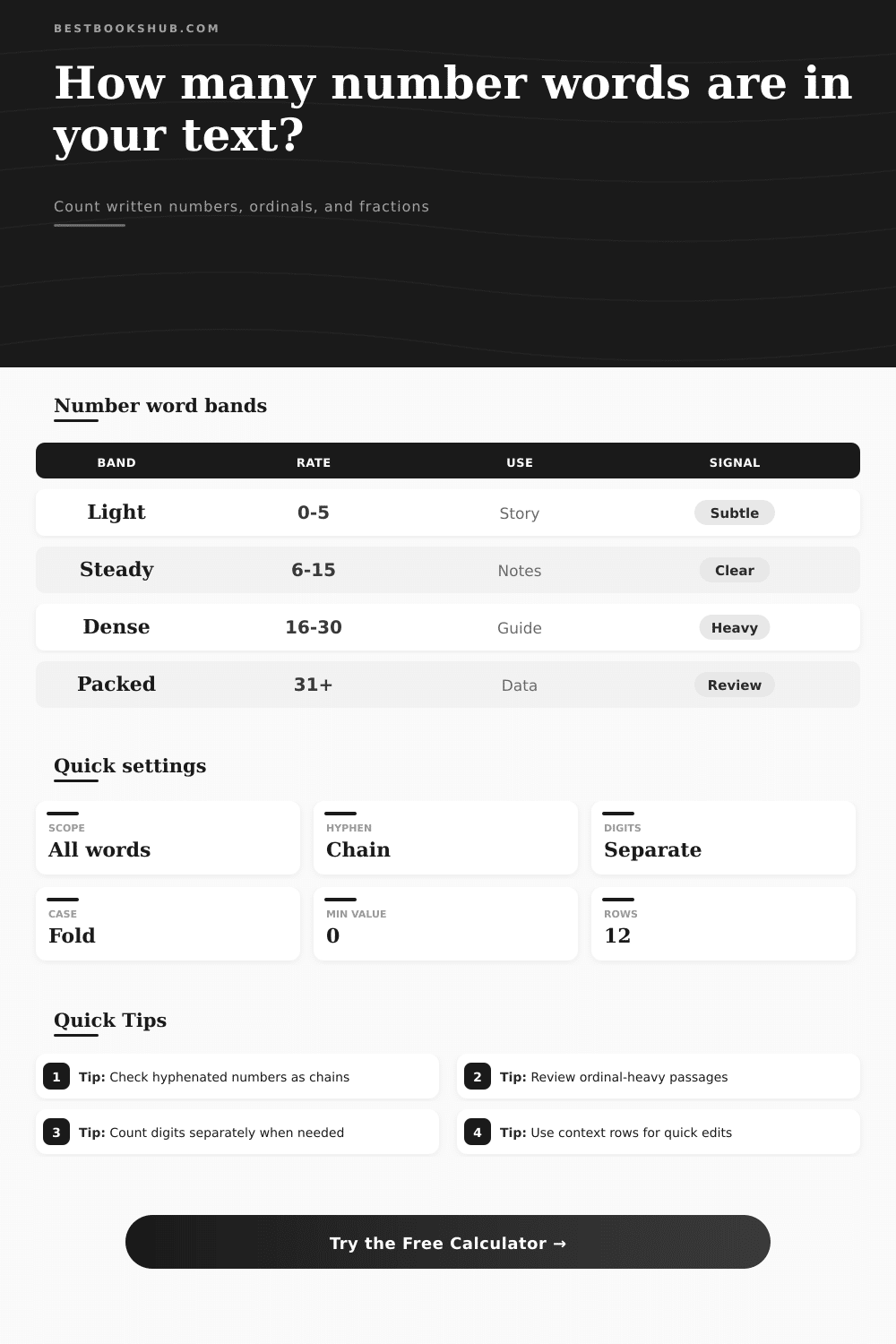
| Density band | Rate per 1,000 | Likely text | Editing signal |
|---|---|---|---|
| Light | 0 to 5 | Literary prose | Numbers are subtle |
| Steady | 6 to 15 | Study notes | Check consistency |
| Dense | 16 to 30 | Instructions | Review readability |
| Packed | 31 or more | Data captions | Consider a table |
DISCLOSURE: This post may contain affiliate links, meaning when you click the links and make a purchase, I receive a commission. As an Amazon Associate I earn from qualifying purchases.
Numbers are invisible to you until a pile-up of number words accumulates in your writing. You read your manuscript draft out loud and it sounds good, but then an editor picks up on the invisible weight of numbers. Usually, it isn’t a character problem or even a plot problem. It’s the numerical language itself that gets overlooked.
Numbers are like visual clutter that your brain skims over. They’re treated as visual clutter by our brains even though they is actualy structural elements. The number word counter on this page makes the hidden stuff easy to see. Not only does it count digits; it reads your prose to see the extent of your reliance on scale words, fractions, ordinals, and written numerals. Then it forces you to look at what you normaly don’t see: the data.
How to Count and Fix Number Words in Your Writing
Numbers is used by most writers as if they were all the same sort of thing. They’re not. Some are cardinal (seven), which anchors a scene in an aspect of reality. Others are ordinal (first) which show both hierarchy and sequence. Others are fractional (half) which denotes division. Others are scale (thousand), shifting size of what follows. Mix them up randomly and there’s a risk that your text will come across as disjointed, it can lurch between a precise detail and some kind of big idea with no reason for the leap.
By helping you untangle these threads, calculator above enables you to single out the cardinals from the ordinals, focus on fractions, etc. Why is this helpful? Because it exposes your own structural habits. Maybe you write historical fiction but use too many ordinals so that it sound dryly rhythmic. Perhaps your fantasy novel contains too many big scale words and pushes reader away from the character’s experience.
The key word is density. It is not the absolute amount of number words but the proportion of them per thousand words. Typically, literary prose is lightly banded, there’s the occasional number. Steady or dense band often denotes study notes or some other kind of guide: you know to expect regular quantification. If you’ve reached the packed band (thirty or more number words per thousand), the text begin to resemble a spreadsheet.
This isn’t necessarily undesirable. A data caption should indeed be packed. An inventory list is what you want to avoid when reading a romantic dinner scene. The tool does this rate calculation for you and takes guesswork out of your editing. Does it sound like you’re writing as a statistician? Or as a novelist?
Another level where small choices create big differences: compound handling. Is “twenty-one” a word? Or is it one phrase made up off two words? Well, it’s whatever you’re interested in measuring. If you want to know how readable your text is then it probably makes sense to treat the hyphenated string as one thing. That’s how the reader would process idea. But if you were creating a vocabulary list for someone learning a language, then maybe each component should of been split apart.
You’ll be able to toggle between these types of rules in settings so that you don’t have to rewrite your text. Run a passage through multiple times with different settings and observe the difference in meaning. That flexibility is important. It doesn’t require you to have any one set-in-stone understanding of what counts as a number. You get to experiment with your assumptions, see how it reads under close examination versus looser definitions.
But the true power comes from knowing what to look for: When you’re reading through a scene meant to feature movement, you notice an unusually high concentration of ordinals. Perhaps this signal a section where you’re detailing instructions rather than actions. Or perhaps you see too many scale words in a calm passage. Maybe there has been too much exagerration. These patterns can be difficult to recognize while reading straight through. After all, it’s hard to step away from the text and zoom out far enough to view its shape.
By examining the frequency of words though, you can tweak your voice. You can trim fat. Strengthen faltering limbs. Don’t aim to erase the number. Aim to master it. You get to see exactly when and where they appear, which makes your writing precise rather than haphazard because you’ve learned exactly how many times they pop up on a page. The tool gives you control. It turns gut feelings into facts.
Now that you see it, you’ll never not-see it again. You’ll feel the numbers on the screen as you type even before you press the spacebar, the next time you write.