🔢 BestBooksHub number tools
Numeric character counter
Count digits, number tokens, separators, and numeric density in book text, bibliographies, notes, and scans.
| Rank | Number token | Count | Share |
|---|---|---|---|
| Load text to view the top number token rows. | |||
| Band | Digits/100 | Token mix | Read as |
|---|---|---|---|
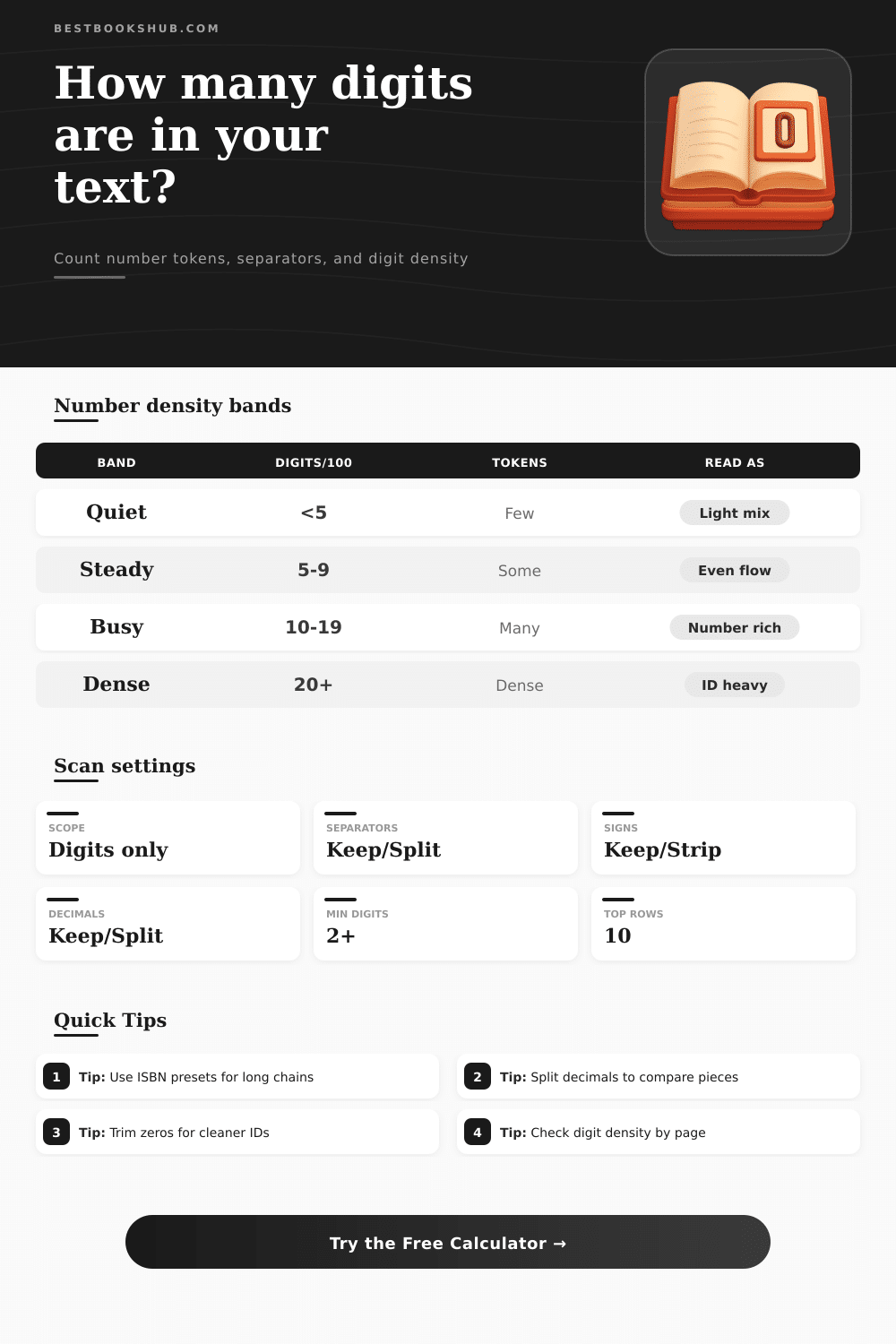
| Quiet | <5 | Few | Light mix |
| Steady | 5-9 | Some | Even flow |
| Busy | 10-19 | Many | Number rich |
| Dense | 20+ | Dense | ID heavy |
| Form | Pattern | Where it shows | Example |
|---|---|---|---|
| ISBN | 13 digits | Book IDs | 978-0-14-312774-1 |
| Page refs | Ranges | Margin notes | 12-13 |
| Dates | Year sets | Timelines | 2026-01-08 |
| Call no. | Mixed code | Catalogs | QA76.73.J38 |
| Mode | Keeps | Removes | Best use |
|---|---|---|---|
| Digits only | 0-9 | All else | Raw count |
| Tokens | Groups | Split text | ISBNs |
| Split | Runs | Joiners | Page refs |
| Trim zeros | Core digits | Padding | Code cleanup |
| Cue | Common numbers | Cleaned form | Signal |
|---|---|---|---|
| ISBN line | Long code | Keep joins | Book ID |
| Page stack | 12-13 | Split refs | Margin use |
| Date trail | Years | Keep dashes | Timeline |
| Catalog note | Mixed code | Trim zeros | Library tag |
DISCLOSURE: This post may contain affiliate links, meaning when you click the links and make a purchase, I receive a commission. As an Amazon Associate I earn from qualifying purchases.
A numeric character counter are a tool that allow people to identify the various type of numbers that exist in a text. When scanning books or research notes, people encounter various type of numbers. For example, ISBN numbers is a string of digits, but page numbers are only part of a short range of digits.
These two types of numbers has different purposes, but a numeric character counter allow for these type of numbers to be separated from one another. A person can use a numeric character counter to distinguish between the various type of numbers in the text based off the use of each type of number for its specific purpose. The settings for a character counter will determines how the character are group.
How to Count and Separate Numbers in Text
For example, if you alter the settings for separators and decimals to match the type of material that is being analyze, the character counter will recognize each type of number as separate from the other. Each setting are accurate in measuring the numbers according to their different purpose. However, each setting will change the character token list that the character counter produce.
Therefore, you must choose the specific settings to achieve the desired outcome of the measurement with the character counter. Another of the measurement that can be made with a character counter is the digit density of the text. Digit density is a way of determining how many digit are present in the text in relation to the total number of characters present in that text.
If a page have a low digit density, it means that the digits in that page are incidental to the text. However, if the digit density is high for a page, it indicate that the text on that page is organize around identification codes or data. Therefore, by looking at the digit density of a text, it is possible to determine if the excerpt consist of prose and/or numbers.
When using optical character recognition (OCR) to scan a text, there are potential error in the text. For example, there may be stray digit that are incorporated into the text that dont belong to any specific number or object in that text. You can filter these error by adjusting the character counter settings to ignore short digits and only preserve longer identification code.
For example, a long run of twelve or thirteen digit is likely to be an ISBN number, while a short run of two or three digit is likely to be a page or footnote number. It is common for people to make mistake when using a character counter by treating every number in the text as if it is the same. If every separator is keep, ISBN numbers may be preserved, but page numbers may be converted into individual tokens.
If you strip every separator, any identification codes may be cleaned up for readability, but information regarding where the text come from can be lost. Therefore, a person should of decide what type of numbers they are looking for before use a character counter to analyze the text. The reference table at the top of the page allow for digit density to be interpreted based on the raw percentage of digits in the text.
Each band of digits within this table allow for a quick interpretation of the digit density of a given text. Once you interpret the digit density of a text, it is easier to interpret the remaining data from that text. This is especially benefit when comparing different excerpt from the same text.
For example, one excerpt may have a steady digit density, while another excerpt may have a dense digit density. However, each of these density allow people to recognize when a text move from one type of content to another without having to read the text. By using a character counter to analyze a text, these shifts in digit density is visible to the reader.