⏱ Omnibus pace planner
Omnibus reading time calculator
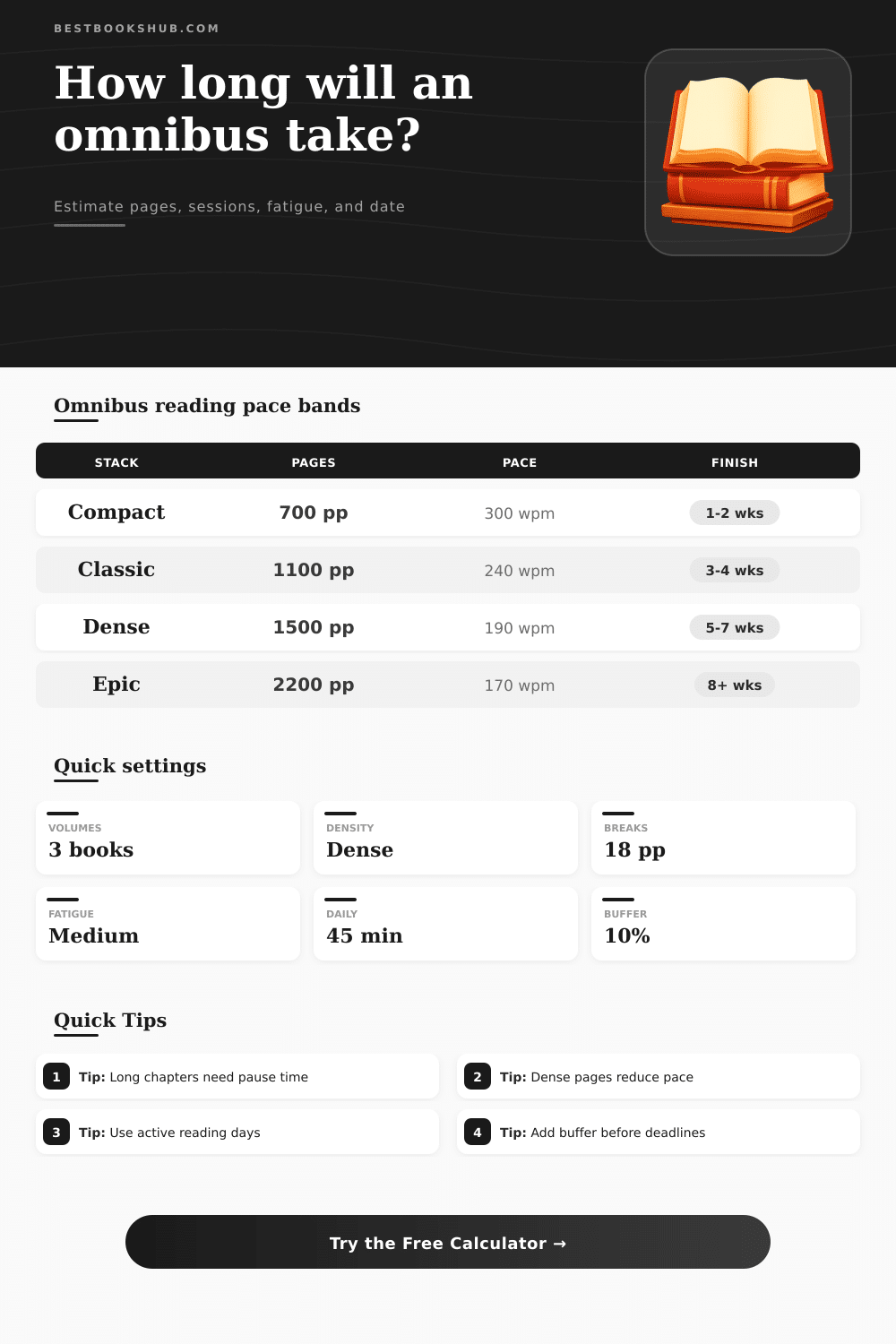
Estimate a multi-volume omnibus from page count, volume count, print density, chapter breaks, session fatigue, daily reading time, active reading days, and your target start date.
Choose a starting pattern, then tune the page count, format, fatigue, breaks, and schedule to match the exact omnibus on your shelf.
| Print density | Words/page | Best match | Planning note |
|---|---|---|---|
| Light pages | 240 | Dialogue-heavy fiction, airy YA, short paragraphs | Usually faster, but chapter breaks can still add time. |
| Standard trade | 300 | Most modern novels and general nonfiction | Good default when the exact word count is unknown. |
| Dense omnibus | 380 | Collected fantasy, science fiction, mystery, classics | Expect slower pages and more stamina drift. |
| Compact classic | 450 | Small type, thin paper, narrow margins | Use a larger buffer before deadlines. |
| Visual panels | 120 | Manga, comics, graphic novels, art-heavy collections | Words are lower; page navigation can still be brisk or slow. |
| Annotated pages | 520 | Scholarly editions, notes, commentary, appendices | Reading notes often behaves like a second text. |
| Omnibus size | Total pages | At 30 min/day | At 60 min/day |
|---|---|---|---|
| Compact bind-up | 600-800 pages | About 3-4 weeks | About 10-14 days |
| Standard trilogy | 900-1300 pages | About 5-7 weeks | About 3-4 weeks |
| Dense collected edition | 1300-1800 pages | About 8-11 weeks | About 4-6 weeks |
| Epic multi-volume stack | 1800-2600 pages | About 12-17 weeks | About 6-9 weeks |
| Archive or complete run | 2600+ pages | Plan by volume arcs | Plan by monthly blocks |
| Fatigue profile | Best for | Slowdown model | When to choose it |
|---|---|---|---|
| Low fatigue | Familiar style, high stamina, light pages | Small slowdown after long sessions | You can read for an hour without losing focus. |
| Medium fatigue | Most omnibuses and normal schedules | Moderate slowdown after session threshold | You notice pace dropping late in a sitting. |
| High fatigue | Dense classics, complex worlds, footnotes | Stronger slowdown across long sittings | You reread paragraphs or need more recap pauses. |
| Recovery reading | Short sessions, low energy, busy weeks | Gentle but limited daily output | You need realistic progress without pressure. |
| Scenario | Volumes | Pages | Suggested setup |
|---|---|---|---|
| Fantasy trilogy omnibus | 3 | 1200-1600 | Dense pages, medium fatigue, 10-15% buffer. |
| Manga collector brick | 4-6 | 700-1200 | Visual pages, short breaks, lower buffer. |
| Classic annotated edition | 1-2 | 900-1400 | Annotated pages, high fatigue, longer breaks. |
| Mystery collection | 3-5 | 750-1300 | Standard pages, frequent chapter pauses. |
| Book club catch-up stack | 2-4 | 600-1200 | Trade format, higher daily minutes, firm finish date. |
DISCLOSURE: This post may contain affiliate links, meaning when you click the links and make a purchase, I receive a commission. As an Amazon Associate I earn from qualifying purchases.
This is the big omnibus edition, which you intend to plow through. It’s a hefty volume. There are three novels worth of material here. The print is dense; reality hits fast. Two hours later, your eyes has glazed over and the reading plan have failed. That’s because reading plans assume that time is proportional to page count. They fail to consider that humans can only process a certain amount of information before they stop registering words.
Simply input your density preferences and how many volumes you want, and the calculator takes care of the rest. No more converting or using coefficients. All you have to do is read.
How to Read Big Books Without Getting Tired
Most people believe total time = (word count / reading speed). That’s false! Why? Because it fails to account for mental fatigue. It also doesn’t account for the fact that you don’t read every day, nor does it account for pausing between chapters. Print density matter more then raw page numbers. Collected editions is denser than trade paperbacks. They cram almost four hundred words onto each page where a TPB gets away with only three hundred. A given number of pages won’t look like the same thing. The tool adjusts for that by asking what kind of print style you want to use.
And if you’re reading an annotated edition, say, with notes printed alongside the text, then you’re doubling your cognitive load. You have to shift focus between text and commentary. That’s why there is a fatigue pattern in the inputs. Fatigue modeling looks at how being tired makes reading harder. Low fatigue profiles assumes that you can plug in and churn through pages like a robot. That’s not really how most people work, you’ll lose track of what characters are who, re-read sentences, etc. High fatigue models acknowledge how draining thick books can be; each page take longer as you read along. Medium fatigue lets you set a starting point and then gradually slows down your estimated pace based on session length. It is a subtle tweak that shifts the finish date from “uh-oh” into something attainable.
Chapter breaks are a hidden cost. Each time you finish a chapter, you pause. We might use that time to check our phones or stretch. The calculator accounts for a couple of minutes here, as there are naturaly places where you would stop. On fifteen-hundred pages (especially if the book has many short chapters), those pauses add up to several hours. Don’t ignore it; you’ll project too optimisically.
Daily schedule discipline matter more than daily reading speed. It’s far easier to sustain a 45-minute-a-day schedule for five days than a two-hours-on-the-weekend schedule. That way, when life happens and it’s hard to find time, you won’t freak out because the tool will base your finish date based on your number of active reading days rather than calendar days. If you don’t hit a day, no worries: that wasn’t an active reading day.
Plan with a buffer. Account for ten or fifteen percent for things like: missing days, distractions, and sections of the book that are denser than expected. You want to enjoy yourself when you read an omnibus, not do an endurance training session. Not planning this can leave you stressed out while you go through it, even if you just barely make it.
Treat volume breaks as your mental checkpoint. If all you see is the last page number, then an omnibus seems like a never-ending journey. When you break it down by arc or even book, you have smaller victories that keeps you motivated. This helps as you approach the middle of the stack, which tends to start dragging.
Different formats affect the pace differentaly (see reference table on the page). Words read faster as a graphic novel collection, yet we’re also scanning visually which dramatically alters the pace. You can eliminate skewed results by matching your settings to the actual format.
Begin with reasonable inputs. If you’re craving a faster completion time, don’t lie to yourself by increasing how fast you can read. That dishonesty will get you in trouble when the math catches up. Tell the truth: how much time do you really have during the day? How much text density can you handle? And then rely on the output to give you a finish date that matches who you realy are. Not only will you finish the book, but maybe you’ll even like it as you go.