✍ First page lab
Opening line length checker
Measure the first sentence or first line by words and characters, compare it with genre targets, test the hook length band, and preview how it leads into the first paragraph.
Load a realistic opening style, then adjust parsing, genre, character rules, and paragraph-relation settings for your own draft.
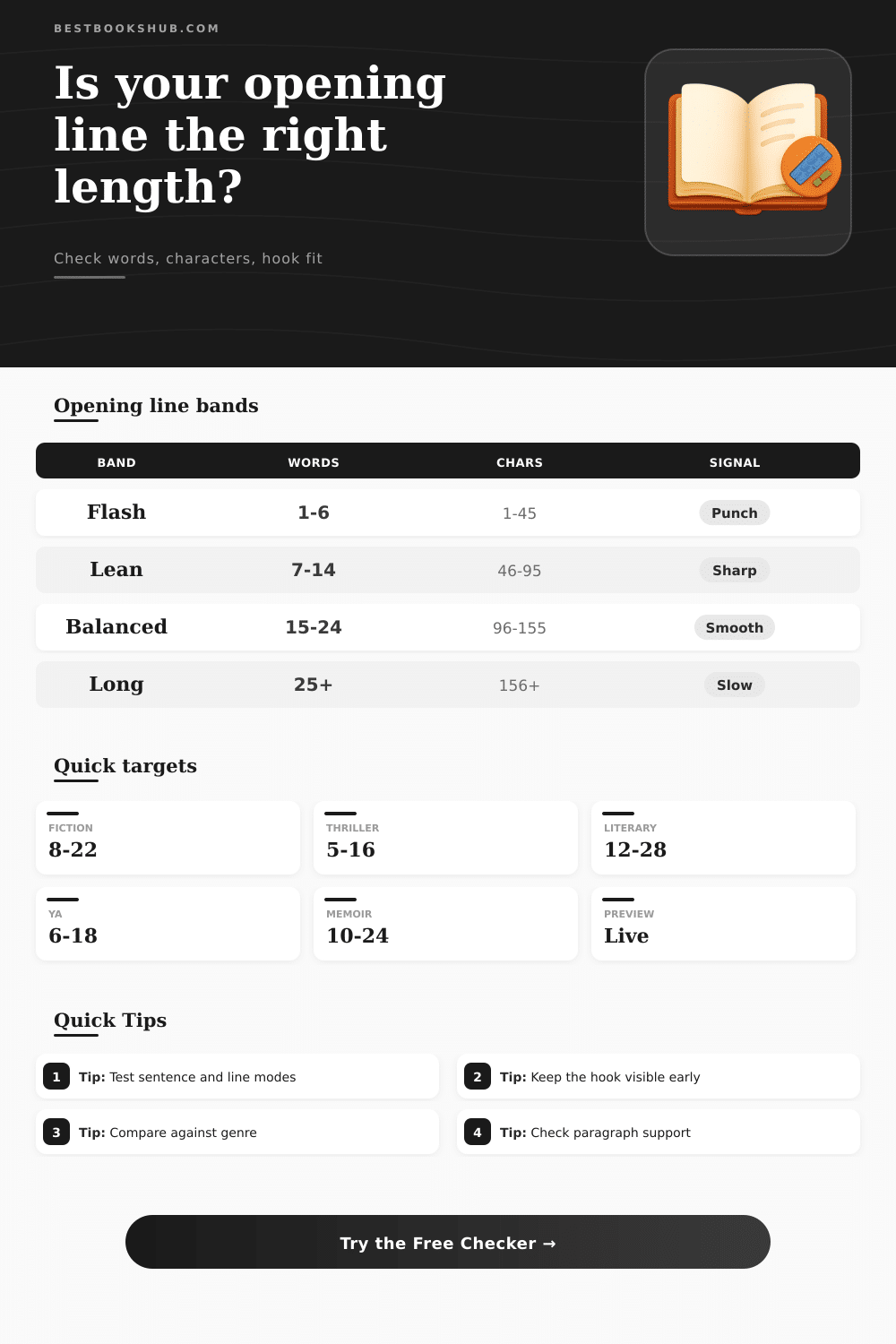
| Band | Word range | Character range | Typical feel | Watch for |
|---|---|---|---|---|
| Flash hook | 1-6 words | 1-45 chars | Stark, dramatic, or comic | Too little context if the next sentence is also vague. |
| Lean hook | 7-14 words | 46-95 chars | Fast but complete | Overstuffed clauses can hide the main image. |
| Balanced hook | 15-24 words | 96-155 chars | Voice plus situation | Long subjects before the first verb. |
| Lyrical hook | 25-32 words | 156-210 chars | Atmospheric and rolling | Reader may wait too long for tension. |
| Genre profile | Target words | Target chars | Paragraph relation | Best signal |
|---|---|---|---|---|
| Thriller or mystery | 5-16 | 35-120 | 25-55% of paragraph | Immediate problem, danger, or contradiction. |
| Literary fiction | 12-28 | 80-190 | 20-45% of paragraph | Voice, image, and pressure in one movement. |
| Fantasy or sci-fi | 10-26 | 70-180 | 20-50% of paragraph | World detail with a human hook. |
| YA and middle grade | 5-18 | 35-130 | 25-60% of paragraph | Voice and stakes appear before exposition. |
| Memoir | 10-24 | 70-165 | 20-45% of paragraph | Clear memory pressure or reflective turn. |
| Opening share | What it suggests | Best use | Revision cue | Result |
|---|---|---|---|---|
| Under 15% | Very short lead | Shock, dialogue, comedy | Make sentence two carry context. | Punchy start |
| 15-35% | Lead and support balance | Most fiction openings | Keep the next image specific. | Balanced flow |
| 36-55% | Opening dominates paragraph | Lyrical or reflective starts | Check for buried verb or delay. | Measured pace |
| Over 55% | Paragraph depends on one sentence | Occasional one-sentence paragraphs | Split, shorten, or add support. | Potential drag |
| Preview width | Approx chars per line | Best check | Good signal | Risk signal |
|---|---|---|---|---|
| Narrow paperback | 42-52 | Small trim fiction | Hook wraps cleanly within two lines. | Opening becomes a blocky first page. |
| Trade paperback | 55-68 | Common print preview | First image appears before line two ends. | Main verb arrives after the wrap. |
| Wide manuscript | 70-85 | Submission pages | Sentence feels readable in double spacing. | Line looks safe but sentence is overloaded. |
| Mobile reading app | 32-44 | Small-screen ebook feel | Opening survives tight wrapping. | Too many clauses before first pause. |
DISCLOSURE: This post may contain affiliate links, meaning when you click the links and make a purchase, I receive a commission. As an Amazon Associate I earn from qualifying purchases.
This opening line length checker allows writers to check the hook band, word count of the first sentence, character count of the first sentence, relationship between paragraphs, genre fit, preview flow, and revision needs before making edits. Before starting to edit a draft, this tool enables writers to check some key metrics. It provides the numbers that tell us how an opening hold up to typical standards. Therefore, we can adjust accordingly with more insight than pure intuition.
Every story begin with a weightless sentence, but it holds enormous power. In a few seconds, readers either commit to continue or don’t. More often than not, that choice is less about literal content then perceived length. A punchy six-word opening can shock us out of sleep. A rolling thirty-word beginning can envelop us in its atmosphere before we know that we’re already hooked. And while sometimes this is simply a matter of chance, most times it isn’t; most times, it’s something a writer has learned to feel on the page and adjust to match.
Why Opening Length Matters
Most new writers don’t realize how important length are to rhythm. If a first sentence is too brief, the second must race ahead to provide context, dropping the reader in cold water. Too long? Paragraphs sag before the verb even appears. Let the calculator do the counting for you. You’ll spend less time thinking about numbers and more time feeling them.
It tells you if your sentence falls within leaner hook zone thrillers favor. Or it shows if it is closer to the more elastic range literary fiction tends to reward. Why? Readers come to table with different expectations regarding how much patience they should bring to page one. Those differences are reflected in the bands.
Genre also quietly shapes expectations. If you’re writing a thriller that takes 25 words before dropping us into any danger, you risk pushing away exact readers who want it fast. If you leap in on a memoir with only five words, there’s a chance the whole point of the memoir, reflecting, will be jarring. The tool allows you to run your line past the profile you’ve set for yourself, and the fit signals update in real time. And that feedback eliminates the guessing game that had you print out the page, place it beside published books, and squint.
But, again: Numbers don’t tell the whole story. You also need voice, syntax, and of course the promise you make. Even with a beautiful lyrical opening sentence, you can still go on to fizzle out into a paragraph that doesn’t bother to reward what it asked for. The best openings strike a bargain with the reader; they request a bit more time or trust from us in return, but repay this investment soon after.
And that’s where the paragraph-relation measure comes in handy. If your first line is taking up half the paragraph, then you might find some excess setup or hidden clauses that could of be saved for later. If you are only lighting the fuse, then you might find some excess setup or hidden clauses that could be saved for later.
The predictable errors are there too. Some writers fall in love with an atmospheric opening line that stretches across the whole width of the page, and they can’t bear to give up that space when they realize it’s slowing down the entry into the story proper. Or the ones who learned that ‘short is good’ by cutting every single sentence into fragments (‘why does my voice sound flat now?’, they ask). The answer lies somewhere between those extremes, and it varies from book to book. That trick you used on the previous novel might not work at all this time around.
Using the Preview function lets you see that before you revise. You can try out extracts in different modes: should you go for first visual line or a string of sentences? And you’ll see how differently it looks when rendered on a phone screen rather than a narrow paperback page.
In the end, length becomes a servant, but never the master. Once you decide on a length and understand what that length implies, you can choose to change it or keep it as is. Some things have to begin with a held breath. Other things must begin with a slap. But in either case, the key is to make sure the length aligns with the kind of breath you hope the reader will take. Then it’s just a matter of when the numbers add up and the length matches the feeling you aimed for. At that point, the sentence stops fighting the story and carries it instead. That’s when the page gets to work.