📏 Reading layout lab
Optimal line length calculator
Estimate characters per line, readable column width, line count, and comfort score for books, articles, study notes, ebooks, and mobile reading layouts.
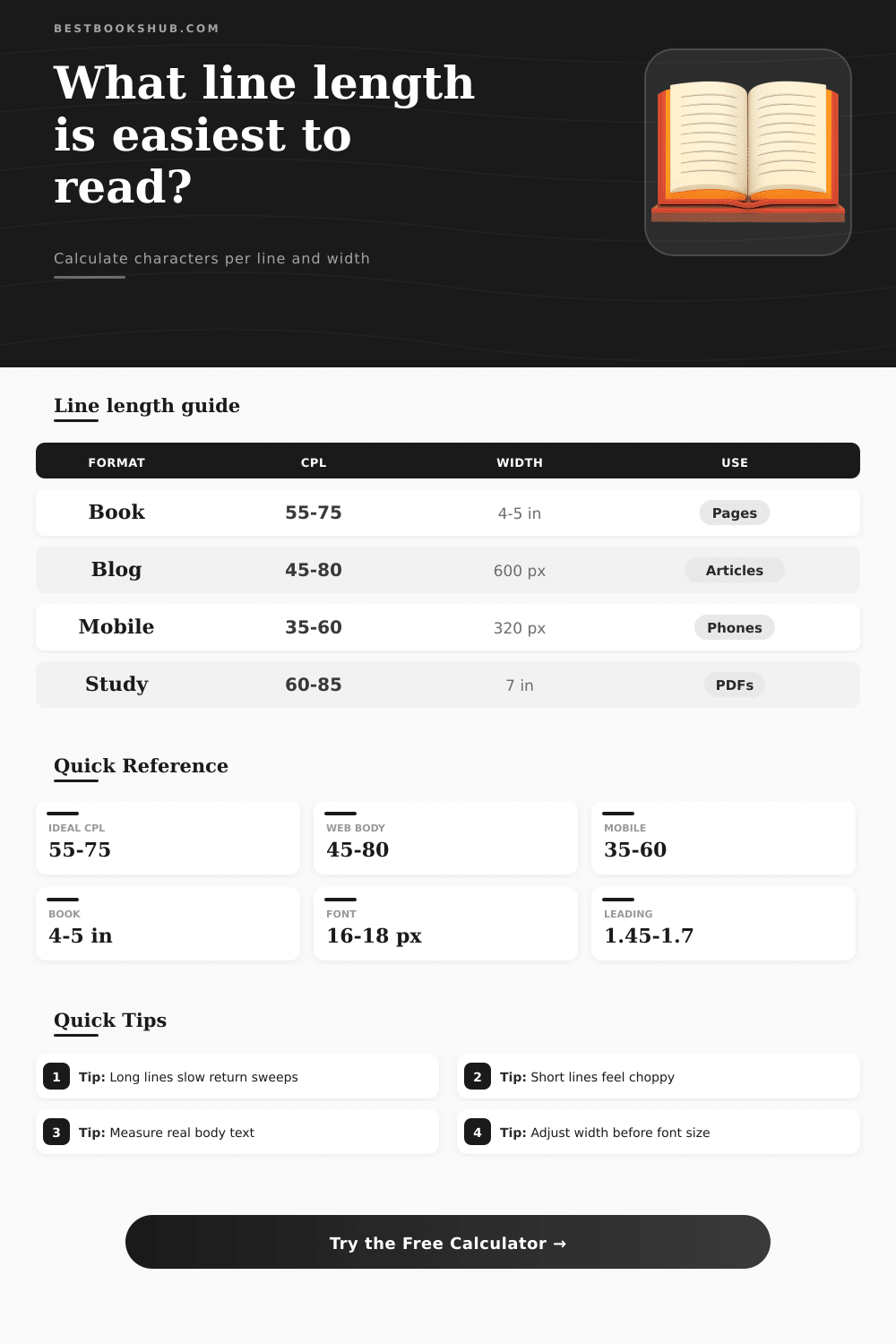
| Reading format | Comfortable CPL | Common width | Best use |
|---|---|---|---|
| Paperback novel | 55-70 CPL | 4.0-4.8 in | Continuous fiction and narrative nonfiction |
| Hardcover text | 60-75 CPL | 4.5-5.3 in | Long-form prose with larger pages |
| Web article | 45-80 CPL | 560-720 px | Responsive essays and guides |
| Ebook reader | 45-70 CPL | Device dependent | Adjustable type and margins |
| Academic PDF | 60-85 CPL | 6.5-7.5 in | Study, citations, and tables |
| Mobile reading | 35-60 CPL | 300-420 px | Phones and narrow reading panes |
| Font size | 55 CPL width | 66 CPL width | 75 CPL width |
|---|---|---|---|
| 14 px body text | 400 px | 480 px | 546 px |
| 16 px body text | 458 px | 549 px | 624 px |
| 18 px body text | 515 px | 618 px | 702 px |
| 20 px body text | 572 px | 686 px | 780 px |
| Measured CPL | Reading effect | Likely adjustment | Layout note |
|---|---|---|---|
| Under 35 CPL | Frequent line breaks | Widen column | Often choppy for adult prose |
| 35-55 CPL | Compact and quick | Good for mobile | Can work with higher line height |
| 55-75 CPL | Balanced tracking | Usually keep | Common target for books and articles |
| 75-90 CPL | Longer return sweep | Add leading | Works better for study pages |
| Over 90 CPL | Easy to lose next line | Narrow column | Consider two columns or larger type |
DISCLOSURE: This post may contain affiliate links, meaning when you click the links and make a purchase, I receive a commission. As an Amazon Associate I earn from qualifying purchases.
A certain kind of eye strain arise when you read a piece of text that’s ever-so-slightly too wide to be comfortable. You’ve finished the line. Your eyes jump left to begin next line, and now you’re lost for a fraction of a second. It happens quick enough that you don’t even really register it but your brain does. Twenty pages later, all that small friction become fatigue.
Most writers just assume as long as font’s legible, the layout doesn’t matter. Here’s why: They’re forgetting about width of their text block altogether.
Why Line Length Matters for Reading Comfort
This handy-dandy line length calculator on this page will help you measure that unnoticeable friction before it tire out your audience. And that’s what this comes down to: characters per line (CPL). That’s your measure to see how far across your eyes must move before they reset.
For something like a blog post, you’re aiming somewhere between forty-five and eighty. It is something more like a book. It gets a little higher (typically in the sixties to seventies). You can pick your format on the calculator above; it’ll do the math for you so you don’t waste time wondering if your current column width look nice but isn’t actualy readable.
Know that line length does not stand alone. It’s always interacting with line height (vertical space between each row of text). Without some additional breathing room, it becomes hard for reader to know where next line begins especially on very long ones. This is why when your column widths is wider, you’ll need to bump up the line-height multipliers. When you tightly wrap dense and wide text into narrow spaces, it become a wall you can’t penetrate.
To account for this relationship, the tool allows you to adjust both width and line height multiplier at the same time. If you increase the width without giving enough vertical space, you’ll notice comfort score drops. That number isn’t arbitrary. It’s a sign of cognitive load.
It’s also easy to fall victim to an error: people tend to measure what’s inside the whole content container rather than just the text area itself. On a web page, there’s padding, margin, sidebar and other stuff which eat up real estate. Plug in a full width screen dimension (say one thousand pixels), and you’ll find that your CPL rise right into uncomfortable territory. You should of measure the body copy column only.
To help you see those constraints without having to do any manual conversion, I’ve included some common scenarios as presets: academic PDFs, mobile essays etc. It’s faster than having to hunt around for your own style sheets each time you want to check out a layout.
That’s also true of the font you choose. Depending on how wide or narrow the letterforms are, the calculator estimates how many characters can fits across each line within the same number of pixels. And the calculator prompts you for a rough guess at its average character width (so it can adjust the CPL calculation). For example, a wide sans-serif font doesn’t fit as many characters horizontally as a condensed serif one would. Pick a monospace font, and by definition, your character count per line will be narrower… But physically, it’ll be wider. Monospace typefaces is visually heavy; they’re difficult to read in long chunks because of their constant rhythm. So maybe you have to squeeze things tighter to make up for that.
Keep in mind: Who’s going to be reading it? Are they older? Do they have some kind of visual impairment? Bigger font and shorter lines tend to help out. And if you’re creating a newsletter for an audience with a mix of preferences, being slightly more generous with CPL won’t eat up too many pixels while making it easier for everyone to read.
These breakdowns (and there are reference tables included with the tool) let you quickly see what industry standards is for each size and format. Most books tend to find themself in a comfy space because their publishers tested them quite a bit. Test out the numbers yourself for your own online stuff.
When typography works, no one notices; but when it doesn’t, it’s in the way. That’s never what you want; your readers should be soaking up your thoughts, not thinking about the grid you constructed for them. These inputs are there for you to tweak so that they remove the strain on people’s attention. Always, the aim is the same: Let the words flow with minimal tripping-over-their-own-layout.