📖 Focus rhythm planner
Optimal reading session length calculator
Estimate a realistic reading block from your pace, book difficulty, attention level, comprehension target, break style, and total reading window.
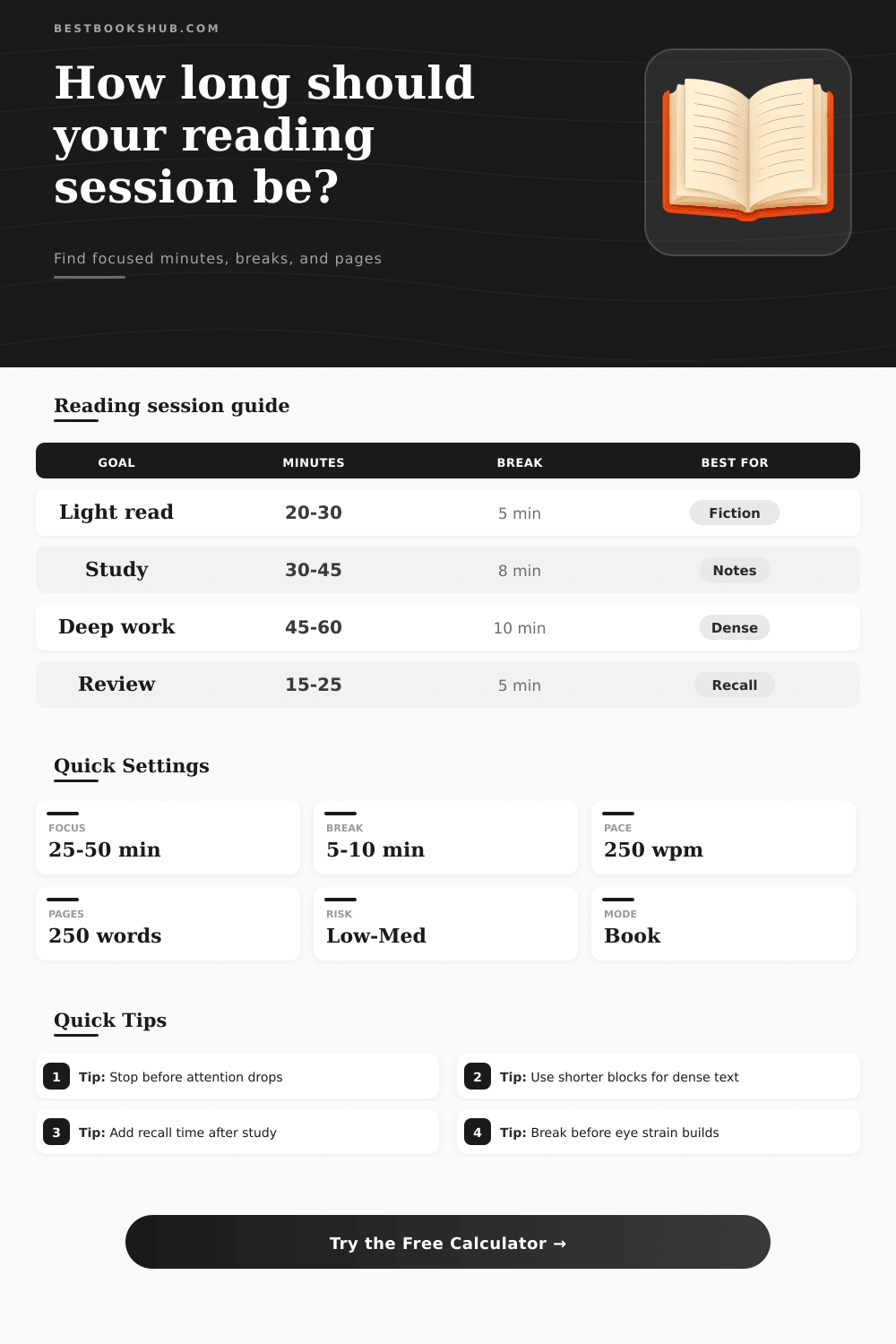
| Material | Baseline block | Pace factor | Best use |
|---|---|---|---|
| Light fiction | 50 min | 1.00 | Relaxed chapter reading |
| Literary fiction | 45 min | 0.90 | Close prose and theme tracking |
| General nonfiction | 42 min | 0.85 | Concept reading with light notes |
| Dense nonfiction | 35 min | 0.72 | Argument-heavy reading |
| Textbook or manual | 32 min | 0.65 | Study, examples, and problem sets |
| Research paper | 28 min | 0.58 | Methods, tables, and citations |
| Poetry or close reading | 24 min | 0.45 | Slow rereading and annotation |
| Audiobook | 55 min | 0.95 | Listening while walking or commuting |
| Comprehension target | Session adjustment | Note allowance | Recommended break |
|---|---|---|---|
| Skim level, 70% | Longer blocks | 0-5% | 5 minutes |
| Solid grasp, 80% | Standard blocks | 5-12% | 6-8 minutes |
| Strong recall, 90% | Shorter blocks | 12-20% | 8-10 minutes |
| Exam detail, 95% | Shortest blocks | 20-30% | 10-12 minutes |
| Available window | Suggested pattern | Total reading | When to use |
|---|---|---|---|
| 20-30 min | One short block | 15-25 min | Commute or warm-up reading |
| 45-60 min | One full block | 35-50 min | Chapter completion |
| 75-100 min | Two blocks | 60-85 min | Study session or book sprint |
| 120-180 min | Three or four blocks | 95-155 min | Weekend deep reading |
DISCLOSURE: This post may contain affiliate links, meaning when you click the links and make a purchase, I receive a commission. As an Amazon Associate I earn from qualifying purchases.
We tend to assume that reading is just… reading: you pick up a book and turn some pages. Then you put it down because you’re bored, you feel like it, you need more coffee, or you don’t feel like thinking anymore. In reality, reading isn’t always that easy.
You settle in, you get serious about this whole “readin’ thing” and then, ten minutes later, you’re looking at the same paragraph over and over while your mind wander off to contemplate dinner plans. It’s not really a lack of willpower (it’s pacing). Reading have a natural pace. Our attention has a biological expiration date. Pushing past it makes us tired which kills both the enjoyment and the understanding.
How to Read Better
Once you set your own constraints (above), this calculator will do the math for you, so you don’t have to guess whether to power through now or call it quits. So how do we optimize our session length? The key insight here is that not all reading are equal.
When you’re reading something like light fiction before bedtime, you want to read in a different way then when you’re studying some dense legal text for an exam. In the former case, you can probably get away with longer immersion-style sessions since the narrative flow pulls you along and keeps your attention going without constantly having to rethink how you process information.
But when you’re reading study material, you has to actively engage with it. When you’re reading through a research paper or a textbook, your working memory will start to fill up with new terminology and concept quite rapidly. And once it’s filled up, further minutes staring at the screen won’t produce much in way of diminishing returns. It’s not that you learn more, but rather that you tire yourself out quicker.
Set your expectations based off the difficulty of the material. Pace factors is listed on the page’s reference table; they’re a way of quantifying how much harder or easier each genre is to work through. Your baseline could be a fifty-minute focus block of light fiction. Research papers will tend to drive it far lower because the dense writing need to be processed at a higher rate per word.
Complex nonfiction tends to require sentence-by-sentence parsing: you need to understand what each sentence mean, rather than just skim them for the plot. Trying to hold that level of intensity for a whole 50 minutes is probably going to cause your comprehension to fall apart long before the time run out. Better to schedule shorter, sharp blasts of intensity then to rely on one long fade-out.
The nature of the book itself isn’t everything, so too is how focused you feel while reading. We’re not all mentally sharp at 9 AM or 10 PM. To handle this, the tool enable you to set your current focus state. A session that seemed doable when you were fresh could of prove impossible if you’ve only slept for three hours.
That’s why rigid schedules so frequently fail: they overlook the variable of human energy. It makes no sense to force yourself into an arbitrary page count… Better to shrink your goal when you get tired. Twenty minutes of laser-focused work will always beat an hour spent distractedly skimming without retention.
Downtime isn’t optional; it’s a necessary part of the work. Taking time away from text allows your brain to process what it has absorbed up to that point (this is when learning actualy occurs). Sitting there in silence for two hours without pausing breaks that process and piles up mental clutter. Shorter resets allow you to clear the cache and come back to next block with fresh eyes.
Because lighter reading require less recovery time than heavy study, the duration of your break should be loosely proportional to how intense the reading material is. It’s about respecting your cognitive limits, not fighting against them.
And then there’s the subtler timing factor: You’ll remember more if you read when you’re most awake (typically mornings). It turns out that hard stuff requiring solid attention works best in the morning. Review type work or lighter reading tend to go smoother later in the day, since our brains are wired to wind-down in the evening. Matching your goals with your biology… Using the proper time of day for each task, can significantly impact what you remember and how far you get.
The trick isn’t to read more, but to understand better. When you find a pace that matches both your energy level and the challenge of the material, you have found a steady rhythm. Instead of resisting naturaly limits, you learn to work with them. Your best reading sessions will be those you don’t quite want to bring to an end, you can’t wait to pick up again. This is the sweet spot between focus and flow. This is where pages become knowledge.