📅 Monthly reading pace tracker
Pages Read This Month Calculator
Track pages logged this month, days elapsed, remaining days, monthly target pages, average pages per day, book count, and the catch-up pace needed before the month ends.
Load a realistic monthly reading pattern, then adjust the logged pages, target, elapsed days, remaining schedule, book length, and active reading rhythm.
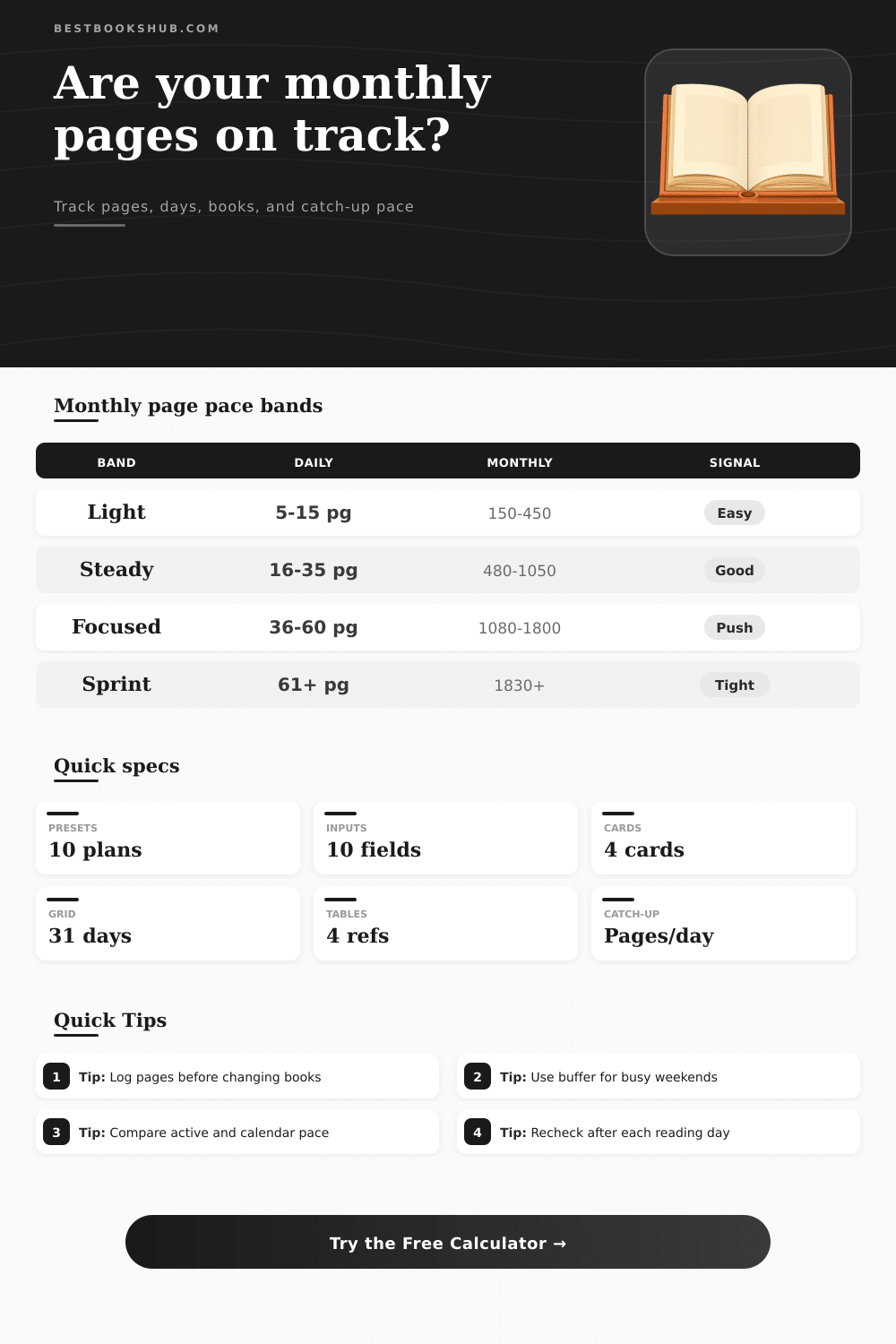
| Pace band | Pages per day | Monthly page range | Reading month signal |
|---|---|---|---|
| Light | 5 to 15 pages | 150 to 450 pages | Works for habit rebuilding, bedtime reading, or a single shorter book. |
| Steady | 16 to 35 pages | 480 to 1,050 pages | Often enough for one to three general-length books in a month. |
| Focused | 36 to 60 pages | 1,080 to 1,800 pages | Needs regular sessions and honest page logging. |
| Sprint | 61+ pages | 1,830+ pages | Usually a catch-up month, vacation month, or very active reading challenge. |
| Month checkpoint | 31-day target share | 1,200-page example | How to use it |
|---|---|---|---|
| Day 7 | 23% | 271 pages | Early signal; small gaps are easy to fix with one focused session. |
| Day 14 | 45% | 542 pages | Midmonth pace check; compare average pages per elapsed day. |
| Day 21 | 68% | 813 pages | Late-month warning point; catch-up pace should still feel plausible. |
| Day 28 | 90% | 1,084 pages | Final-week checkpoint; buffer days become very visible here. |
| Reading mix | Average pages | Typical pages per hour | Monthly tracking note |
|---|---|---|---|
| Novellas and short novels | 120 to 220 pages | 35 to 60 pages | Book count rises quickly; keep page target honest. |
| General fiction | 280 to 360 pages | 30 to 45 pages | Good default for monthly page and book projections. |
| Dense nonfiction or classics | 300 to 500 pages | 12 to 30 pages | Use lower pages per hour when note-taking slows sessions. |
| Long fantasy or omnibus | 500 to 900 pages | 20 to 40 pages | Page progress may be strong even when book count stays low. |
| Graphic novels and manga | 120 to 260 pages | 60+ pages | Separate visual reading from prose-heavy monthly comparisons. |
| Catch-up result | Compared with original target | What it usually means | Practical adjustment |
|---|---|---|---|
| Below original pace | Under 1.00x | You are ahead or the target is already mostly handled. | Protect buffer days and keep logging consistently. |
| Near original pace | 1.00x to 1.25x | The month is still behaving like the original plan. | Use normal reading sessions and check weekly. |
| Raised pace | 1.26x to 1.75x | The goal is recoverable but needs active attention. | Add pages to each active day or add one extra reading day. |
| Rescue pace | Over 1.75x | The remaining days are carrying much more load than planned. | Reset the target, remove buffer, or schedule longer sessions. |
DISCLOSURE: This post may contain affiliate links, meaning when you click the links and make a purchase, I receive a commission. As an Amazon Associate I earn from qualifying purchases.
The point is that reading plans have a way of veering off course very rapidly. One moment, you’re going into January all fired up about reading six fat novels, and then it’s halfway through February and you’re staring at page forty-two wondering whether to forge ahead or just give up. This isn’t typically a motivational issue; it’s a mathematical one.
When most of us keep score, we do so in terms of books completed. This only shows what has already happened. It only measures what has actualy happened. We should be tracking our pages read. That’s a leading indicator. It reflects where we are, not where we were several weeks back.
Count Pages, Not Books
If you input your target number of books, along with how many pages you’ve already logged, then the calculator above will do it for you. You don’t have to wonder if you’re on track for meeting your month’s goal or not; instead you know exactly how many pages you need to read each day in order to reach that target. And there’s the key: counting by pages is more reliable than counting by books.
Yes, one book is one book, no matter how long or short, but that doesn’t mean every book take the same amount of time and effort. A 300-page history book may take much more effort then a 200-page novella. By counting in terms of pages, we eliminate those rough spots and get a clearer picture of our true reading speed.
The buffer days input might be the single most valuable feature. We all have life happen. These might be errand-filled weekends, nights out with friends, or nights where we’re just too tired to pick up a book. When those days occur, you’ll want to mark them off without it counting towards your catch-up rate. It lets you set a realistic schedule rather than an idealized one. The tool adjusts based on how many days per week (or month) you intend to read. It helps you avoid panicking if you get derailed for two consecutive days and think you can never meet the goal again.
Active pace vs. Calendar pace This is also where calendar pace differs from active pace. Active pace is calculated by dividing number of pages left by the number of days left in the month. Sounds fair, right? But it’s deceptive.
Suppose you have 300 pages to go and 30 days left. Ten pages a day doesn’t sound so bad. But what about if you travel? Or work late? What if only eight out of those 30 days are actualy reading days? If only eight of those days are actual reading days, the load jumps to nearly forty pages per session. That’s the gap the calendar shows, how much each reading session actualy counts. This is what people often miss. Their daily average looks great, so they assume they’re on schedule. Except they haven’t factored for non-reading days sucking time from the clock.
If those page counts seem high/low, here are some pace bands from the reference table to put things in perspective. A light approach means reading 5-15 pages per day for bedtime reading or habit building. This is sustainable and low pressure. Focus on 36-60 pages per day using scheduled sessions and dedicated time. If your catch-up number goes beyond the 60+ range, aka “sprint”, then either life got in the way OR the initial goal was too aggressive. Either way, recognizing this sooner rather than later lets you adjust course before you burn out. Lower your target and add an extra day of reading. It’s a small tweak but important when it comes to sticking with it over the long run.
But at the end of the day, reading is supposed to be fun, right? It’s not an accomplishment, its entertainment. Except, once you have that general idea of where you’re going, there’s no more friction caused by doubting yourself. Now, there is nothing left to guess: you know exactly what steps lead to your finish line. The calculator isn’t judging how fast you go. All it’s doing is clearing the way. When you see those numbers in front of you, you get rid of the anxiety and instead think “I know EXACTLY what I’m going to do next time”.
Close the tab, grab your book, and read.