📖 Draft rhythm checker
Paragraph opener variety checker
Paste a chapter, essay, review, or reading-guide draft to find repeated paragraph starts, overused grammatical patterns, weak transition clusters, and the paragraphs that most need revision.
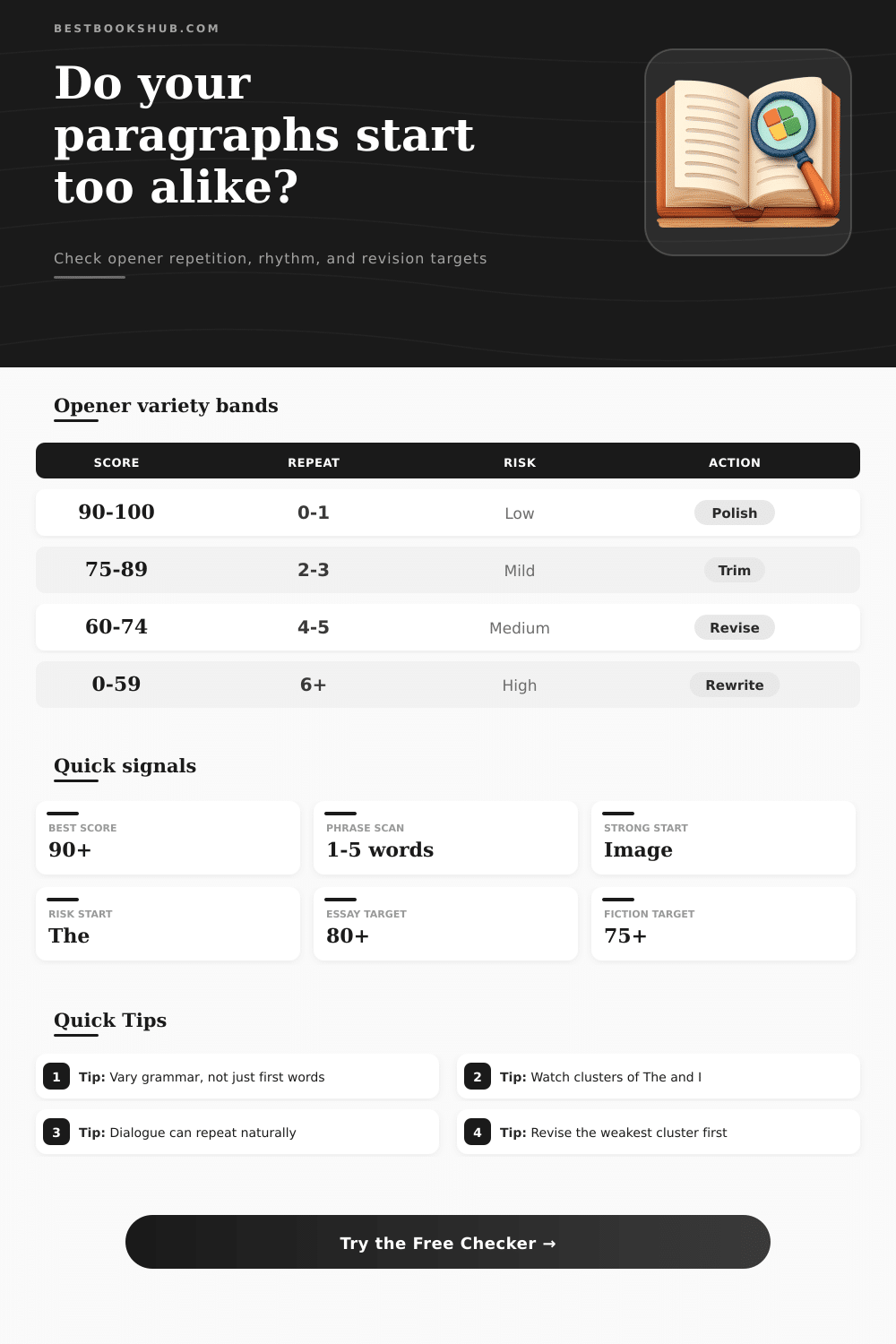
| Variety score | Likely draft condition | Editorial meaning | Best next action |
|---|---|---|---|
| 90-100 | Flexible paragraph rhythm | Openers rarely draw attention to themselves | Polish only the loudest repeats |
| 75-89 | Healthy but patterned | A few clusters may be visible to careful readers | Revise repeated first words and transitions |
| 60-74 | Noticeably repetitive | Several paragraphs begin from the same grammatical habit | Vary sentence shape before changing content |
| 0-59 | Rhythm fatigue likely | The draft may feel flat even when ideas are strong | Rewrite clustered starts paragraph by paragraph |
| Opener family | Examples | Strength | Risk when overused |
|---|---|---|---|
| Concrete image | The hallway, Rain, A torn page | Immediate scene or object focus | Can become decorative if every paragraph stages a prop |
| Pronoun start | He, She, I, They | Fast character continuity | Can make paragraphs march in the same rhythm |
| Determiner start | The, This, That, A | Clear subject entry | Often signals default sentence construction |
| Transition start | However, But, Therefore, Meanwhile | Strong logical movement | Can sound mechanical in clusters |
| Prepositional phrase | In the room, On page five | Useful for place, time, and evidence | May delay the main clause too often |
| Participial phrase | Holding the book, Turning away | Creates motion and simultaneity | Can feel mannered if stacked tightly |
| Writing profile | Repeat tolerance | Common false alarm | Target score |
|---|---|---|---|
| Fiction scene rhythm | Medium | Dialogue and action beats may intentionally echo | 75+ |
| Essay or analysis | Low-medium | Evidence phrases may repeat when citing closely | 80+ |
| Book review voice | Medium | Title, author, and character names can recur | 78+ |
| Research summary | Medium-high | Method and finding paragraphs may share labels | 74+ |
| Author newsletter | Loose | Conversational I and you starts may fit the voice | 72+ |
| Reading guide | Medium | Question-led paragraphs can repeat by design | 76+ |
| Flag type | What it means | Revision move | Example direction |
|---|---|---|---|
| Exact opener repeat | The same first phrase appears too often | Change the sentence subject or opening phrase | Move from The room to A low lamp in the room |
| Pattern fatigue | Different words share the same grammar habit | Alternate subject, place, action, and contrast starts | Swap three The starts for image, clause, and question |
| Nearby cluster | Repeats occur within a short paragraph span | Revise the middle paragraph in the cluster first | Break the run before the reader notices it |
| Weak abstract start | Paragraph begins with vague argument language | Name the claim, scene, evidence, or object sooner | Replace This shows with Morrison makes the gap visible |
DISCLOSURE: This post may contain affiliate links, meaning when you click the links and make a purchase, I receive a commission. As an Amazon Associate I earn from qualifying purchases.
If you’ve ever edited yourself, then you know what this is like. You’re reading through a section of writing and something just doesn’t feel right, except it sounds fine until you realize that all the sentences is starting with the same word, or they sound exactly the same grammatically. The writing starts to feel like list instead of flowing smoothly.
A paragraph opener variety checker will help you notice those invisible repeated phrases your brain has already glossed over on the first read. For example, it will scan your draft for the use of The, This and However, all crutch words that we lean on as we write. If you begin most of your sentences with The, then this is what the reader will get accustomed to hearing. Predictable is boringer, both in an argumentative essay and in fiction. The calculator flags when it sees these groups of over-used articles so you can break their use before they form habits.
Why You Should Use a Paragraph Opener Checker
You have the option to set length of the scan (up to 5 words) as well, which means you can look only at the first word or up to four more following. Frequently, if you look at three or four words, you’ll catch some more basic structure problems than you might be able to see by just looking at one word at a time.
So what? Instead of going after the ideal score, know WHY some of those flags are tripping you up. Like: If you begin a sentence with something that transitions, e.g. Therefore or But, you’re signaling a logical step. Great. Use that. Five times out of six paragraphs, it sound mechanical.
The reference table on that same page helps you interpret your patterns according to the type of writing you’re doing. Dialogue, and action beats tend to echo naturaly; there’s a reason. You can get away with repeating things. In academic work, you want tighter control, to keep authority up. Know what score you’re aiming for. Then you’ll know whether a repeat is worth fixing, or leaving as-is for rhythmic reasons.
All of these inputs correspond to your desired level of nitpicking. Higher settings will flag things you’re less likely to care about; lower settings will let you get away with sloppier prose. That means if you’re drafting a piece, you’d set it loose to catch ideas but not worry much about syntax. On the other hand, if you’re polishing a final draft, you’ll probably want to tighten it up and make sure everything makes sense.
Depending on what you write, you may find yourself ignoring certain inputs: If you’re writing a novel chapter, you can tell it to ignore dialogue starts (characters tend to repeat themselves). You can also ignore list labels and headings, which keeps the tool from mistaking those for repetitive prose. In short: The inputs give you control over what the tool checks, letting it fit your voice instead of you having to fit your voice into its model.
Choosing every first word at random is not what variety means. Variety is swapping out the grammatical way you enter your idea. You can vary from a subject-led beginning to an image-led one. Try the following: He looked at the door The door creaked open Both express the same action but they appeal to different sides of the reader’s imagination. It doesn’t change the meaning of what is being said. It just breaks up the monotony. It varies the texture of the sentence, it keeps the reader engaged.
Some paragraphs should be punchy and direct. Others are complex and layered. Mix it up and you create a dynamic reading experience. This makes it feel intentional and human.
Another pitfall is weak abstract beginnings. That and This leads to later. It postpones the point. Readers don’t care about whether there’s an argument, they want to know who’s doing what. The tool flags these vague introductions, letting you swap out their fuzzy abstraction for a specific verb or noun phrase. To name your claim outright is to strengthen your writing. It says you believe in your material. There’s no need to complicate each sentence into some complex clause. If it’s simple enough to say, sometimes the simplest thing is best. This is true as long as it isn’t the previous one.
The revision notes point out the exact paragraphs that is holding you back. Start there. Oftentimes just fixing the worst examples would of had a big impact on the variety with very little work. Not all paragraphs are guilty: If it’s just a few, then don’t try to fix everything. Look for the clusters, which are the places where similar beginnings occur within inches of one another. Mix things up and break up the run. Try using a participial clause, a question, or a preposition phrase. Just get the reader to keep going while they’re none the wiser about how you got them there.
Bottom line: Writing is a matter of control and release. Control what the reader knows and how you release it to them. Release it in an interesting way while still keeping things clear. And part of that control is checking the variety of openers. You don’t want to bore your readers by repeating the same rhythm over and over again. When you catch on to this, you’ll start catching it on every draft after. You’ll get better at hearing what works for you. It is what’s behind the words and the music. That’s something more valuable than a scorecard. That makes good writing great, and it happens one paragraph at a time.