📚 Rhetorical structure tool
Parallelism counter
Measure repeated syntactic starts, balanced line lengths, phrase-pattern matches, conjunction placement, and overall structural similarity in a speech, poem, essay, or draft passage.
| Opening phrase | Count | Share | Lines or units |
|---|---|---|---|
| Run the calculator to list repeated syntactic starts. | |||
| Unit | Words | Pattern signature | Closest match |
|---|---|---|---|
| Pattern signatures appear after calculation. | |||
| Unit | Word count | Length band | Conjunction map |
|---|---|---|---|
| Line balance rows appear after calculation. | |||
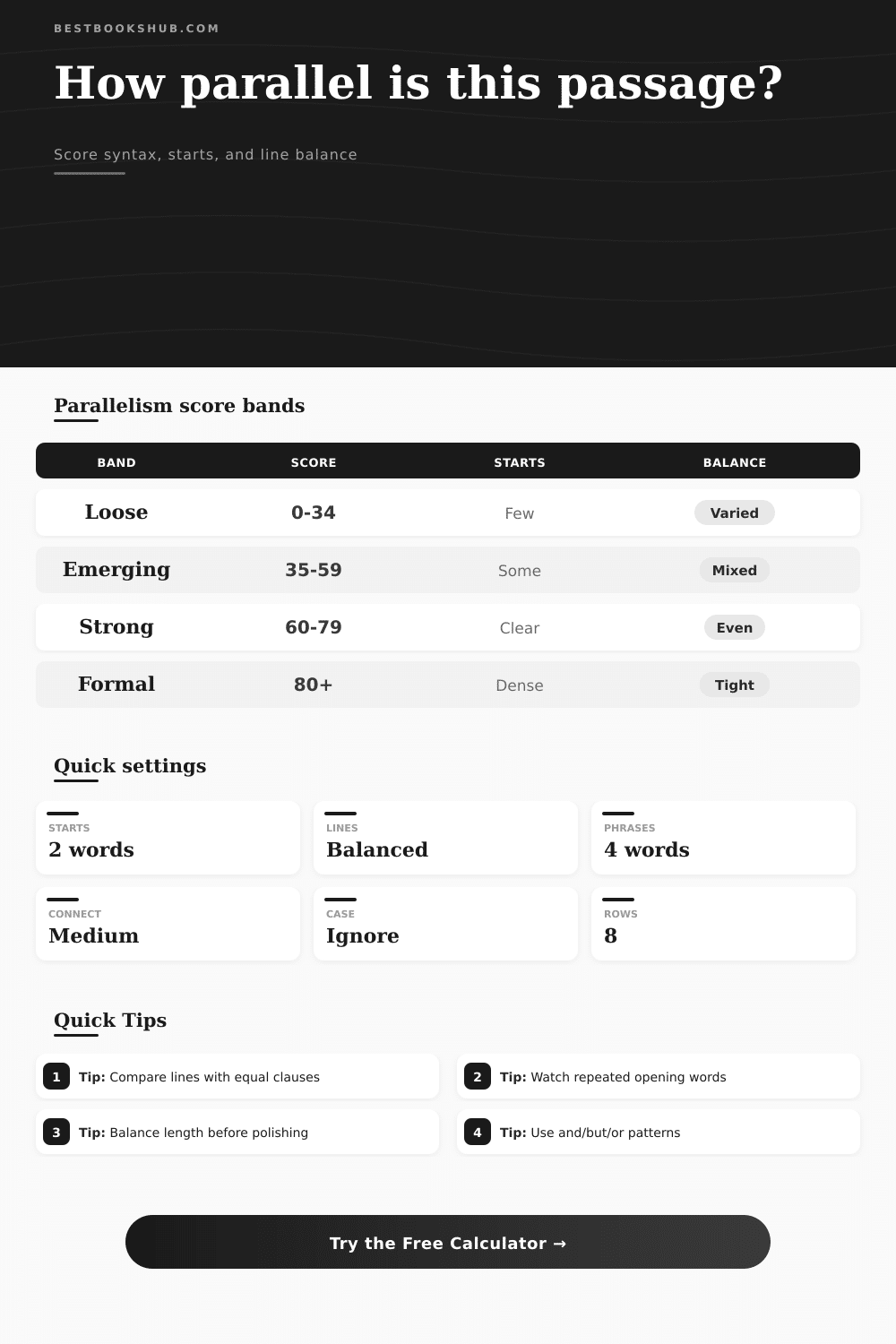
| Score band | Repeated starts | Length pattern | Likely reading effect |
|---|---|---|---|
| 0-34 | Rare or accidental | Highly varied | Loose prose, exploratory draft, or mixed sentence plan. |
| 35-59 | Some local echoes | Partly even | Emerging parallelism that may need clearer repetition. |
| 60-79 | Clear repeated openings | Mostly balanced | Strong rhetorical cadence suitable for claims or lists. |
| 80+ | Dense structural echo | Tight and deliberate | Formal parallelism with visible phrase and clause symmetry. |
DISCLOSURE: This post may contain affiliate links, meaning when you click the links and make a purchase, I receive a commission. As an Amazon Associate I earn from qualifying purchases.
Speeches are memorable for more than what they say; they’re memorable for the way that they sound. That’s why parallelism is important: it’s a tool that allows you to feel how your speech sounds as well as write it down. When a speaker hits on a rhythm that sounds inevitable, you’ve likely felt that before. The words march in lockstep, the structure holding complex ideas together, so the audience doesn’t have to work to follow along. The brain see a clause mirroring another, and then relaxes, recognizing the pattern and anticipating the payoff.
Parallelism checks repeated starts, balanced lengths, conjunction placement, and phrase signatures. This allow the writer to compare rhetorical structure across lines. It turns a vague feeling about rhythm into something that one can actualy measure. People often think parallelism is just about repetition; they think if you repeat the word “freedom” or “love,” you has done a good job. But parallelism is actualy a matter of syntax, of sentence shape different than word choice.
How to Make Your Speech Rhythm Better
A single brief clause followed by a meandering explanation break the pattern. The ear expects a beat; it finds a stumble.
Once you’ve pasted in your draft, the calculator will do the math. It’ll compare every unit to all the rest to determine whether they really match up. Set it to scan for four-word phrases. Set it to check two-word openings. Because while short openings is often matches by coincidence. When the two words are “the fact”… That’s a match with real structural intent.
The other side of the equation is called line balance. Sure you can have the same first words, but if one line has ten words in it and another has twenty, it just doesn’t work. The closer the number of word in each unit, the higher this tool will rate your line balance. This creates a sense of symmetry between two, both visually and audibly. The argument sounds solid.
And when the sentence scores poorly in terms of cadence, it’s telling you your sentences lack a certain rhythm. Maybe you’re qualifying certain ideas more than others. Cut off the fat until all the lines weigh the same amount. Mostly, you should of know what the tool is measuring so you understand why.
The joints are the conjunctions. Words like and, but, and or connects the parallel elements. The positioning of the conjunctions is weighted by the calculator, looking at how it strengthens or disrupts the pattern. If you’re composing a list with the need for solid connectors, your conjunction weighting will help. On the other hand, if you’re working on some poetic lines whose connection is more implied than stated, light weighting are preferable. This is the critical difference between tone. A poem depends on ambiguity, while a memo requires clarity. Altering these settings will make a dramatic change, which is precisely the goal. You are fine-tuning the instrument to fit the genre.
The tool ranks your score as either formal or loose, and it has reference bands to show how close you are to each rating. If you’re working out ideas and exploring, that’s okay; your score would fall below thirty-five. But if you’re getting ready for performance or publication, you’d like to see your score in the formal or strong range. If you’re in the strong or formal range, it means your writing is packed with structural echo. Your reader will glide over text without tripping over clunky clauses.
It also shows your writing’s hidden inconsistencies. You may believe a paragraph is tight, but the breakdown flag an outlier sentence that doesn’t fit the pattern. Often, fixing this single line enhance the entire passage.
Perfection should never be an obsession. Rarely do we want a hundred on the scale. It’s best if there are some variations: otherwise it sound like a robot wrote it. We’re going for rhythm here, not sameness by habit. Where the calculator comes into play is as a tool to highlight weaknesses.
Read the paragraph out loud after that. Is it still stilted? Simplify it some more. Your ear is the ultimate judge; the calculator provides the roadmap.
Write a rough draft first. Let the calculator point out where the rhythm goes off kilter. Then adjust accordingly, open strong, close strong, make sure things balance. You have something that rolls along on purpose. Those words march in step.