💬 Bracket and aside analyzer
Parenthetical counter
Paste prose, notes, citations, or manuscript text to count parentheses, brackets, braces, nested parentheticals, unmatched pairs, and parenthetical word-share targets.
Use a sample to test narrative asides, academic citations, nested editorial notes, reference-heavy prose, and deliberate unmatched-pair checks.
DISCLOSURE: This post may contain affiliate links, meaning when you click the links and make a purchase, I receive a commission. As an Amazon Associate I earn from qualifying purchases.
Review the matched spans, issue list, and line-level density to decide whether an aside is useful, over-nested, or missing a delimiter.
| # | Pair | Depth | Words | Share | Preview |
|---|---|---|---|---|---|
| No span data yet. | |||||
| # | Issue | Marker | Position | Line | Context |
|---|---|---|---|---|---|
| No issue data yet. | |||||
| Line | Pairs | Words | Paren words | Share | Preview |
|---|---|---|---|---|---|
| No line data yet. | |||||
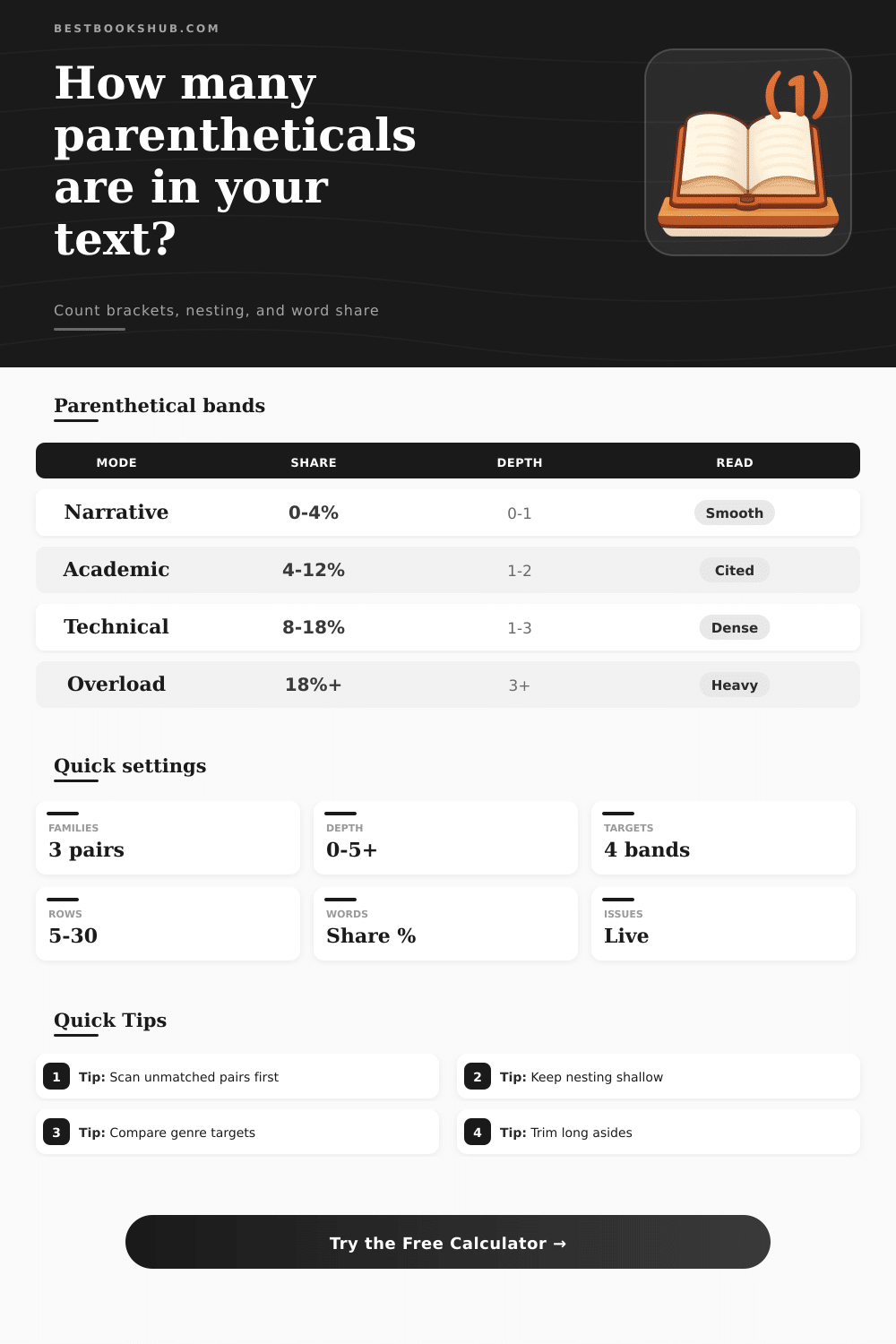
Use these planning bands for editorial reads. They are diagnostic ranges, not grammar rules.
| Target band | Parenthetical word share | Typical depth | Best fit |
|---|---|---|---|
| Narrative prose | 0% to 4% | 0 to 1 | Fiction, memoir, essays with light asides |
| Academic prose | 4% to 12% | 1 to 2 | Citations, terminology, study commentary |
| Technical/reference | 8% to 18% | 1 to 3 | Definitions, version notes, examples |
| Annotated notes | 12% to 28% | 1 to 4 | Draft notes, marginalia, editorial markup |
| Delimiter family | Open | Close | Common editorial use |
|---|---|---|---|
| Parentheses | ( | ) | Asides, citations, clarifications |
| Square brackets | [ | ] | Editorial insertions, quoted changes |
| Braces | { | } | Code, logic, structured notes |
| Mixed nesting | ( [ { | } ] ) | Layered notes that need close checking |
| Nesting depth | Reader signal | Risk level | Revision cue |
|---|---|---|---|
| 0 | No asides | None | Add only if clarity needs it |
| 1 | Normal aside | Low | Usually readable |
| 2 | Layered aside | Medium | Check if one layer can move |
| 3+ | Stacked aside | High | Split or rewrite for clarity |
| Issue type | Example | Likely cause | Fix check |
|---|---|---|---|
| Unclosed opening | (note continues | Missing closing marker | Add mate or remove opener |
| Orphan closing | note ends) | Extra closing marker | Find intended opener |
| Mismatched close | (note] | Wrong family | Use matching delimiter |
| Deep nesting | (a [b {c}]) | Layered inserts | Flatten or split note |
Measure the share of words in parentheses against a mix of annotation, technical, academic, and narrative targets. Measure parentheticals against unmatched pairs, brackets, nested asides, and bracket families. Most writers considers parentheses a harmless piece of punctuation. They are anything but. When they appear to often, those curved marks begin to form in a way that affects clarity, rhythm, and even the reader’s trust in you.
One good aside adds a dab of color. Three nested asides in one paragraph typically indicate the writer is losing track off the primary thought. We may not realize it, but difference makes a world of difference. The trick, however, is understanding exactly what parentheticals do to your text. They take you momentarily off the main road, pulling you into a detour that might illuminate scenery or create traffic jams.
How Parentheses Affect Your Writing
Fiction writers depends on them for their private asides. Academic authors use them to hide their citations. Technical documentation use them to define terms without stopping. Each genre has its own tolerance so crossing the line will change how the page feel.
Depth of nesting indicate something about how you write. If you’re in brackets within brackets within brackets (and that’s only the third one!), then your sentence likely attempted to do too many things all at once. There is a first aside. No problem. Second aside? Readers has to set up a sort of mental bookmark. What about a third aside? Why not just put this into two different sentences? That’s what people often misses.
And the punctuation isn’t the issue. Rather, it’s the mental effort that these little marks silently burden us with. And then there are unmatched pairs, which present a whole new headache. Even if meaning remains clear, one lost closing parenthesis can leave an otherwise solid passage feeling sloppy. They’re the kind of mistake that professional editors looks for first. They erode your confidence quicker than anything else going mechanically wrong. But with the calculator, it immediately flags it for you. No manual hunting around in a thick stream of words required.
A more helpful story is told by word share: When more than four percent of the words in a book exist between parentheses, the voice begin to feel interrupted. That’s what readers notice. The endless detours. But the same four percent hardly matters in academic writing. The math change depending on purpose, and forcing yourself to consider the share percentage makes you ask if those asides deserve their real estate or if they’re just comfortabley crutches.
There are also common errors that crop up from manuscript to manuscript. Some writers tuck their finest writing in parentheses rather than determining if it’s appropriate to include within the narrative. Others use brackets when they might better express an opinion with conviction. It all seems harmless, until another reader encounters the page and detects some ambivalence. Long parenthetical asides especially deserves scrutiny (typically when they exceed twenty words), as they frequently wants to be their own sentence.
Every project has its own fingerprint, and style guides provides general guidance. Asides may be used for a memoir, since they reflect how thoughts play out. Surgical accuracy is required of a legal document where each bracket must have an explained reason. It’s about consistency inside a given project regardless if it defies wider genre expectations.
In the end, however, parentheses (ha ha) serves their purpose most effectively by fading away. They should of draw attention to nothing save the light, and help advance the primary idea rather than distract from it. Put your words into the thing, examine the location of the clusters, and then consider the single important question: Does this sound more like somebody talking with confidence or continually getting in their own way? The punctuation marks is small, but together they are rarely insignificant. *The parentheses in this paragraph were added later to demonstrate how parentheticals can be used for emphasis.