📖 Passive pattern analyzer
Passive voice percentage calculator
Paste prose to estimate passive voice percentage with be/get plus participle heuristics, sentence counts, by-agent phrases, genre target bands, and controls for common false positives.
Load a sample, then adjust genre, participle confidence, agent-by scanning, and false-positive controls to see how passive percentage changes.
DISCLOSURE: This post may contain affiliate links, meaning when you click the links and make a purchase, I receive a commission. As an Amazon Associate I earn from qualifying purchases.
Review flagged sentences before revising. A heuristic can find likely passive constructions, but final grammar decisions still need context.
| # | Pattern | Auxiliary | Participle | By-agent | Sentence preview |
|---|---|---|---|---|---|
| Run the calculator to list flagged passive sentences. | |||||
Use these tables to compare passive percentage targets, detection cues, false-positive controls, and revision priorities by writing context.
| Genre | Target band | Higher passive can fit when | Revision signal |
|---|---|---|---|
| Fiction and memoir | 0-8% | The actor is unknown, hidden, or emotionally distant. | Review if action scenes feel flat or distant. |
| General nonfiction | 3-12% | The process matters more than the actor. | Clarify who acts when accountability matters. |
| Academic methods | 8-20% | Procedure and replicability are the focus. | Balance passive method wording with clear claims. |
| Business reports | 5-15% | Actions are institutional or actor-neutral. | Add agents for decisions, risks, and ownership. |
| Pattern type | Example cue | What it suggests | Detector treatment |
|---|---|---|---|
| Be + participle | was approved | Classic passive construction. | Counted in be and be/get modes. |
| Get + participle | got moved | Informal passive or event result. | Counted unless get-only is disabled. |
| By-agent phrase | by the editor | The actor appears after the verb phrase. | Counted within the selected scan window. |
| Compound auxiliary | has been revised | Passive with perfect or modal support. | Scanned across nearby helper words. |
| False-positive source | Typical phrase | Why it is tricky | Control to try |
|---|---|---|---|
| Adjectival participle | is tired | Describes a state, not an action done to a subject. | Use balanced or strict adjective filtering. |
| Progressive verb | is reading | Ends in ing rather than a past participle. | Ignored by participle rules. |
| Linking description | was known | Can be adjective-like or passive by context. | Add extra ignore terms if needed. |
| Quoted dialogue | "I was told" | Dialogue may intentionally sound indirect. | Ignore or flag quoted speech separately. |
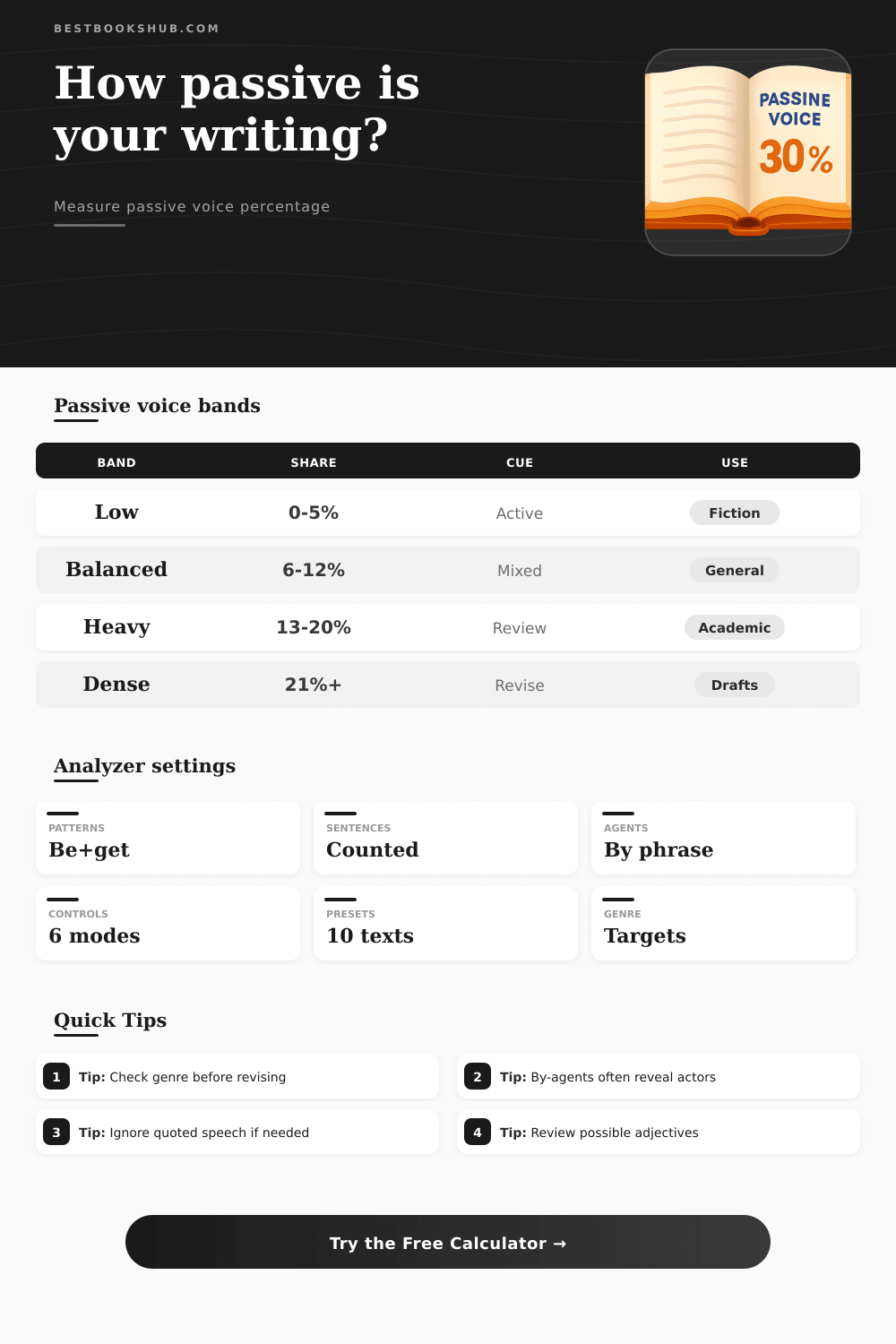
| Passive share | Interpretation | Best next check | Common action |
|---|---|---|---|
| 0-5% | Mostly active | Make sure actor focus still fits the genre. | No broad revision needed. |
| 6-12% | Moderate mix | Review flagged sentences with missing actors. | Revise only weak or vague lines. |
| 13-20% | Passive-heavy | Compare with genre target before cutting. | Add actors where clarity improves. |
| 21%+ | Dense passive load | Inspect every cluster of passive sentences. | Rewrite repeated patterns first. |
Use a passive voice percentage calculator to guess how many passive sentence you have. Find out which patterns are used for be/get participles. Count the number of by-agent phrase. Benchmark these against target values for genres.
Passive voice: That’s what writers call the uninvited guest in the living room. They recognize its face and feel its pull on the dinner-table pace. But just how much? How do we know too much?
How to Use Passive Voice Well
Here’s the secret that runs counter to conventional wisdom: Sometimes you need passive voice, and you don’t always want to banish it. It serves a purpose. It can create distance, shift focus, or obscure blame when appropriate. So the trick isn’t to be rid of passive voice; rather, it’s to measure how much there is and judge if it helps or hinders your intent.
Take this example: Imagine a mystery writer who wants the reader to be uncertain. So he writes something like: “The letter was found on the desk.” That sentence conceals the identity of the discoverer a couple more beats. It is tense. He then alters it to: “Detective Ruiz found the letter on the desk.” Suddenly he’s sped up the pace. Both sentences is worth using; the difference are a matter of conscious choice.
Until you realize your writing has slid into a passive habit, most of us don’t know we’ve done it, then the page feels flabby or slippery. This is why we need an objective measure. But the percentage alone isn’t the whole story. Five percent sounds perfectly reasonable as a passive rate for a thriller, but oddly evasive in a business report. Business reports tend to cluster around the midpoint unless they is describing an action, whereas academic writing tends to settle comfortabley above. And there are no hard-and-fast rules here, just patterns based off how readers have come to expect texts to read depending on their genre. If your draft falls outside its typical range, it’s still going to read just a little bit off, even if you can’t quite explain why.
But there are other complications. For one thing, some past participles act as adjectives instead of true passive verbs. For example, “The door was closed” might not mean somebody did something; it might just describe a current situation. There’s also dialogue. People use passive voice all the time in conversation when they’re being evasive, polite, or just talking naturaly. If your word-counting calculator doesn’t account for quoted material, then your picture of narrative voice will be cleaner.
Then there are these clues by-agent phrases. They hide the actor within the sentence until the construction provides “by management” or “by the committee.” That doesn’t necessarily make the sentence wrong; but when you have clusters of such, those is chances to re-arrange for greater impact.
Writers who go after a target number too forcefully runs into common errors. For example, they transform all their passive statements into active ones. And some of these new versions are clunky to say the least. A more effective tactic is to scan for clusters: If you notice three consecutive passive phrases in a row in your action scene, then it’s likely the energy dissipated somewhere along the way. On the other hand, if there is a sudden increase of active-voice phrases in your methods section, the reader may worry about hurting replicability. This is a concern they hold dear, and it matters more than any one-size-fits-all commandment.
Once you know what those numbers mean, things makes sense. If I see a high passive percentage on a query letter, it can tell me that this author is hiding behind events rather than owning the story. But if I see the same percentage in a technical manual, I might just have a document that’s doing precisely what it’s supposed to do.
It doesn’t make decisions for you; it just gives you the map and then you pick the route.” It is done by agents. By paying attention, they’ll show you the subject you’ve hidden. Move that subject along and notice how the sentence perk up. Leave the passive in place if the result or receiver really should of get the spotlight.
It’s not about eliminating… It’s about getting aware. When you can see the pattern clearly enough, your instincts will improve, and the prose will begin to sound more like you again…only better. This sort of noticing (without panic) and adjustment (without overcorrection), this quiet recalibrating, is what makes the difference between competent writing and work that feels alive on the page.
The numbers help, yes, but the judgment you form after? That’s what counts.