📊 Text percentage tool
Percentage mention counter
Paste a chapter sample, blurb, review note, or study passage to see what share of the text mentions your chosen term set.
| Term | Mentions | Percent of base | Percent of mentions | Segments |
|---|---|---|---|---|
| Results appear after text is scanned. | ||||
| Percentage base | Best use | Example denominator | Watch point |
|---|---|---|---|
| Total words | Term density in prose | 1,000 words | Long terms count as one mention |
| Total sentences | How often ideas appear | 48 sentences | Dense sentences can hold repeats |
| Total paragraphs | Section-level coverage | 12 paragraphs | Paragraph length varies widely |
| Total lines | Notes and outline checks | 30 lines | Wrapping can change line counts |
| Total characters | Short labels or compact copy | 4,500 chars | Spaces are included in the base |
| Matching rule | What it counts | Good for | Example |
|---|---|---|---|
| Exact word or phrase | Standalone term boundaries | Names, motifs, key phrases | art matches art |
| Substring inside words | Any visible string match | Root fragments and variants | art in artist |
| Wildcard star match | Star allows flexible letters | Variant families | memor* finds memory |
| Word starts with term | Words beginning with term | Plural and suffix checks | book finds books |
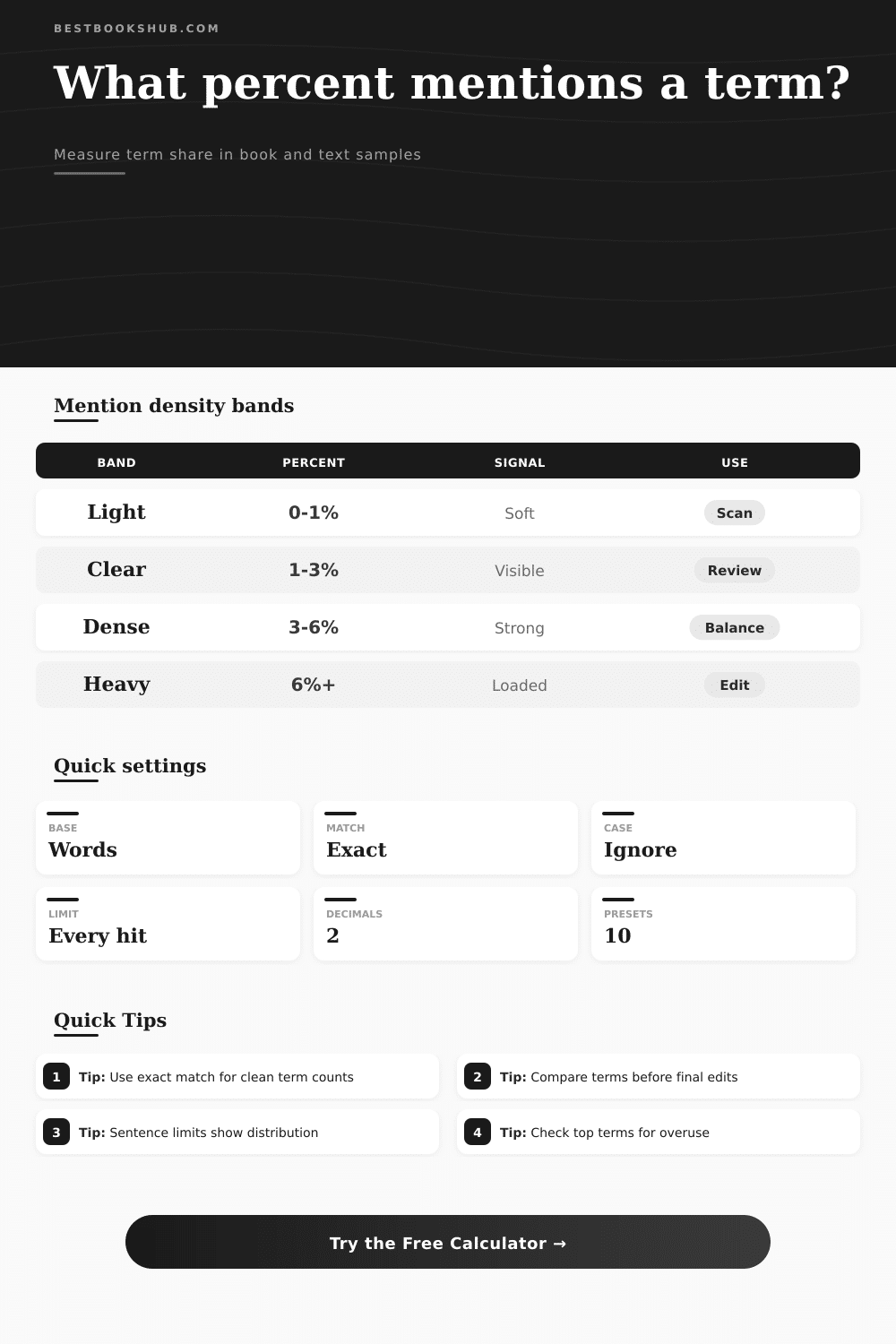
| Mention band | Word-base percent | Typical signal | Useful check |
|---|---|---|---|
| Trace mention | Under 0.5% | Rare or background | Confirm the term is intentional |
| Light mention | 0.5% to 1% | Present but gentle | Check scattered placement |
| Clear mention | 1% to 3% | Visible emphasis | Compare against nearby themes |
| Dense mention | 3% to 6% | Strong repetition | Review sentence-level clustering |
| Heavy mention | Over 6% | Dominant wording | Inspect for accidental overuse |
| Sample type | Common base | Useful limit | Percent question |
|---|---|---|---|
| Chapter excerpt | Words | Every occurrence | How dense is the theme? |
| Study notes | Lines | Max one per line | Which lines mention the idea? |
| Review paragraph | Sentences | Max one per sentence | How often is the term raised? |
| Back cover copy | Words | Every occurrence | Is the keyword too repeated? |
| Index draft | Lines | Max one per line | Which entries include the term? |
DISCLOSURE: This post may contain affiliate links, meaning when you click the links and make a purchase, I receive a commission. As an Amazon Associate I earn from qualifying purchases.
Filler = repetition without intent. Rhythm is repetition with intent. The difference typically isn’t felt; it’s measured in percentages. That is why we pay attention to the density of mentions.
How do most editors check for overused words? They trust their instincts. They look at a page, squint and guess whether or not something have been used too many times. Instinct is good. But it is also biased by how you read. As you move quickly through text, your brain smooths over groups of repeated words and fills in the gaps. Because of this, you do not notice a particular pattern pop up in almost every other sentence.
Why Use a Word Counter Tool
The calculator (above) runs this math for you. It turns the feeling of an annoying phrase into facts. How often have those words appeared? What percentage of your text does that represent? The denominator matters. What does this tell you? Depending on your denominator, it’ll change what the data say.
Did you count against total words? That’s counting density. It measure how dense a term appear within a text. That’s why this approach make sense when counting across prose: it normalizes by length. A hundred words, whether spread over one paragraph or 10, is still a hundred words.
Did you count against sentences? That’s frequency. Frequency measures the number of times a reader will encounter a term. You might have three instances of a single word in one loopy sentence. Volume counts that word count. Frequency count only once.
Doesn’t matter which you need to know, so long as you know which one to use. And then there are rules about matching. Exact matching will only return words that contain the exact term you searched for. But substring matching return all instances where root exists somewhere in word. It is handy if you’re looking for a thematically relevant fragment, but it is dangerous if false positives is a concern. For example, if you search for “art,” substring matching will find “artificial” and “artist” as well; which could be exactly what you need. Or it could not. You can turn this on/off with the tool, depending on whether you’d like your hunt to be precise or permissive.
One more thing: what about limits? How do you want to treat it? Should I count each and every instance? Do you want to cap the count at once per paragraph?
Counting each instance shows intensity. It shows whether or not a word or phrase is getting hammered home in a tight little cluster. Capping the count show distribution. It shows how evenly distributed the word is across the work. Both are valuable, one tells you the heat, the other the reach.
Just because a percentage of a word is high doesn’t mean it’s bad. To be clear in any kind of technical writing, for example, key words need to show up a lot. If a name pops up repeatedly throughout your story, maybe the character is at the heart of whatever scene they’re in. What matters is that it pulls readers out of the story. If a word leaps out at you, chances are good it’s there too many times.
This reference table break it down into bands from light to heavy. Six percent and higher is generally heavy enough that you’ll want to give it a second glance. Crutch words such as “just” and “very” have a way of showing up all over without us even knowing. The number is never as important than context. Maybe it’s a small percentage, but it’s bugging you because the word begin each sentence. Or maybe it’s large enough that when repeated, it fit into a rhythmic beat and feels okay.
The tool provides the map. It provides the baseline. Then you have to go walk the territory. Flag it with the data where you think there might be something going on. Then read out loud from the flagged area. What your ear catches, the algorithm misses.
The idea isn’t for you to get to some exact number. The idea is to have control over the voice. When you know precisely how much space does this term take up? Do they earns their keep? How do you turn noise into signal?
You should of checked it.