📝 Punctuation rhythm tool
Period frequency calculator
Paste prose, notes, catalog copy, or manuscript text to measure full-stop rate, abbreviation noise, sentence rhythm, and staccato pressure.
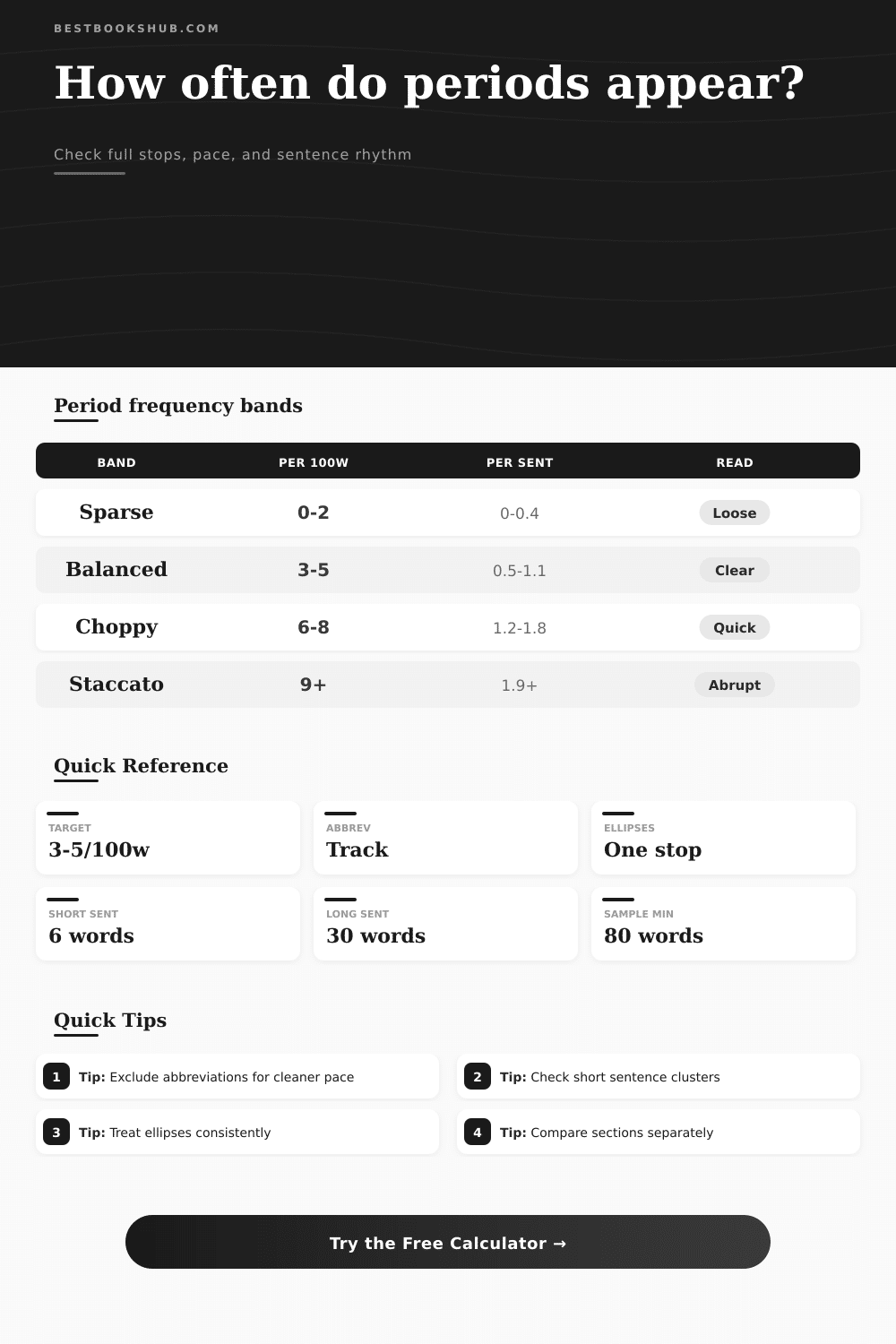
| Frequency band | Periods per 100 words | Sentence feel | Typical signal |
|---|---|---|---|
| Sparse | 0-2 | Loose or flowing | Longer sentences |
| Balanced | 3-5 | Clear paragraph pace | Steady prose |
| Choppy | 6-8 | Quick stopping rhythm | Short sentences |
| Staccato | 9+ | Abrupt beat pattern | Heavy stops |
| Period source | Example pattern | Default treatment | Why it matters |
|---|---|---|---|
| Sentence stop | End of sentence. | Counts in pace | Marks closure |
| Abbreviation | Dr. or etc. | Tracked separately | Can inflate rate |
| Decimal | 3.14 or 2.0 | Excluded in strict | Not sentence rhythm |
| Ellipsis | Wait... | One pause by default | Shows hesitation |
| Text type | Usual density | Common noise | Best mode |
|---|---|---|---|
| Fiction prose | 3-6 per 100w | Dialogue pauses | Sentence periods |
| Academic note | 2-5 per 100w | Citations | Strict cleanup |
| Catalog record | 6-12 per 100w | Initials and codes | Track abbrev |
| Outline notes | 7-14 per 100w | Fragments | Terminal stops |
| Sentence share | Short rate | Long rate | Reading effect |
|---|---|---|---|
| Even mix | Under 25% | Under 20% | Stable rhythm |
| Short cluster | 25-45% | Under 15% | Fast beat |
| Long drift | Under 15% | 25%+ | Delayed stops |
| Mixed tension | 30%+ | 20%+ | Uneven pace |
Sentence-ending periods
Best for measuring actual stop rhythm because it ignores marks inside abbreviations, citations, and number formats.
All period marks
DISCLOSURE: This post may contain affiliate links, meaning when you click the links and make a purchase, I receive a commission. As an Amazon Associate I earn from qualifying purchases.
Useful for metadata and OCR checks where every dot matters, including initials, decimals, and file-like fragments.
Ellipsis-aware counts
Prevents three dots from looking like three complete sentence stops when the mark is really one pause.
Short-sentence clusters
Shows when high period frequency comes from deliberate punch, clipped notes, or choppy paragraph pacing.
In addition, you might have also realized that certain paragraphs is short and brief, whereas other ones are longer and more complex.
Writing rhythm isn’t something that only occurs in music. Think about space between the stops. The full stop or period are like a brake. How frequently you use this can be difference between your own reading experience being smooth or jarring.
Control Your Writing Rhythm
Punctuation is a tool for pacing, but most writers believes it’s a fixed set of rules. That’s the mistake. You can write perfectly good grammar and still make something exhausting to read.
Why? It’s probably because of how often you bring up the last stop in your sentence. Your eye scans down page looking for these little dots. Too few dots, and the eye swims. Too many dots, and the eye stumbles. Look at the numbers, and then you’ve got it right.
That’s what this tool does. It removes guesswork and calculates numbers for your text above: It removes the noise, not all periods are pauses or even marks of punctuation. What about a period at end of Dr.? That’s a label, not a pause. And what about a period within a number (as in 3.14)? It is a separator, but not a stop. Counting every single dot will make your pace look artificially choppy. So how do you know? Well, the tool filters that out.
The rhythm of fiction and technical writing are not the same. Fiction needs to flow, perhaps with fewer stopping points for every hundred word. It draws reader on, uninterrupted. On the other hand, academic text tend towards more precision. Here, short sentences becomes a feature that forces us to pay attention to detail.
The table below shows how various genre slot into particular frequency bands. If you know where your writing should fall then you will be able to judge whether your draft is overly dense or whether you are simply accustomed to a different style.
Rhythm analysis is ruined by abbreviations. They litter the count. Do you write in fields that include lots of acronym? Science. It is law. Medicine. Unless you take those into consideration, your period frequency will resemble rapid fire. The tool allows you to track those on their own. This gives you a clear view of what your real sentence structure look like. Perhaps you’ll discover your raw count is high, yet your actualy rhythm is balanced. That distinction helps you maintain a clear draft as opposed to having to rewrite it.
And then there’s this: the ellipses. What are these? They are visual pauses. They are logical halts. Three dots aren’t three different sentences; they’re one pause that you can choose to treat as single stop rather than three separate ones … and in doing so, you capture what your eye does when you read.
This is important. Because if all you’re doing is counting out characters, this change won’t matter. But if you’re modeling the experience of someone reading, this will matter.
Look at another signal: short sentence cluster. It’s possible to use a few short sentences for emphasis. A cluster of them can be erratic. You can see whether the pace is intentional with this tool, which highlights those clusters. Sometimes you write short sentences because you don’t know what point to make. Sometimes you do it for effect. The data will help you tell the difference.
Writing well is like breathing. The punctuation shouldn’t be noticed by the reader. It should be felt as part of flow. Learning to stop gives you control of that flow. From there, guesswork becomes design. Each period is a tiny mark, but where you choose to put it shapes the form of your thought. Learn how to use the tool. And then listen with your ear until you get the rhythm just right.
No need for perfection. Just clarity. Make the stops when they belong and the words will breathe. You should of used this sooner.