🔊 Phoneme Count Calculator
Count the number of sounds (phonemes) in any word or sentence — perfect for teaching, speech therapy & linguistics
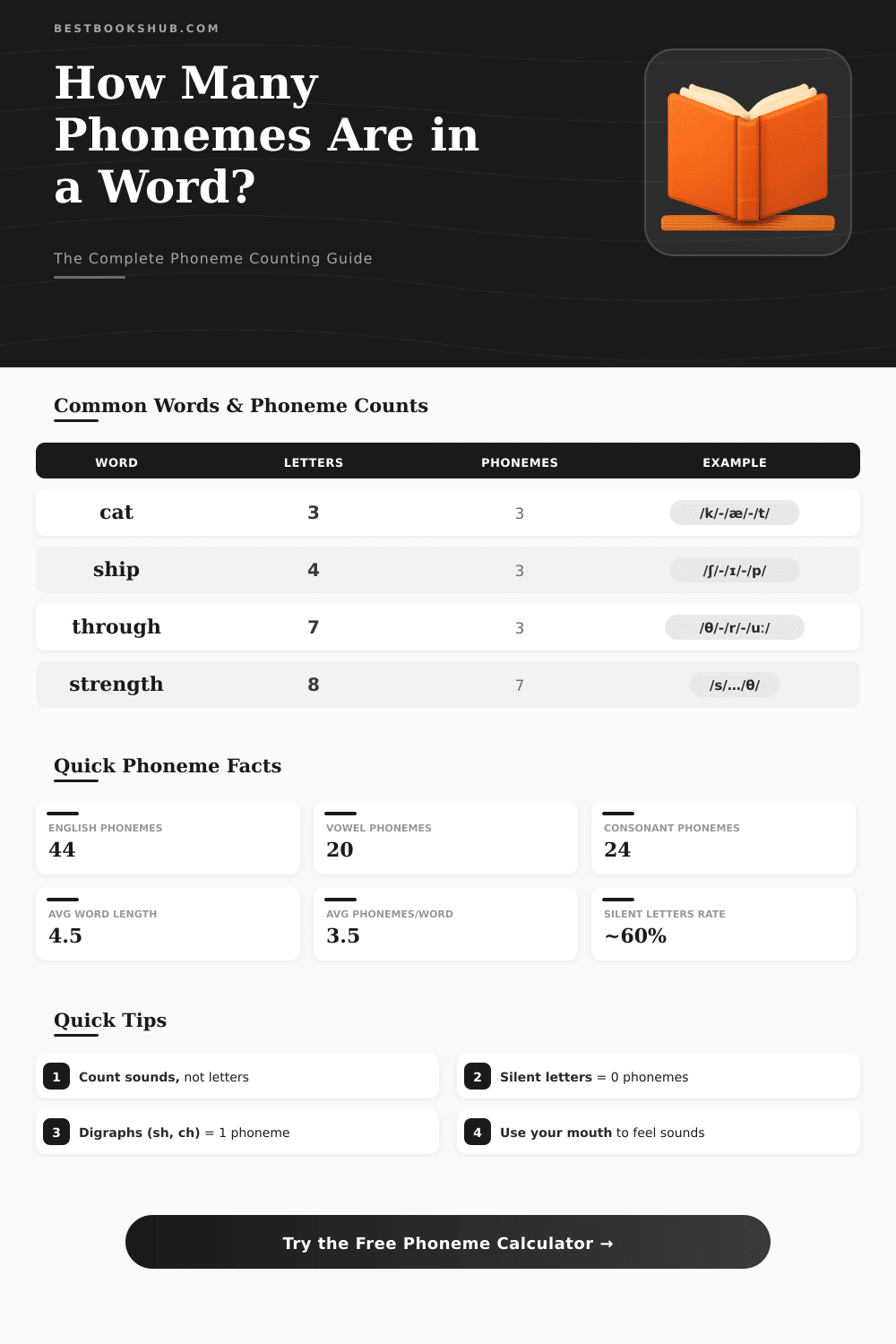
| Word | Letters | Phonemes | Phoneme Breakdown | Silent Letters |
|---|---|---|---|---|
| cat | 3 | 3 | /k/ /æ/ /t/ | none |
| ship | 4 | 3 | /ʃ/ /ɪ/ /p/ | none |
| through | 7 | 3 | /θ/ /r/ /uː/ | ough |
| knight | 6 | 3 | /n/ /aɪ/ /t/ | k, gh |
| phone | 5 | 3 | /f/ /əʊ/ /n/ | e |
| strength | 8 | 7 | /s/ /t/ /r/ /ɛ/ /ŋ/ /k/ /θ/ | none |
| church | 6 | 3 | /tʃ/ /ɜː/ /tʃ/ | none |
| school | 6 | 4 | /s/ /k/ /uː/ /l/ | none |
| elephant | 8 | 7 | /ɛ/ /l/ /ə/ /f/ /ə/ /n/ /t/ | none |
| squirrel | 8 | 6 | /s/ /k/ /w/ /ɜː/ /r/ /l/ | none |
| straight | 8 | 5 | /s/ /t/ /r/ /eɪ/ /t/ | gh |
| knife | 5 | 3 | /n/ /aɪ/ /f/ | k, e |
| Category | Count | Examples | Spelling Patterns |
|---|---|---|---|
| Short Vowels | 5 | /æ/ /ɛ/ /ɪ/ /ɒ/ /ʊ/ | cat, bed, sit, hot, cup |
| Long Vowels | 5 | /eɪ/ /iː/ /aɪ/ /əʊ/ /uː/ | cake, see, kite, bone, moon |
| Diphthongs | 5 | /aɪ/ /ɔɪ/ /ɪə/ /eɪ/ /əʊ/ | boy, now, ear, cake, coat |
| Other Vowels | 5 | /ə/ /ɜː/ /ɔː/ /ʊ/ /ø/ | about, bird, law, book |
| Plosives | 6 | /p/ /b/ /t/ /d/ /k/ /g/ | pat, bat, tap, dog, kit, got |
| Fricatives | 9 | /f/ /v/ /θ/ /ð/ /s/ /z/ /ʃ/ /ʒ/ /h/ | fan, van, thin, then, sun |
| Affricates | 2 | /tʃ/ /dʒ/ | chip, judge |
| Nasals | 3 | /m/ /n/ /ŋ/ | map, nap, sing |
| Approximants | 4 | /l/ /r/ /j/ /w/ | let, red, yes, wet |
| Spelling Pattern | Phoneme Count | Sound | Example Words |
|---|---|---|---|
| sh | 1 | /ʃ/ | ship, fish, rush |
| ch | 1 | /tʃ/ | chip, church, catch |
| th (voiceless) | 1 | /θ/ | thin, bath, three |
| th (voiced) | 1 | /ð/ | this, that, them |
| ph | 1 | /f/ | phone, graph, photo |
| ck | 1 | /k/ | back, duck, clock |
| wh | 1 | /w/ | where, what, when |
| bl, cl, fl | 2 | /bl/ /kl/ /fl/ | blue, clap, fly |
| str | 3 | /s/ /t/ /r/ | street, strong, string |
| tch | 1 | /tʃ/ | catch, fetch, match |
Phonemes are those little sounds that join to form words. In English there are around 44 different sounds, that one also calls phonemes. All those 44 sounds help to tell one word from others.
DISCLOSURE: This post may contain affiliate links, meaning when you click the links and make a purchase, I receive a commission. As an Amazon Associate I earn from qualifying purchases.
Although the English alphabet has only 26 letters, the number of separate sounds beats that a lot. From those sounds are born endless ways to create words.
Phonemes: Small Sounds That Help You Learn to Read
To learn to read, it matters to learn phoneme count in words. This is one of the best steps for success in learning reading. Listening and calling the phonemes in words can seem hard even so regular practice makes it simpler.
A fast way to do phoneme count is to say a word very slowly and note every time, when the mouth changes position. Take for example the word “cat”. It holds three sounds: /k/, /a/ and /t/. Tasks like tapping on a box for every sound, or clapping and calling, when one hears a sound in a word, help to practise.
When one mixes those sounds again, that also helps to read words.
Here is something interesting to think about. The phrase “He stuck in his thumb and pulled out a plum” carries 28 phonemes. Normal saying of it lasts around 3 seconds.
So, more than 9 phonemes come out every second. That is really surprising, how quickly the mouth wroks.
One hard spot is the diphthongs. Some vowels are made up of two different vowels combined. For instance, the sound “ou” in “dog”, “oy” in “boy” and “ai” in “skin” are diphthongs.
The mouth moves from one vowel to the other while one says them. Even so one must count each as one phoneme. For the general American accent, their exist 8 separate vowel sounds and 5 diphthongs.
Different dialects of English have different amounts of phonemes. For children that learn to read, most important is to fit the teaching to their own way of talking. For instance, teaching a boy from Boston that the sounds of “car” are k-ah-r could confuse him, if he says “ka” without an r-sound.
Worksheets and flashcards help to build this skill. Sets of flashcards for phoneme count, with many images, give little children something that they right away know. Games and quizzes, where children see an image, count the sounds and choose the right number, also work well.
There are online tools, where one can enter text and get a count of phonemes for American or British English.
In Hungary, children in the first and second grades get direct teaching about phoneme awareness and phonetic decoding of words. Since the third and fourth grade, the focus shifts to vocabulary, reading plans, spelling and grammar. Hungary ranked 13th highest from 50 countries in reading fornine-year-olds according to a study of 2016.