🔁 Repeated wording scan
Phrase repetition detector
Paste a draft to detect repeated word groups, close echoes, stop-phrase noise, and revision pressure across fiction, essays, pitches, copy, and long-form prose.
Use smaller phrase sizes for tight line edits and larger sizes for long passages. The detector scores exact repeated word groups after your cleanup settings are applied.
| Phrase size | Best use | Likely catches | Common false signal |
|---|---|---|---|
| 2-word phrase pairs | Dialogue cadence and web copy | Small verbal tics, repeated modifiers, slogans | Ordinary grammar pairs such as of the |
| 3-word phrase echoes | General manuscript line editing | Noticeable repeated wording without being too strict | Repeated transitions in instructional prose |
| 4-word repeated phrases | Essays, blurbs, and article drafts | Copied sentence starts and repeated claims | Intentional section labels or recurring terms |
| 5-word copied runs | Plagiarism-adjacent and heavy echo checks | Long repeated fragments and pasted material | Formal citations or boilerplate disclaimers |
| 6-word long echoes | Long chapters and polished copy | Large repeated runs that feel accidental | Poetic refrains or repeated headings |
| Draft lane | Light range | Watch range | Heavy range |
|---|---|---|---|
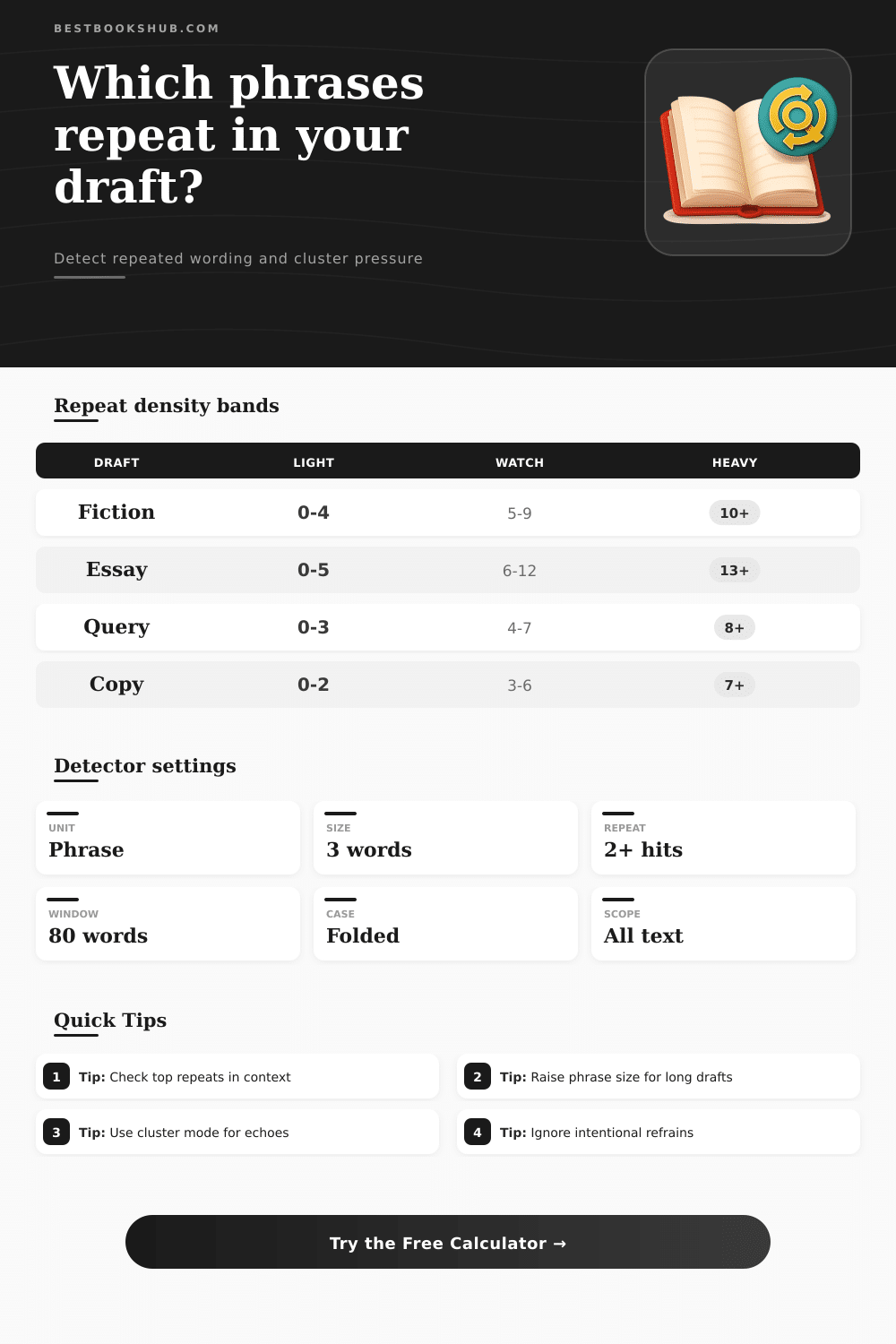
| Fiction chapter or scene | 0 to 4 repeats per 1,000 words | 5 to 9 repeats per 1,000 words | 10 or more repeats per 1,000 words |
| Dialogue-heavy excerpt | 0 to 6 repeats per 1,000 words | 7 to 13 repeats per 1,000 words | 14 or more repeats per 1,000 words |
| Memoir or personal essay | 0 to 5 repeats per 1,000 words | 6 to 11 repeats per 1,000 words | 12 or more repeats per 1,000 words |
| Query letter or pitch | 0 to 3 repeats per 1,000 words | 4 to 7 repeats per 1,000 words | 8 or more repeats per 1,000 words |
| Sales or landing-page copy | 0 to 2 repeats per 1,000 words | 3 to 6 repeats per 1,000 words | 7 or more repeats per 1,000 words |
| Control | Conservative choice | Balanced choice | Aggressive choice |
|---|---|---|---|
| Case treatment | Preserve case differences | Fold uppercase and lowercase | Smart fold except acronyms |
| Punctuation cleanup | Keep apostrophes in words | Strip punctuation marks | Respect line breaks as stops |
| Stop-phrase handling | Keep every phrase | Trim weak phrase edges | Strict filler suppression |
| Quoted text scope | Scan narration and dialogue | Favor text outside quotes | Focus on quoted speech |
| Revision sensitivity | Lenient draft pass | Balanced edit pass | Minimal repetition tolerance |
| Result metric | What it measures | Best for | Revision signal |
|---|---|---|---|
| Repetition score | Overall pressure from density, excess repeats, clusters, and sensitivity | Quick triage before editing | Higher scores need a line pass |
| Repeated phrase count | Unique phrases that meet the repeat threshold | Finding variety problems | Many unique repeats suggest patterned wording |
| Repeat density | Excess appearances per 1,000 scanned words | Comparing short and long drafts fairly | Heavy density can feel monotonous |
| Cluster hits | Repeat appearances within the selected word window | Spotting nearby echoes | Close clusters are usually more noticeable |
| Phrase spread | Distance between first and last appearance | Distinguishing refrain from scattered habit | Wide spread may be a draft-wide tic |
DISCLOSURE: This post may contain affiliate links, meaning when you click the links and make a purchase, I receive a commission. As an Amazon Associate I earn from qualifying purchases.
So maybe you read what you wrote and realize it’s familiar, only uncomfortably so. And the problem isn’t necessarily that you’re not a good writer. These same three word appear everywhere on the page. The thing is: Readers hardly ever notice repetition because our brains fill in blanks so well. That is why being able to detect phrase echoes are important. Then your verbal tics becomes visible data points you can actualy fix.
Writers tend to hunt by looking for repeating words. Find any “ands” or “thes,” and they’re off to the races. But our ears pick up rhythm better than isolated letters. Even though each word in a three-word string may be common enough that we don’t notice it on its own, the whole phrase have a rhythm that sounds tired.
How to Find Repeated Words in Your Writing
That’s where this calculator comes in. It goes through your draft and finds any two-to-six word phrases that appear too often. Your decision is how long (up to six) to look for. If it’s two words, you’ll get rid of verbal tics and slogan-type habits. If it’s four or five words running together, you might catch duplicated sentence structure, or even accidently plagiarized material.
It’s largely about knowing what “density” really refers to in practice. Agents skim through hundreds of query letter a day and there’s no place for you to hide. If your pitch repeats the same phrase twice, it signals carelessness. Because of this, it takes much less repetition to be considered excessive in sales copy then in a novel chapter. You can get away with a bit more redundancy in fiction, since that sort of repetition gets absorbed by narrative flow. Academic writing is somewhere in the middle. Here precision counts, but at the same time you’ve got techspeak coming at you left right and center. So tool will adjust its sensitivity depending on which lane you choose; you won’t have to guess whether three repeats are normal or bad.
The silent killer is stop phrases. “As a result” and “in other words” sound harmless when sprinkled around once or twice on a page … until it happens four times in two pages. These are crutch words used to support structure (not actually content). Depending on what you’re going for, you can have the cleanup settings remove these words, or leave them in.
For example, if you’re doing a strict line edit, instruct system to suppress all phrases that contain only filler words. That cleans up the noise and lets you spot the real issues. Your main problem might not be transition words. Instead, it is a descriptive habit. For example, you might use three different ways to describe eyes with only one verb.
There’s also this: cluster pressure. You can spot when you’ve used a particular phrase twice within a single paragraph, but it will be harder to see if you have used the same phrase throughout an entire chapter. Close proximity makes things annoying. Repeats near each other sound like a stutter. You get to control your definition of “close” using the window setting. Set it broad and you’ll snag spread-out habits. Set it narrow and you’ll capture local echoes that disrupt immersion in a given scene. That distinction teaches you where to focus efforts for maximum impact at minimum cost.
But intentional repetition is another matter. There are refrains in poetry. Marketing copy uses slogans for brand recognition. Key images is repeated in memoir to build a theme. If you delete every repeat, you kill your voice. The ignore list is a way to protect those intentional choices. You type in the line, once upon a time, a character’s catch-phrase, and the system doesn’t flag it again. It keeps the tool from making your unique style look like generic prose.
The final score gives you a quick triage. The answer will tell you something, and so will the first sentence. And there is the one after that. And it is the hundredth. And all the rest. These numbers are a quick check; a high number doesn’t equate to bad drafting. It equals need for attention.
Now go to the top result and look at its phrase. Is it a motif that matters to the piece? Or is it simply a lazy crutch? Toss out the lazier of the two. Substitute a synonym or change up the structure instead. Leave the important phrases intact. Editing isn’t perfection. It’s balance. You want fresh prose, but don’t want it to sound sterile.
Repetition becomes less of a subjective feeling, like wondering if something sounds repetitive. It becomes more of an objective measure, like knowing exactly how many times you repeat a phrase. That way you know where to cut instead of guessing. You should of aim for zero repeats, since that is impossible. But you can have control over each and every echo in your text.