📖 Read-aloud timing lab
Picture Book Reading Time Calculator
Estimate storytime length from page count, words per page, read-aloud speed, pause questions, picture discussion, child age, page turns, repeat reads, and session limits.
Pick a named read-aloud situation, then adjust the page count, word density, question style, picture-talk time, age band, and repeat reads.
DISCLOSURE: This post may contain affiliate links, meaning when you click the links and make a purchase, I receive a commission. As an Amazon Associate I earn from qualifying purchases.
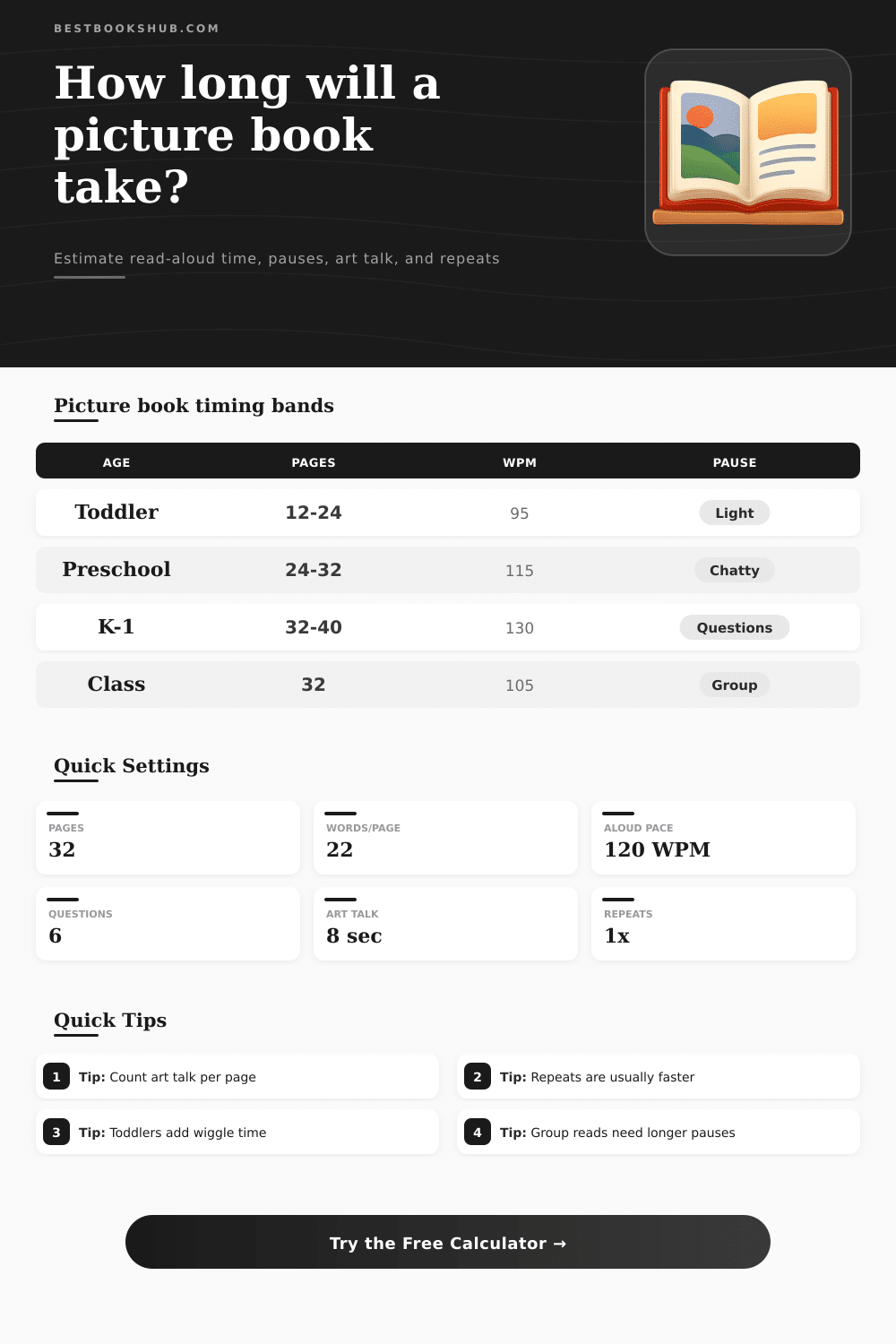
This grid divides the book into page bands so you can see which part of the read-aloud is likely to carry the most time.
| Age or audience band | Typical attention pattern | Timing factor | Use in the calculator |
|---|---|---|---|
| Baby or young toddler | Short bursts, pointing, interruptions | 1.22x interaction load | Best for board books, lap reads, and repeated favorites. |
| Toddler, 2-3 | Frequent naming and page control | 1.15x interaction load | Adds room for naming, turning, and choosing pages. |
| Preschool, 3-5 | Questions and visual prediction | 1.00x baseline | Good default for most one-child picture book reads. |
| Early elementary, 5-7 | Longer attention, richer inference | 0.95x interaction load | Useful when listeners follow the plot steadily. |
| Mixed group or class | Turn-taking and group responses | 1.35x interaction load | Use for library, classroom, and event storytimes. |
| Format | Common pages | Words per page | Timing cue |
|---|---|---|---|
| Board book | 10 to 24 pages | 0 to 12 | Fast narration, but page control and repeats can dominate. |
| Classic picture book | 28 to 40 pages | 12 to 35 | Usually balanced between text, art, and questions. |
| Rhyming read-aloud | 24 to 40 pages | 10 to 30 | Expressive pacing may slow WPM even when words are simple. |
| Wordless picture book | 24 to 48 pages | 0 to 3 | Almost all time comes from picture walk and child narration. |
| Informational picture book | 32 to 48 pages | 35 to 90 | Fact checks, captions, and diagrams often require slower pace. |
| Pause style | Question count | Seconds each | Best fit |
|---|---|---|---|
| Almost uninterrupted | 0 to 2 | 5 to 10 | Sleepy bedtime, quick transition, or familiar reread. |
| Light prediction | 3 to 6 | 10 to 18 | One child answering a few what-next questions. |
| Interactive lap read | 7 to 12 | 15 to 25 | Naming, pointing, feelings, and visual details. |
| Group discussion | 10 to 20 | 20 to 45 | Library, classroom, and comprehension conversations. |
| Repeat mode | Multiplier | What changes | Planning note |
|---|---|---|---|
| Very quick favorite pass | 55% | Child anticipates lines and skips some stops. | Good for one more read before sleep. |
| Normal repeat pass | 70% | Fewer surprises and faster page handling. | Useful default for familiar favorites. |
| Child joins in | 85% | Shared chanting and page pauses keep time up. | Best for rhyming books and refrains. |
| Full reread | 100% | Treats each read as a complete fresh pass. | Use for close reading or group requests. |
| Slot length | Likely book fit | Interaction room | Watch for |
|---|---|---|---|
| 3 to 6 minutes | Short board book or quick favorite | Very limited | Repeats can double the slot quickly. |
| 7 to 12 minutes | Most 24 to 32 page books | Light to moderate | High picture talk may need trimming. |
| 13 to 20 minutes | Classic read with discussion | Comfortable | Good range for preschool and library reads. |
| 20+ minutes | Classroom close read or two books | High | Break up questions so attention stays fresh. |
This matters because when we read aloud from a picture book we’re not just sliding our eyes along printed text. There’s a negotiation in play: how much visual engagement will the page offer? How dense is the text? And how can you hold the attention of this little person (your kid) sitting on your lap? The answer is simple: it depends.
You know that moment in a bedtime story where you’re five pages in and your kid needs a drink or wants to look at the dog again. Suddenly, fifteen minutes have passed. It is not bad luck. It is physics. Most adults assume reading speed is static because that’s how silent reading works. That’s why most grown-ups assume it is. You find a place to sit you open up a book and then… well, you read it. You read at about 1,200 words a minute.
How Long Does Reading Take?
Picture books are a whole other animal. All you has to do is input your word count and page count into our calculator, and it does the rest of the work for you. You won’t have to wonder if that forty page masterpiece will fit into ten minutes before dinner or go right past bedtime.
For example, imagine reading two different books that have equal word counts (both 2,500 words) but very different number of pages: Book One has thirty words per page; Book Two has just ten words on each page. Although both books contain the same number of words, which one will your reader finish first? Why? Because they’re having more fun looking at pictures. The blank space invites them into the conversation.
The fewer words to keep their eyes on, the more likely they’ll look at the illustrations. They’ll point. Ask questions: Why is the bear wearing a hat? And it’s here, here is where we estimate goes wrong; that conversation about the visuals occurs. If you are reading aloud to a toddler, plan for stopping to talk about colors and name things. If you are reading aloud to a preschooler, plan for predictive what-happens-next type questions. The age range you choose in the estimator takes all this picture-time interaction into account.
A baby doesn’t care about the story; they just love the feel of the book. However, an early elementary kid follows the twists and turns in the plot quite closely. And what about repeatability? Kids don’t want a new story. The kids want the same story as last time. That’s where repeat reads matters.
Everyone understands how the second pass through it happens more quickly. The kid knows what’s coming next. He knows how it ends. He skips over all the close-ups of each minor character in the background. If your repeat pass is a normal one, it’ll go at 70% of original time. But when the kid starts filling in blanks and chanting refrains, that time advantage dissapears.
Because now you’re not just doing the read. You’re doing the show, with an audience member who already has the script memorized. And that’s what rereading’s for. If it’s storytime at your library or school, there’s an additional wrinkle. Breaks multiply if you’re working with a group; for example, one kid asks a question and now everyone gets diverted. The dynamic of that group also increase the interaction load even more.
You will want to give them time to settle back down after laughter and take turns with questions. For this reason, among many, the tool lets you adjust the pause seconds up, and provide a wiggle buffer between activities so that you have enough time to move from page to page. Better to be generous different than rushed on those last few pages when someone wants just one more look, and three kids want to go, too.
In the end it’s all about letting yourself get into sync with the kid (and the rhythm of the book). Don’t resist the pauses. Allow them to come naturaly. Though these are benchmarks on our output cards, they’re not hard and fast rules; they’re merely useful guidelines for sequencing your books well.
When attention levels is high, go with the word heavy informational text. When it’s time to channel energy by having kids participate, save the interactive rhyming story for later. Instead of surviving the experience, you get to create a better experience because you know how long a story realy takes. You get to build an experience that fits within the allotted time frame.
You won’t have to cut something off mid-sentence or drag things out so long that people roll their eyes. It makes bedtime a cozy, predictable ritual instead of a chaotic nighttime routine. And what if your kid asks for another read? You would of already know how many minutes to block off for the encore.