🎧 Listening choice lab
Podcast vs audiobook time calculator
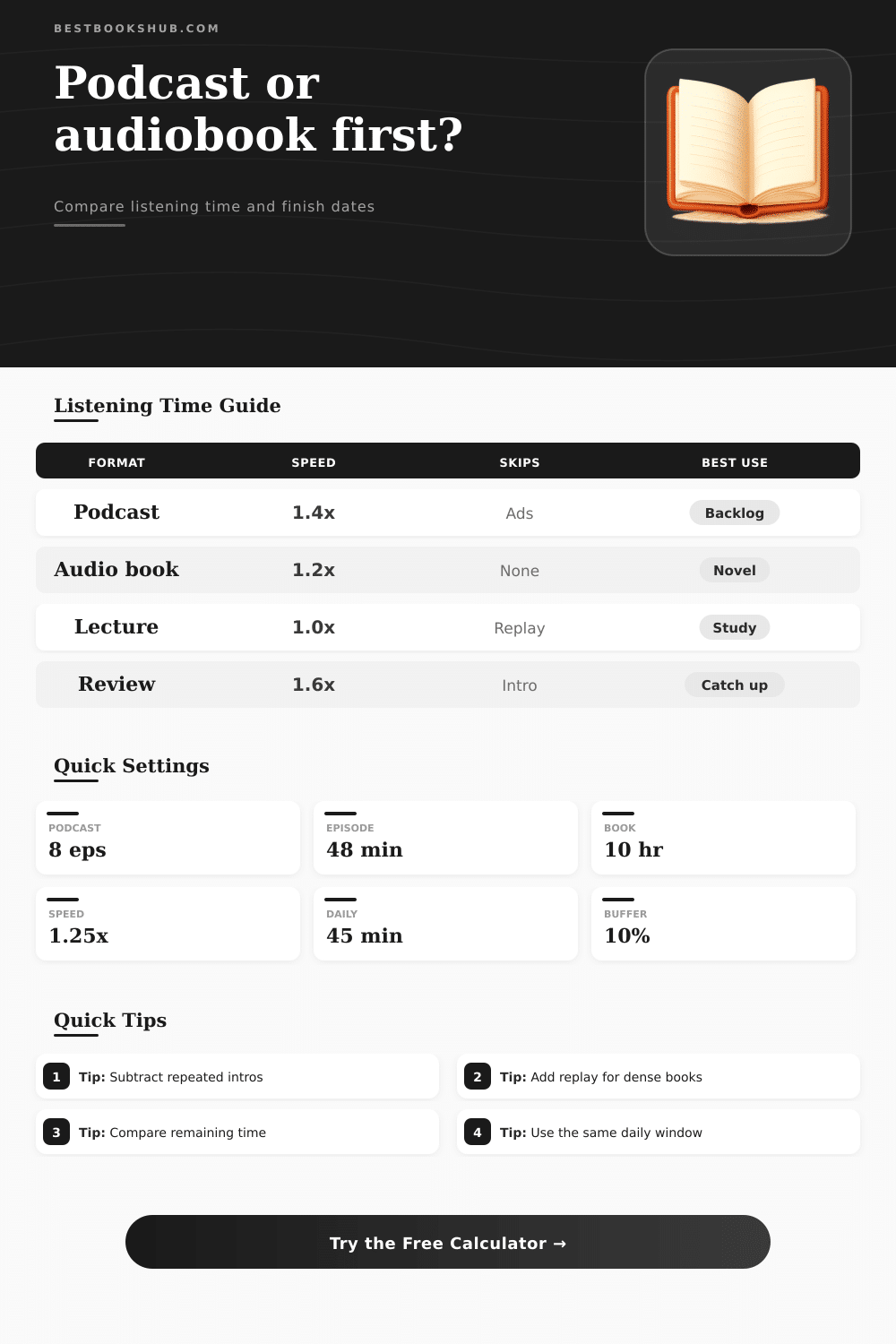
Compare a podcast backlog with an audiobook using playback speed, skipped segments, replay, daily listening windows, buffers, and deadline pressure.
| Listening source | Usual raw length | Adjustment to consider | Calculator input |
|---|---|---|---|
| Interview podcast | 45-90 minutes per episode | Skip ads, intros, and sponsor blocks when predictable. | Skip per podcast episode |
| Narrative podcast | 25-60 minutes per episode | Less skippable material, but faster speeds may still work. | Podcast playback speed |
| Fiction audiobook | 7-14 hours | Usually lower replay load unless names or timelines are dense. | Audiobook replay load |
| Nonfiction audiobook | 8-18 hours | May need chapter pauses or replay for notes. | Replay and chapter pause time |
| Playback speed | Time multiplier | Best fit | Watch point |
|---|---|---|---|
| 1.0x | 100% of listed time | New narrator, fiction, dense content | Most accurate emotional pacing. |
| 1.2x | 83% of listed time | Standard audiobook pace | Good balance for long books. |
| 1.4x | 71% of listed time | Conversational podcasts | May flatten nuance in performance. |
| 1.75x | 57% of listed time | Review, backlog, familiar voices | Replay can erase the time gain. |
| Daily window | Weekly minutes at 5 days | Podcast example | Audiobook example |
|---|---|---|---|
| 20 minutes | 100 minutes | Two short episodes per week | About 1.7 listed hours at 1.0x |
| 45 minutes | 225 minutes | Four to six medium episodes | About 4.5 listed hours at 1.2x |
| 60 minutes | 300 minutes | One long episode most days | About 6 listed hours at 1.2x |
| 90 minutes | 450 minutes | Backlog sprint pace | Most 10-hour books in two weeks |
| Planning factor | Why it changes time | Typical range | Where to enter it |
|---|---|---|---|
| Already heard | Only remaining time should be planned. | 0-80% of source | Already heard fields |
| Replay load | Rewinding for missed details adds real minutes. | 3-20% | Replay or pause load |
| Switching overhead | App changes and queue setup interrupt sessions. | 2-10 minutes | Switching overhead |
| Planning buffer | Protects the plan from skipped days or fatigue. | 5-20% | Planning buffer |
DISCLOSURE: This post may contain affiliate links, meaning when you click the links and make a purchase, I receive a commission. As an Amazon Associate I earn from qualifying purchases.
It’s a time management trap common to all audio listeners: there on the screen are two things you want to listen to, a pile of podcasts or an audiobook that’ll take fourteen hours to get through. Neither one appear likely to be completed by next Tuesday. Of course, we think to ourselves “Oh, it won’t take me long. I’ve got forty-five minutes a day.” And then it doesn’t work out that way because raw doesn’t equal real.
In other words, plans fail in the gap between your app and your ears. Plug in your daily availability and size of your backlog, and let the calculator do the math. You’ll be spared the guesswork when it comes to session counts and conversions. However, understanding what’s driving those input variables is at least as important than the output number.
How to Plan Your Listening Time
Playback speed is the first variable. There’s an individual ceiling we all reach (around one point four times normal speed) after which the voices begin to sound cartoonish. Beyond that comprehension plummets; you’re forced to hit rewind. That is why a replay load percentage is included in both format. While an interview show with a conversational feel may only need a zero percent replay load (you’re listening for vibes, not facts), a dense nonfiction tome might take five or ten percent extra due to the need to rewind complex arguments. People who ignore this replay cost ends up three chapters shy on deadline day.
And what about all the stuff you’re skipping? Podcasts is famous for their tangential host banter, long intros, and sponsor readings. Maybe at some point two five times speed. That cuts it down considerably, but then you manually skip past three minutes of ads in each episode. Yeah, you just ate back half of your speed gain. The page’s reference table illustrates that in practice, different sources has dramatically different skip profiles, so you can’t use the same efficiency strategy for all of them. Trying to treat a well-edited mystery novel like the ramblings of a political talk show is going to waste your time.
There’s another source of friction: Audiobooks. They resist fast forwarding because that feels like skimming; cheating yourself out of experience of the entire narrative. The narrator’s pace might be slightly accelerated, but then you pause to jot down a note, look up a name, or get your head around the next scene. This is where the calculator’s “already heard” fields come into play, as well as the pause between chapters. Log what you’ve already completed and let it adjust amount left by subtracting your listening time. Did you listen to two hours on a long flight? Don’t pretend there’s still ten hours left. What remains will shrink, and maybe change what else (if anything) will fit within your window.
Everything comes back around to daily listening windows. A twenty minute drive to work doesn’t seem like much until you consider that’s just a hundred and fifty minutes over five days a week. Two podcast episodes? Maybe. Or enough time to make a dent in a novel? Barely. By visualizing days available vs. Sessions needed, it compels you to ask: Are you looking to sprint your way through content? Or would you prefer to let it unfold at its natural pace? There is no wrong answer here but there is a right answer for your particular schedule.
The planning buffer is the last piece. You have life happen and you miss a day. Or you have a late meeting. A 10-20% addition to your estimated time helps protect you from falling behind when that inevitability happens. It allows for flexibility while still following a plan instead of schedule. Otherwise, every slight setback becomes a missed deadline. With the buffer, you can breathe.
Audiobooks vs. Podcasts: Which is more interesting? No. Which better fits your available hours? You only have so many hours and even fewer are free. If you don’t count for buffer time, replay time, skip time, and playback speed, you’re guessing. You’re winging. This isn’t math.
But when you do account for those things, you switch from guessing to planning. And then, when the math matches up with your calendar, you can finish without feeling like you just did 10 pull-ups on a barbwire rope made of broken glass. THAT’s how we know it was all worth it, at least once we get to that point.