📜 Poetry Book Title Generator
Generate unique, evocative poetry collection titles based on your theme, mood, and style
| Title Structure | Example | Best Mood | Market Appeal | Avg Word Count |
|---|---|---|---|---|
| Single Noun | Ravine | Contemplative | Literary | 1 |
| Noun + Noun | Salt & Fire | Fierce / Raw | Wide | 2–3 |
| Adjective + Noun | Brief Infinite | Philosophical | Academic | 2 |
| Title: Subtitle | Drift: Poems | Any | Debut | 3–6 |
| Verb Phrase | Learning to Fall | Melancholic | YA / Spoken Word | 3–4 |
| Prepositional | At the Edge of Light | Dreamlike | Literary | 5–6 |
| Paradox / Contrast | Loud Silences | Confessional | Wide | 2 |
| Place Name | This City, Always | Nostalgic | Urban / Contemporary | 3–4 |
| Collection Title | Structure | Word Count | Theme |
|---|---|---|---|
| Ariel | Single Noun | 1 | Identity / Surreal |
| Milk and Honey | Noun + Noun | 3 | Love / Healing |
| The Sun and Her Flowers | Noun Phrase | 5 | Nature / Growth |
| Leaves of Grass | Prepositional | 3 | Nature / America |
| Howl and Other Poems | Noun + Subtitle | 4 | Rebellion / City |
| The Collected Poems | Adj + Noun | 3 | Archive / Legacy |
| Devotions | Single Noun | 1 | Nature / Contemplative |
| Citizen: An American Lyric | Noun: Subtitle | 4 | Identity / Race |
| Wild Geese | Adj + Noun | 2 | Nature / Redemption |
| When My Brother Was an Aztec | Verb Clause | 7 | Family / Culture |
| Word Count | Memorability | Common Use | Examples |
|---|---|---|---|
| 1 word | Very High | Literary presses | Ariel, Devotions |
| 2 words | Very High | Debut & literary | Loud Silences, Wild Geese |
| 3 words | High | Wide market | Milk and Honey |
| 4 words | High | Spoken word / YA | Salt & Storm Rising |
| 5 words | Medium–High | Subtitle variation | The Sun and Her Flowers |
| 6+ words | Medium | Academic / niche | When My Brother Was an Aztec |
Titles that place two opposite concepts together (e.g. "Loud Silence", "Bright Ruin", "Soft Thunder") create immediate tension and intrigue. Readers feel compelled to resolve the contradiction — making them pick up the book.
The best poetry book titles have a natural rhythm when spoken. Say your shortlisted titles out loud. If it flows like a line of poetry itself — with a pleasing stress pattern — it will be remembered. Avoid titles with hard consonant clusters at the start.
| Subtitle Pattern | Formula | Example | Best For |
|---|---|---|---|
| Simple Descriptor | [Title]: Poems | Drift: Poems | All markets |
| Genre Label | [Title]: A Collection | Salt: A Collection | Literary / debut |
| Place Anchor | [Title]: Poems from [Place] | River: Poems from the South | Regional / niche |
| Time Anchor | [Title]: [Year] Poems | Hollow: New Poems | Established poets |
| Lyric Descriptor | [Title]: An American Lyric | Citizen: An American Lyric | Political / cultural |
| Form Label | [Title]: Sonnets | Bright Hour: Sonnets | Form-focused press |
Poetic book-titles can be genuinely wonderful, some of the most impressive and memorable belong to poem-collections. A good title has that remarkable skill to compress the whole feeling of a poetic book in only some words. Choosing a good title is its own creative task.
DISCLOSURE: This post may contain affiliate links, meaning when you click the links and make a purchase, I receive a commission. As an Amazon Associate I earn from qualifying purchases.
One simple way is to take the title directly from a poem that appears in the same collection. Vikram Seth used that method for “All You Who Sleep Tonight“. On the other hand, for something more surprising, Gulzar chose “Apparent Poems“, although such a choice commonly requires explanation in an introduction or foreword to work well.
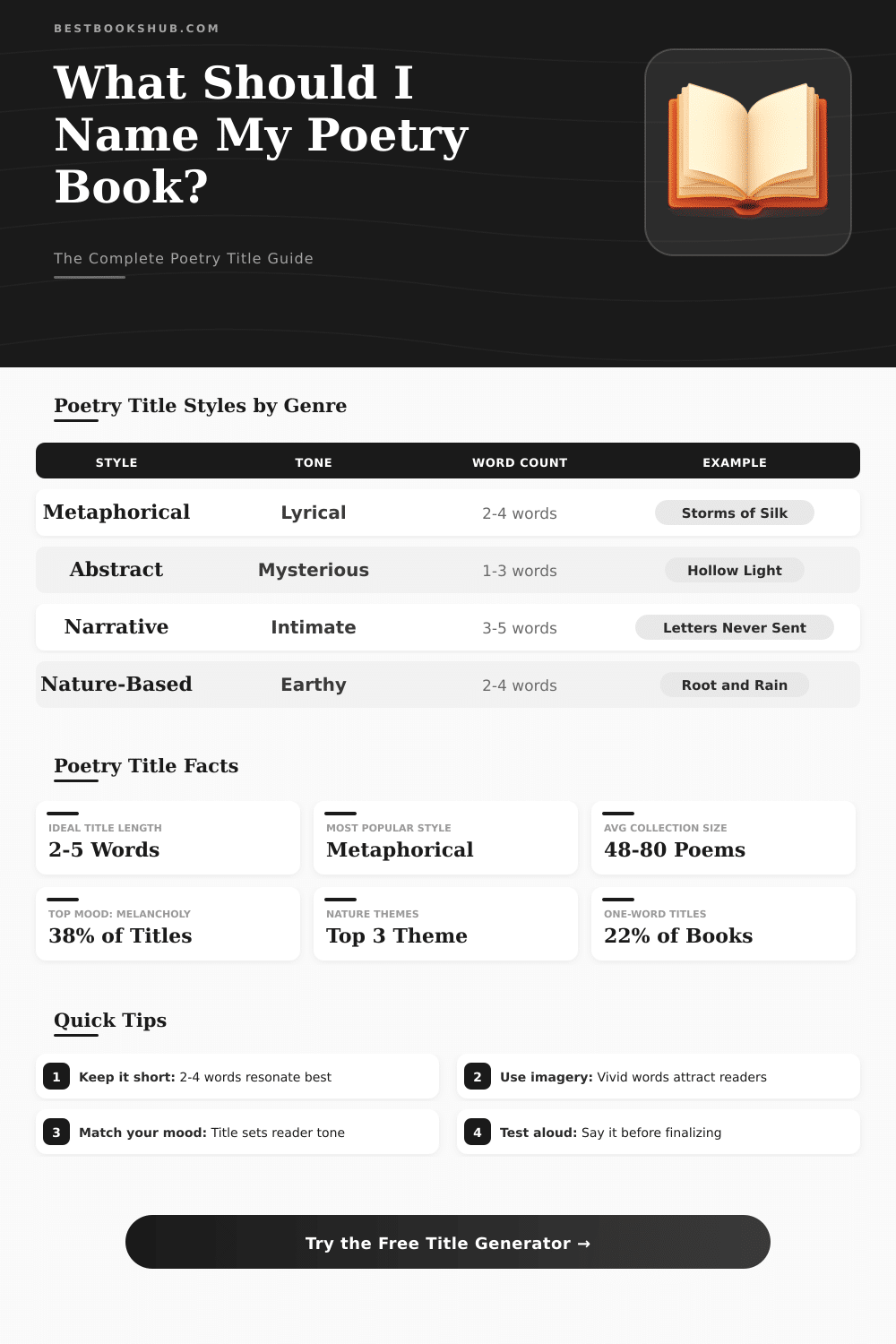
How to Pick a Good Title for a Poetry Book
Simple titles usually sound more natural, because poetry itself builds on simplicity.
Descriptive titles work surprisingly well also. Like “Lunch Poems“, “Irish Poems for Young Folks” or “Japanese Fatal Poems“, they clearly point out what sits inside. This style works especially for readers carefully picking collections.
Some publishers like to add “poems” as a subtitle, which explains exactly what readers receive, although many collections simply skip that step.
Another method that lasted through the years? I like lines form the poems themselves as a base for titles. Shakespeare lines inspired numbers of book titles over the years.
Writing from the 1800s did that well, Thomas Hardy dealt with “Far From the Madding Crowd“, which borrowed its title directly from a poem by Thomas Gray. You would wonder how many famous titles come from poetry like this.
Sometimes titles are born from things that happen in the world of the poet at that moment or something that they themselves experienced. It does not need to be super deep. Consider titles like “Children of War and Anger” or “Time of Bliss“, they seize mood and moments without closing in on one tiny theme.
Because most poetic collections cover several emotional areas, wider and moody titles commonly fit more naturally.
In some poetic titles you sea real art. “Night Sky With Exit Wounds” by Ocean Vuong immediately grabs the attention. “Incorrect Merciful Impulses” by Camille Rankine works likewise.
“Atmospheric Embroidery” by Meena Alexander has that haunting pull. Even books that are not poem-collections sometimes have a poetic name; “In the Evening Calm, Land of Cherry Flowers” makes a good example.
Online generators can make ideas for poetic titles quickly today, if you get stuck. Enter a theme and get custom ideas without signing up. Metaphorical titles work well also, they compare feelings with something grand, like ocean-depths or peaks.
The point is, no real rules exist here. No committee decided what works fora poetic book-title.