📝 Language analysis
Possessive pronoun counter
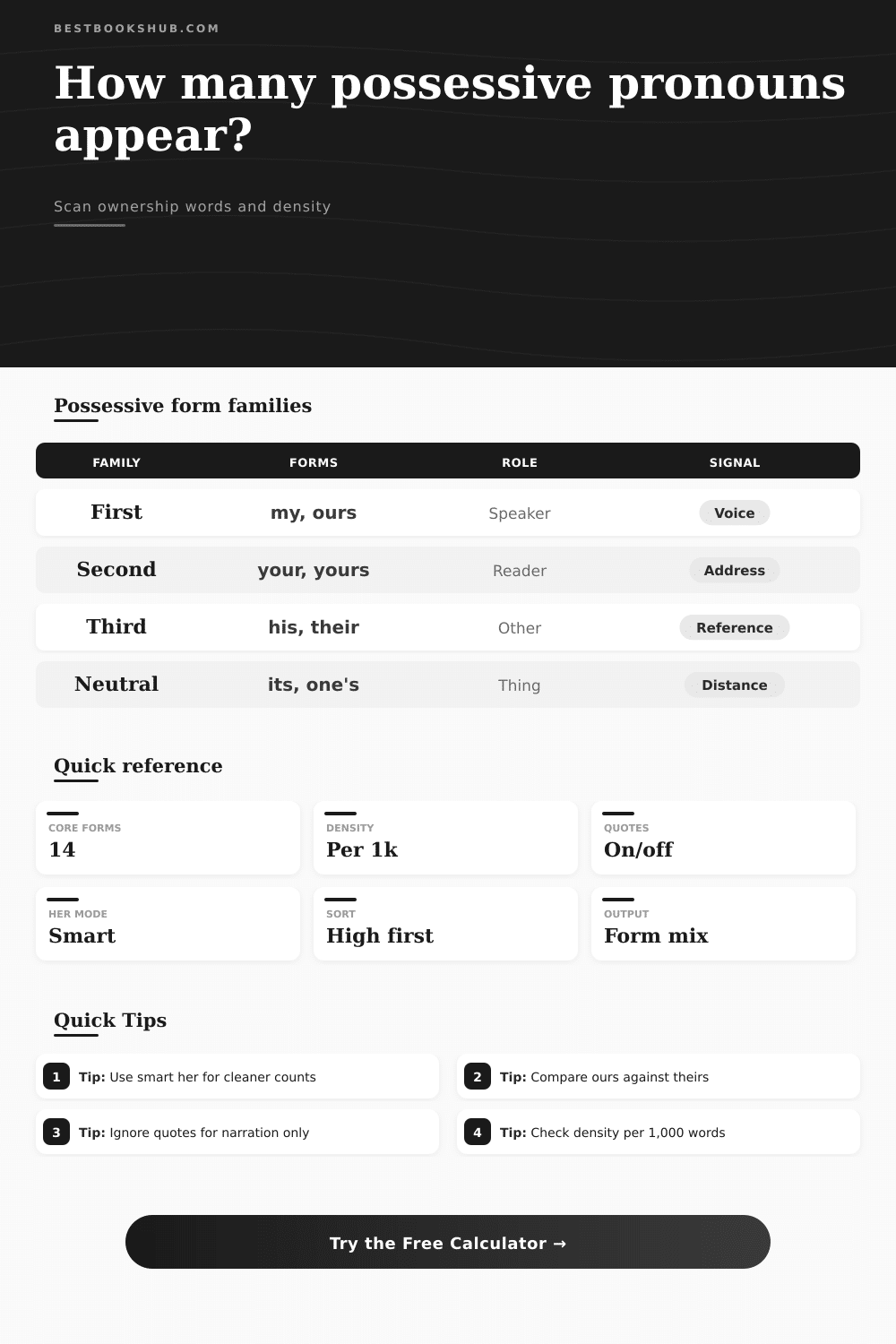
Count ownership words such as my, mine, yours, hers, its, ours, and theirs, then compare determiner forms against independent possessive pronouns.
Paste text or load a preset. This scanner focuses on possessive determiners and independent possessive pronouns, with special handling for ambiguous her.
| Form | Count | Family | Role | Share |
|---|---|---|---|---|
| Run the calculator to fill this table. | ||||
| Family | Determiner forms | Independent forms | Common reading |
|---|---|---|---|
| First person singular | my | mine | Speaker-owned object, memory, or idea. |
| First person plural | our | ours | Shared ownership, group voice, or collective claim. |
| Second person | your | yours | Direct address to reader, listener, or character. |
| Third person masculine | his | his | Ownership by a male referent or masculine noun phrase. |
| Third person feminine | her | hers | Her is ambiguous unless it appears before an owned noun. |
| Third person neutral | its | none | Ownership by an object, animal, place, concept, or organization. |
| Third person plural | their | theirs | Group ownership or singular they ownership. |
| Generic possessive | one’s | none | Generalized ownership in formal or explanatory prose. |
| Density band | Per 1,000 words | Typical signal | Check next |
|---|---|---|---|
| Very light | 0 to 4 | Few ownership claims or sparse personal framing. | Look for missing referents if clarity feels thin. |
| Balanced | 5 to 15 | Normal mix for narration, notes, and practical prose. | Compare first-person and third-person families. |
| Heavy | 16 to 30 | Ownership is doing visible rhetorical work. | Inspect repeated your, our, or their clusters. |
| Very heavy | 31 plus | Possession may dominate sentence rhythm. | Check if nouns can replace repeated pronouns. |
| Edge case | Counted? | Reason | Best setting |
|---|---|---|---|
| its cover | Yes | Its is possessive; it’s means it is. | Strict contractions |
| her notes | Yes | Her before a following word usually marks ownership. | Smart her |
| I saw her | Usually no | Her acts as an object pronoun in this pattern. | Smart her |
| one’s view | Yes | Formal generic ownership. | All forms |
| they’re ready | No | Contraction is not a possessive form. | Strict contractions |
| Sample use | Likely dominant form | Useful comparison | Watch for |
|---|---|---|---|
| Memoir passage | my, mine | First person vs third person | Repeated my before every noun |
| Instructional copy | your, yours | Reader address vs neutral nouns | Overdirected sentences |
| Team note | our, ours | Shared voice vs individual claim | Unclear ownership boundaries |
| Reported scene | his, her, their | Character references by family | Ambiguous her after verbs |
| Formal explanation | its, one’s | Neutral ownership vs human owner | Its confused with it’s |
DISCLOSURE: This post may contain affiliate links, meaning when you click the links and make a purchase, I receive a commission. As an Amazon Associate I earn from qualifying purchases.
Mine holds a different kind of weight for me than mine does. My book is something on my person; it’s something I carry around. But saying it’s mine suggest a boundary.
And writers hardly ever think about the difference between those words until they notice their writing has become clogged up or defensive. If you have to much possessive pronoun use in a manuscript, you likely have an insecure narrator. This narrator is trying to assert control or is worried about their place in the story. It’s that sort of ownership marking that can be the difference between a balanced voice and a grasping one.
How to Use Possessive Words Well
The tool above converts and calculates for you; it knows that there are more words to consider than just theirs, yours, or my. It knows context. Most tools treat every instance as a simple grammatical hit, but this scanner handles the math and conversions for you once you plug in your text. Grammar hit), and you get to do the math yourself: what is the coefficient? What’s the conversion?
That’s important, because some pronouns function as determiners, just labels preceding a noun; and other forms function as independent pronouns. And sometimes those independent pronouns carry emotion, whereas determiners are more functional. The higher your percent of independent shares, the likelier you’re writing about ownership, not just description.
But what about her? Her” could refer to a girl, as in “I saw her.” Or it could show possession, as in “Her coat was beautifull.” A simple counter would fail here. Every time you see the word her, you might have just added another possessive to your word count. But the calculator’s clever little feature aim to fix this problem by glancing at the following word. Does it come after her and appear to be a noun? Count! Is it a period or verb? Probably not. And that’s the trick. It allows for the possibility that a text has many references to women, while not sending off the wrong signal that the text is obsessively owning things left and right.
That’s where most folks go wrong. They read a word and don’t bother to understand the syntax behind it, so they end up cutting out crucial character reference and calling it revision, instead of removing the real possessive gunk.
Another wrinkle: How do you handle quote counts? Conversation is an exchange by nature, and that’s where possessive pronouns live. You got your keys, buddy, I want mine. Put some quoted material into your scan, and watch those density numbers soar. But does that represent your narrative voice? No, it represents the voices of your characters.
Maybe you’d like to remove quotes so you can see how the narrator talks about ownership without having their words interrupted by dialogue. Perhaps instead you want to limit the calculation to just quotes; then you’ll know if your characters is fighting over who owns what more than they should be. That’s an editor’s call, plot dynamics or tone.
The absolute amount doesn’t matter as much as how dense it is. Using “ours” twice in a short note makes me feel you’re being intimate and even communal. Twenty in a thousand-word essay makes me feel you’re delivering a manifesto. That’s why the calculator normalizes it in terms of density-per-thousand-words. Lightly dense means using few “ours,” which sounds cold and distant. Heavily dense means possession rules the rhythm of the sentences, which feels like someone is possessing you.
If you’re writing instruction copy, using “your” too much will address the reader directly (a good thing). But if you’re writing memoir, a highly-dense my can be too close-up for comfort (unless the story itself require that level of focus on the self, as in a story about trauma). Before you know whether the number is good or bad, you must know: What sort of genre are you writing?
On the page itself, the reference table lays it out by family. You can see if your leading owner voice is third person, where your narrator takes notes on what other people is doing. It could be second person, where the narrator tells someone else what they are doing. Or it could be first person, where the narrator says that he, she, or they did whatever it was.
That little change, third to first, say, will let you see if there is a difference in power between characters or just a shift in perspective in a given scene. A lot of writers think they’re observing when really they’re claiming; being able to see how the voices are distributed helps you pick up on that slide. It is a small thing, but it matters.
The last technical challenge is how to handle contraction. When set in strict mode, the scanner distinguishes between the possessive its and the contraction it is. The difference between the two is trivial to many (isn’t?), but it matters for accurate measurement because we don’t want the count of possessive pronouns to be inflated by describing a buildings features. Avoiding this type of error will lead you away from your intended style analysis.
A word counter isn’t enough. You’re trying to measure intent. When I talk about editing for possessive pronouns, I’m not talking about removing every one of them. I’m talking about making sure they work for the story.
If you keep a clean count, you can look back and see when you let go a little too soon, or when you’re clutching on to long. Maybe if you remove ours entirely, or replace some mine with my, it lightens up the sentence and makes it sound truer. Maybe if you add a possessive here and there, something that floated out in the air starts to ground itself in real life. It’s all about finding balance. Make ownership language sound like it was earned, rather than automatic.
And then look through your piece and see how it breaks down. You’re not seeing numbers. You’re seeing invisible lines around your voice, your characters, your ideas. And that knowing is what turns a draft into a polished piece of narrative.