📖 Primary readability lab
Powers-Sumner-Kearl readability calculator
Paste a child-facing passage to estimate the Powers-Sumner-Kearl grade level from sentence length and syllables, then compare the result with primary reading bands.
Load a child-reading sample, then tune sample length, sentence detection, syllable handling, and target band. PSK is most useful for primary passages, not dense adult text.
| Formula part | What it measures | Calculator value | Why it matters |
|---|---|---|---|
| Average sentence length | Words divided by sentences | ASL | Long sentences raise the grade estimate. |
| Average syllables per word | Total syllables divided by words | ASPW | Multi-syllable words raise primary difficulty. |
| Grade equation | 0.0778 x ASL + 4.55 x ASPW - 2.2029 | PSK grade | Outputs an estimated U.S. grade level. |
| Reading age proxy | PSK grade plus 5 | Age years | Helps compare with child-reading bands. |
| Band | PSK grade range | Approx age | Typical passage signal |
|---|---|---|---|
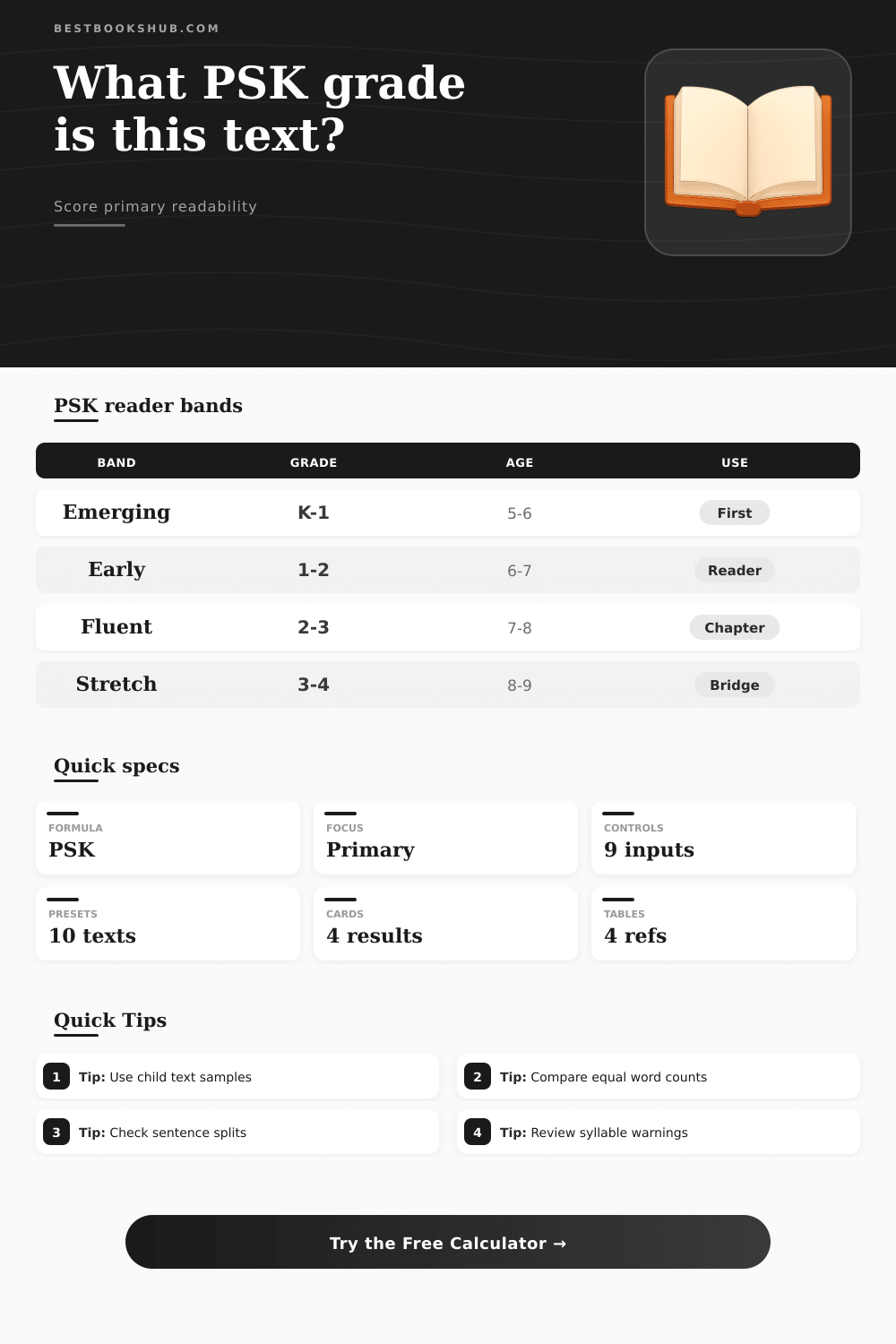
| Emerging reader | 0.0 to 1.0 | 5 to 6 | Very short sentences and mostly one-syllable words. |
| Early reader | 1.1 to 2.0 | 6 to 7 | Simple clauses with familiar two-syllable words. |
| Fluent primary | 2.1 to 3.0 | 7 to 8 | Longer story sentences and some content words. |
| Bridge text | 3.1 to 4.0 | 8 to 9 | Early chapter or informational text with stretch vocabulary. |
| Outside PSK sweet spot | Above 4.0 | 9+ | Use PSK cautiously and compare with another formula. |
| Sample mode | Best use | Strength | Watch for |
|---|---|---|---|
| First 100 words | Opening pages and decodable passages | Fast, standard comparison size | May over-weight introductions. |
| Middle 100 words | Chapter excerpts | Avoids warm-up and ending shifts | Needs enough total words. |
| Last 100 words | Lesson endings or story close | Checks conclusion difficulty | Dialogue may skew sentence length. |
| Custom limit | Short picture-book spreads | Works below 100 words | Smaller samples are less stable. |
| Method | Primary variables | Best range | How to use with PSK |
|---|---|---|---|
| Powers-Sumner-Kearl | Sentence length and syllables | Primary grades | Use as the main check for early-child text. |
| Spache | Sentence length and familiar words | Early elementary | Compare when vocabulary familiarity matters. |
| Flesch-Kincaid Grade | Sentence length and syllables | Broad school text | Use as a broader second opinion. |
| Raygor | Sentence count and long words | Middle grades and above | Use when the passage is beyond PSK range. |
DISCLOSURE: This post may contain affiliate links, meaning when you click the links and make a purchase, I receive a commission. As an Amazon Associate I earn from qualifying purchases.
Before sending any manuscript or even a lesson plan to the classroom, use this Powers-Sumner-Kearl readability calculator. Use it to score primary passages. Check sentence and syllable pressure. Test sample windows. Match texts to child reading levels.
Developed in the 1950s for elementary educators, formula helps you decide whether a text is appropriate for your young reader. Hand a book to a six year old, and watch what happens. One long sentence or one extra syllable can turn delight into frustration.
How to Use the Readability Calculator
The Powers-Sumner-Kearl formula examines two simple signals: average syllables per word, and average sentence length. Then it turns those two things in an estimate of grade level. It’s straightforward math, but it offers insight that is helpful for anyone writing for young readers.
But the meat of the formula lies in its treatment of syllables: words like “dinosaur” or “beautiful” has greater value than words like “run” or “cat.” Because young brains are still hard-wiring their decoding system, every additional syllable requires a bit more working memory. This is what explains how a text may seem easy to you as an adult but feel difficult to a second grader.
By rewarding short texts with little multi-syllable content words, the calculator provides insight into what’s truly difficult about reading: not necessarily understanding individual words, but holding multiple ideas in your head simultaneously before you get to the period. Not only does it account for syllables, then, but also for sentence structure; long sentences requires children to hold several idea while the brain waits for a period to land. Give me short, clean sentences. Give them something to focus on.
What is important is picking your window. I recommend choosing the first one-hundred words versus the middle one-hundred to give yourself a sense for where difficulty may spike or remain steady. Does the beginning of text open with simple language to draw in readers? Does a section near the middle introduce new concepts that raise the score? Are these two sections consistent? That’s what will help differentiate between good revision and guesswork: consistency. It’ll also show you more about the structure of the text.
Apply the same thinking to sentence counting: Do you count every line break as its own sentence? If you do that, a page of mostly dialogue looks like a lot of short sentences. How will you handle punctuation? Your choice will impact the final grade.
There are some little snares in just counting syllables itself. Hyphenated compounds, contractions, and proper names will fool your count if you’re not paying attention. Some of these modes are strict; others create a soft edge that isn’t usually all that noticeable on any given page. Taken over the course of a whole book, though, that can move a manuscript up or down a band.
Early readers can manage a couple of two-syllable friends in their sentences, whereas emerging readers really need very short ones with mostly one-syllable words. As kids head into fluent primary years, they’re ready to take in the occasional stretch word and longer story sentences. Bridge texts falls at the point where chapter books start. They are right along the edge, and you want to match text to the reader’s level.
The other thing about simpler = better isn’t true: sometimes a piece that’s easier will be baby-ish to an advanced kid who’s ready for something more challenging. You want to find the sweet spot: material that is just slightly beyond what they are good at without overwhelming them. Why? It stretches their vocabulary while also building their confidence all in one shot.
Your ear doesn’t go away. The calculator doesn’t replace your ear. It provides data based off your ear. If you read something out loud, and there are places you think a kid’s eye may snag, look at them. Run the numbers and see if it aligns with what you suspect your own ear just heard.
If it does, then you’ve got the text that matches the moment. And that makes a difference in a kid’s reading life.
You should of used this to check for any moddern words that might be difficult. It could of helped naturaly.