📖 Syntax density scan
Preposition Density Calculator
Paste prose, book notes, essays, catalog copy, or study material to count prepositions, measure phrase load, spot stacked links, and compare density by sentence.
Load realistic samples for narrative, academic, review, catalog, instructional, and note-taking prose. Each preset fills every setting and recalculates instantly.
DISCLOSURE: This post may contain affiliate links, meaning when you click the links and make a purchase, I receive a commission. As an Amazon Associate I earn from qualifying purchases.
The calculator matches common English prepositions, applies your scope and quote settings, then scores density, stacking, repeated links, and sentence-level concentration.
Rows sort high-risk sentences first. The flag column marks stacked phrases, repeated links, and dense sentence-level usage.
| Sentence | Matches | Density | Top forms | Flag | Context |
|---|---|---|---|---|---|
| No text analyzed yet. | |||||
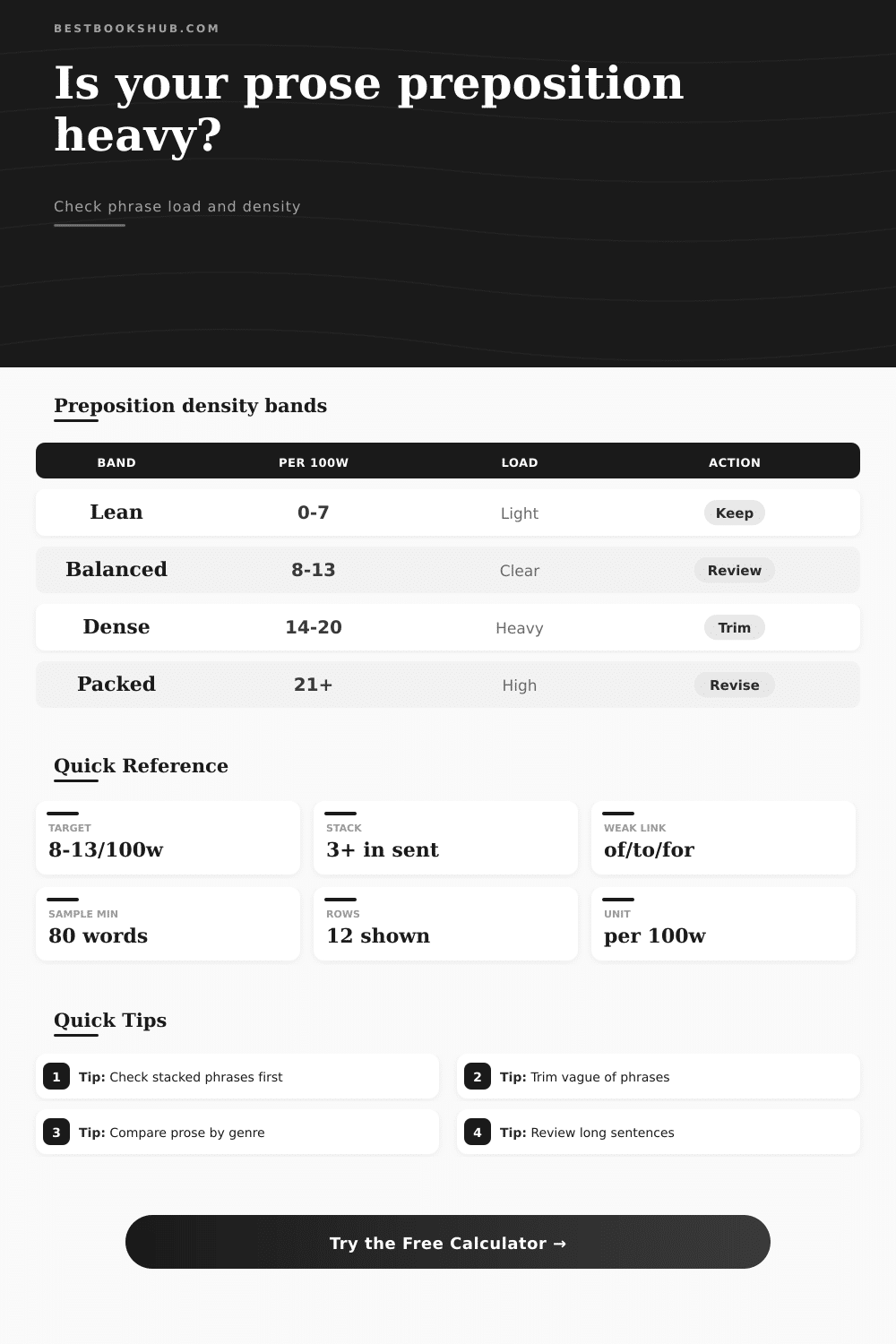
Use these tables to interpret density across prose types, preposition families, and edit priorities.
| Density band | Per 100 words | Common in | Reader effect | First edit check |
|---|---|---|---|---|
| Lean | 0-7 | Headlines, jacket copy, quick notes | Direct and fast | Check missing context |
| Balanced | 8-13 | Reviews, essays, general nonfiction | Clear connections | Trim only repeated links |
| Dense | 14-20 | Academic, descriptive, analytical prose | Layered but slower | Split stacked sentences |
| Packed | 21+ | Legalistic notes, rough drafts, heavy exposition | Can feel buried | Replace of phrases and chains |
| Family | Examples | Typical job | Risk when overused |
|---|---|---|---|
| Place | in, on, at, under, across | Locate objects and scenes | Static description can pile up |
| Time | before, after, during, since | Sequence events and periods | Timeline can feel over-explained |
| Relationship | of, for, with, by, about | Connect ownership and purpose | Vague noun chains become heavy |
| Direction | to, from, into, toward | Show movement or change | Action may sound indirect |
| Compound | because of, in front of | Make multiword links | Long connectors slow sentences |
| Text type | Healthy range | High signal | Best comparison |
|---|---|---|---|
| Narrative scene | 7-14 per 100 words | Location phrases in every sentence | Dialogue versus narration |
| Book review | 8-15 per 100 words | Many about, in, and of links | Summary versus evaluation |
| Academic paragraph | 14-22 per 100 words | Dense of and in clusters | Claim sentence versus evidence |
| Catalog copy | 6-12 per 100 words | Long format and audience phrases | Short blurb versus metadata row |
Prepositions is little words that connect nouns to other elements within a sentence. Prepositions give structure to English language. But too many prepositions can be clutter. Too many prepositions make a paragraph hard to follow. Clearer prose, not heavier prose, is what you’re after.
Preposition count measure how thickly written your text is. They are not vanity metrics. It is more about clarity and rhythm, it is about keeping the reader engaged.
How Prepositions Change Your Writing
Prepositions are tiny little words that most writers don’t see because of there size. However, prepositions are also words with logical meaning. In a sentence with five prepositional phrases, where’s the main verb? What happens to the subject? How does it get pulled out off the action? How does it weaken connections between ideas? Why would you think this sentence was confusing? The calculator show how much weight your syntax carries by how it separates what is important from what is not.
Narrative fiction use fewer prepositions, while academic writing uses more. For narrative fiction, preposition density determines how much we feel different than how much we read. A good novel scene should of have low density. If it’s high, then you’re probably over-describing your setting.
The book was sitting on the shelf in the room behind the door. Better: She grabbed the book.
Preposition Stacking is a big no-no When multiple prepositions line up in a single sentence, it’s called stacked phrases. It’s a chain that slow the reader down. That’s what the calculator do. It flags the sentences with stacking. It highlights where the stacking covers up meaning.
Maybe you’re so focused on content that you don’t notice the repetition. The machine reads for structure and it discovers weak links that turn verbs passive.
What does measurement scope mean? The core prepositions (at/on/in) is pretty common. Then there are their extended forms (e.g., in spite of and because of). Those are heavier, they further slow down the sentence. When editing for speed, attend to the core set first. When polishing for academic precision, think broadly. That lets you see how complex your sentences are. This is a question of tool selection.
Another thing: how do you handle quotes? Fiction dialogue is not prose. It’s different than short, staccato bursts of characters talking. Prose narration use longer sentences. Look at them side by side and the distinction become fuzzy. The average length of sentences blurs the gap. Skip over the quoted material and look only at the narration. That’ll give you an idea whether your writing slows down with description. If so, then cut back on narration but leave the character voice intact.
But don’t go at them with a cleaver and cut out every preposition. In English, prepositions indicate place, time, and relationships. They’re needed to hold things together. The question is: How much? Too few, and you’ve got a saggy structure; too many, and you have a structure weighed down by them. For most ordinary writing, the sweet spot is in between. The band where there’s just enough preposition to connect things but not so much as to hide the topic.
When you’re deep in the thicket, swap words or phrases for simple words. Instead of a member of the team, say the player. Instead of in the room, say inside. These are little tweaks and it has a big effect.
These are the kinds of numbers you see as clear bands on reference tables. These help you understand the results within their context. Ten per hundred words might make sense in a book review. Not so much in a headline. In what context? The tool allow you to find the outliers. From there, apply your judgment: do the outliers support the story?
Sometimes a dense sentence signal complexity or confusion. Other times, it’s simply clutter. Trim off the extras. Let the strong bits stand. Your readers will thank you for making it clearr.