📝 Grammar tense tool
Present tense sentence counter
Paste a draft, review, lesson note, or manuscript sample to count present-tense sentences, tense shifts, auxiliary patterns, and likely revision flags.
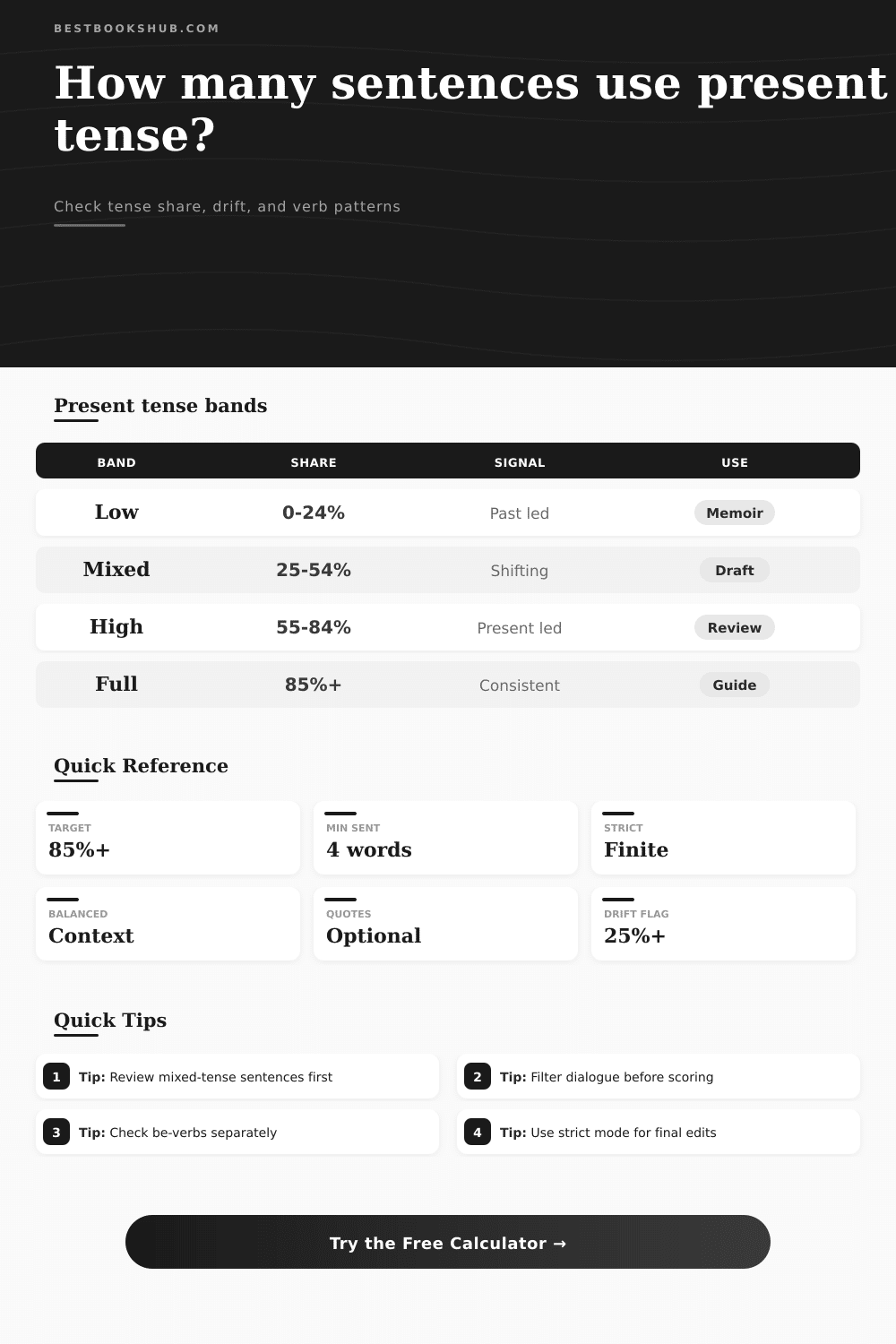
| Band | Present share | Likely pattern | Editing read |
|---|---|---|---|
| Low | 0-24% | Past-led passage | Present tense is incidental or quoted. |
| Mixed | 25-54% | Split tense | Check whether shifts are intentional. |
| High | 55-84% | Present-led passage | Revise isolated past-tense drift. |
| Full | 85%+ | Consistent present | Good for guides, analysis, and summaries. |
| Signal type | Examples | Counter role | Common caution |
|---|---|---|---|
| Simple present | reads, argues, shows | Strong present evidence | Plural nouns can mimic verbs. |
| Present be | am, is, are | Useful with subject context | Definitions may overuse be. |
| Progressive | is reading, are moving | Strong current action | Can include description, not action. |
| Present perfect | has shown, have noted | Present-linked past | Still counts as present aspect. |
| Writing type | Typical tense | Target share | Reason to check |
|---|---|---|---|
| Book review | Present | 70-95% | Reviews often discuss what a book does now. |
| Plot summary | Present | 85-100% | Summaries usually use literary present. |
| Memoir note | Past | 0-30% | Present may mark reflection or quote. |
| Study guide | Present | 80-100% | Definitions and instructions stay current. |
| Mode | Counts strongly | Reduces | Best use |
|---|---|---|---|
| Strict | Finite verbs | Weak be-only clues | Final grammar edit |
| Balanced | Verb clusters | Ambiguous fragments | General drafting |
| Inclusive | Present-like phrases | Few borderline cases | Early review |
| Editing | Present plus drift | Quote noise | Revision triage |
Simple present
Uses base or third-person verbs to state current action, repeated action, analysis, or general truth.
Present progressive
DISCLOSURE: This post may contain affiliate links, meaning when you click the links and make a purchase, I receive a commission. As an Amazon Associate I earn from qualifying purchases.
Combines am, is, or are with an -ing verb to show action happening now or around the current scene.
Present perfect
Uses has or have with a participle to connect earlier action to the present argument or moment.
Tense drift
Appears when present, past, and future clues compete inside a sentence that should probably stay consistent.
You know that sinking sensation when you are writing in present tense, but then you find half your page marked up with “tense?” queries from your editor. Everyone gets it. Write a book, film, or software review, and suddenly your brain slip back into the past because that’s how we tend to remember events. You have to wrestle control over this single grammatical thread. This is difference between a clear-cut review and a muddy one.
How do you see the forest for the trees? Don’t just go through the draft checking verb by verb. This is why glancing at total percentage of sentences written in present tense can be useful. Suddenly, there’s no more guesswork; there’s something to serve as a starting point to judge if indeed your draft sounds current. But there’s a tool (above) to count them for you, saving you all the dull business of circling each and every verb yourself.
Why You Should Check Your Tense
More important then the actual tally is what the tally tells you: the pattern it makes. If you’re plotting out a story, ideally, you’d like to have a large percentage of present tense; an eighty-five percent or higher are not unreasonable. That’s the so-called literary present, the rule that brings the action on the page to life. If you’re working on a memoir, however, then a low percentage are actualy the correct target. The counter alerts you to which band you’re in, and whether or not your intention is being matched by your execution.
It’s about matching your goal with your grammar. This also applies to quoted dialogue, one of most difficult elements to deal with in all of this. In real life, people tend to talk in whatever tense comes naturaly to them at any given time (and it’s usually either the past or future). Counting those quotes towards your present-tense tally will throw things off. Fortunately, the calculator allow you to keep quoted material aside and view how tense your actual storytelling voice really is.
This is important because unlike exposition, whose grammar is entirely under your control, dialogue is not. It’s coming from someone else’s mouth, so you must distinguish between the narrator and person speaking. Sometimes you may find yourself thinking your writing is inconsistent when in fact characters are behaving realistically.
And then there’s the matter of the be-verbs: is, am, are, and their kind, who contributes very little in terms of action while inflating your present-tense count. Even though it is technically in the present tense, the sentence “the book is good” lack any real energy. The tool lets you set its sensitivity to these forms. Lowering weight of only-be-sentences shows a more accurate picture of your verb use. It helps reveal your lazy phrasing, which hides behind present-tense markers. It’s a slight tweak, but it alters the character of your feedback. You begin noticing whether your present tense is used to move your story along or merely as a filler.
The other silent killer is tense drift: slipping from present tense into the past without realizing it, because you began the paragraph in one tense. Even though the reader might not be able to explain why, he will feel it like a jolt. These mixed sentences flags this for you, showing a map of where the shifts happen so that you can go back and smooth them out. This is particularly useful if you’re writing instructionally, such as in an academic piece; consistency builds trust. For instance, imagine you are describing how something works and then you switched to the past tense. Sounds like it doesn’t work anymore, doesn’t it? That’s a little thing, but it matters for credibility.
When most people write, they ignore the larger picture, until it’s too late. They work on individual sentences and fail to see them as part of the whole. Look at total data. What does it tell you about yourself? Maybe you find that you use the past tense to often in one section. Or maybe all those present perfect patterns is cluttering up the writing. You’re not aiming for perfection here; you’re aiming for purpose. You would of wanted each change in tense to be a deliberate decision, rather than an error. When you see the pattern, you know what to do. Then you can adjust the course. Your eye may deceieve you, but the numbers don’t lie.