📨 Agent submission desk
Query letter length checker
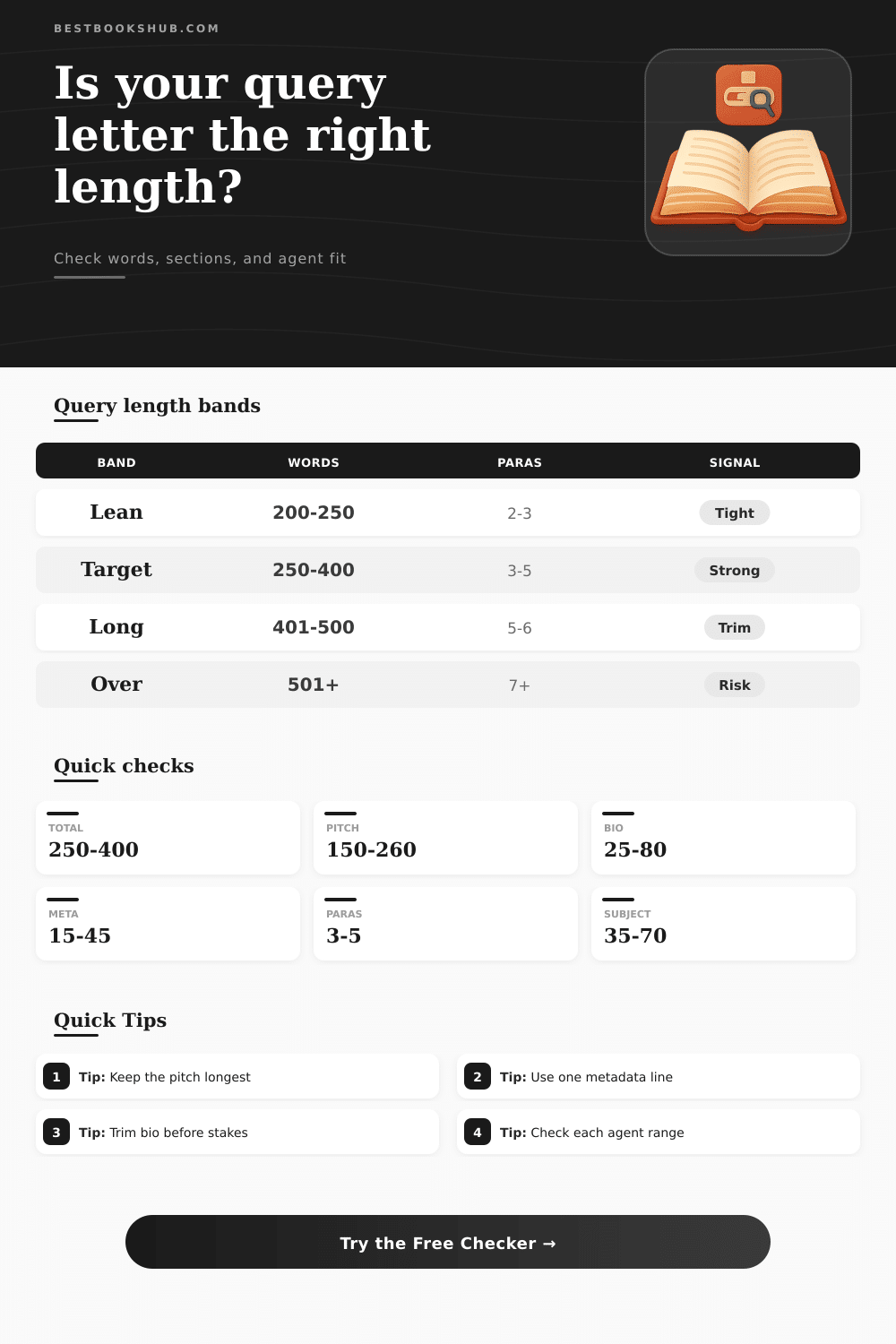
Count total query words, paragraphs, pitch, bio, metadata, and optional email subject length against practical agent guideline bands with clear over or under flags.
Load a realistic query shape, then paste your own letter and tune the guideline band to match a specific agent's instructions.
DISCLOSURE: This post may contain affiliate links, meaning when you click the links and make a purchase, I receive a commission. As an Amazon Associate I earn from qualifying purchases.
The cards update after every calculation so you can see which part of the query is creating length pressure.
Use these planning bands, then defer to the exact instructions on the agent's submission page when they provide one.
| Overall band | Total words | Paragraphs | Length signal |
|---|---|---|---|
| Very lean | 150-200 | 2-3 | Works for form boxes, but may lack pitch detail. |
| Common target | 250-400 | 3-5 | Enough room for pitch, metadata, and a short bio. |
| Long query | 401-500 | 5-6 | Can work only when guidelines allow a broader letter. |
| High risk | 501+ | 7+ | Usually needs compression before sending. |
| Query section | Typical words | What belongs there | Overrun cue |
|---|---|---|---|
| Pitch | 150-260 | Hook, protagonist, conflict, stakes, choice. | Too many side characters or setup sentences. |
| Metadata | 15-45 | Title, genre, audience, word count, comps. | Multiple comp explanations or market caveats. |
| Bio | 25-80 | Relevant credentials, publications, platform. | Unrelated details or full resume language. |
| Courtesy | 5-25 | Greeting, personalization, thanks, signoff. | Long praise or repeated personalization. |
| Guideline profile | Total band | Best for | Editing priority |
|---|---|---|---|
| Tight agency | 200-300 | Agents asking for a brief query or form response. | Cut bio first, then compress setup. |
| Standard query | 250-400 | Most email query letters without special constraints. | Keep the pitch around two thirds. |
| Expanded package | 300-450 | Nonfiction, platform-heavy memoir, requested detail. | Protect clarity while trimming repetition. |
| Form box | 150-250 | Small submission portals with strict field limits. | Use one pitch paragraph and minimal bio. |
| Subject pattern | Character target | Good contents | Risk signal |
|---|---|---|---|
| Simple query | 35-55 | Query plus title and category. | Missing title or genre. |
| Requested pages | 45-70 | Query, title, genre, requested material. | Reads like a full pitch. |
| Referral | 50-85 | Referral name plus core query details. | Referral crowds out title. |
| Form portal | 0-40 | Use only if the portal asks for it. | Duplicate fields already supplied. |
Before you submit, run it through a query letter length checker like this one: https://querylettercheck.com Check the number of words, the number of paragraphs, and how well it hits their guidelines. You can also see if you’ve got enough of a pitch, bio, metadata (subject line) to make a go of it. It will help you confirm all aspects of your letter are set up for the recipient as well as meeting certain requirements or fitting into certain parameters.
Every day, an agent opens her inbox to a flood of queries. Subject lines and opening paragraphs all blur together. Then, she silently filters them into yes, maybe, and no piles.
How to Write a Good Query Letter
Length. Your query is either too long or too short. If it’s too long, the reader’s eyes glaze over before she gets to the heart of what you’re offering. If it’s too short, your story sounds underdeveloped. There is a sweet spot, but it’s not a one-size-fits-all magic number. It changes depending on agency size, genre, and whether the submission come in a rigid online form or an email. This is part of why knowing the shape of a query is more important than trying to hit some random number. Those variables affect how the pitch is received. Know how they interact.
It makes sense that most writers spend all of their effort on the pitch itself: that’s the bit with the hook, the protagonist’s dilemma, the stakes that ought to make the agent lean in. But nobody seems to notice the quiet little lines around the edges… The bio paragraph, the metadata, those swells up like nobody’s business. You start explaining why your comps are perfect, or how you’re positioning this in the marketplace, and a title, genre, word count and two comp titles can balloon from a nice and crisp twenty words into a long seventy. Paste the whole letter onto the calculator, and it sorts out those distinctions for you; that’s where the real pressure lies.
When you check these in isolation, you may find that it’s tempting to let the bio grow beyond eighty words. This is no big deal, but now there’s even less space for the agent to learn about your story. You may also find that the pitch sound a little lean. It’s all about pinpointing areas to cut down.
The story itself is told through the paragraph rhythm. White space is expected by agents. Most standard queries read naturaly at three to five paragraphs. That is the paragraph-rhythm equivalent of a short conversation: hello, some background, main pitch, a little bit about your creds, and goodbye. A letter that runs beyond six paragraphs begin to read like an essay. The eye grows weary, the urgency fades. You wait until you recieve the rejection email with a form-letter note saying something like “not quite right for our list.” It’s the part that many writers miss, until they get the form-letter email. Keep it within this structure; it will make it readable while keeping the agent engaged.
Some manuscripts requires more space than others. Because the sample pages shoulder the burden, a picture book query can do its job in fewer than two hundred and fifty words. For other types of manuscripts (especially nonfiction or memoir that requires a large platform), there’s often an urge to include more real estate for market framing and credentials. There’s a way to flip back and forth between those expectations; no longer comparing apples to elephants, thanks to the tool.
If an agency says they want the letter pared down, don’t assume they’re rejecting your idea; sometimes a tight agency specifically requests briefer letters. That’s them protecting their own reading time, precisely why the bands exist. Adjust to match the stated preferences of the agency and the kind of manuscript you have.
Another hidden element is the subject line. It conveys both category and title, but only allows for thirty-five to seventy characters before it gets chopped off in email preview panes. Longer than that? It looks desperate and spammy. The more polished ones read effortlessly. They are actually the result of thoughtful editing, similar to how you write a strong bio. You cut out personal details to keep only what is most relevant to the book and your expertise, such as the publishing credentials that link back to the work. Because this is what the agent sees first, make sure your subject line says something short and sweet.
The blunders fall into familiar categories. The author hides the hook behind excessive set up. They tack on unrelated life details in the bio. Repeats what will be obvious from reading his metadata. Or just flat out ignores the specific agency posting requirements and sends all three hundred and fifty words to everybody, as if there were no difference between them.
Learning what to trim first when the entire piece exceeds word count is where the true discipline comes in. It’s rarely the part with the emotion at its center. Save the stakes; cut the throat clearing. Make sure you’re prioritizing your narrative core above extra details.
And finally, length isn’t about conforming. It’s about confidence in the story and respect for the reader’s attention span. The beauty of getting it right is that you don’t see the letter anymore, all you see is the idea shining through. Before you click send, that’s the quiet victory every writer is hunting down. Proper formatting should of be viewed as a way to reach a quota; it’s a way to highlight your story.