📖 Citation and dialogue lab
Quotation density calculator
Paste a passage, choose the quote detection rules, and measure how much of the text is carried by direct quotation, block excerpts, and attributed quoted spans.
This tool counts text inside quotation marks and optional block quote lines. Use it to compare draft balance, citation load, and dialogue intensity across similar samples.
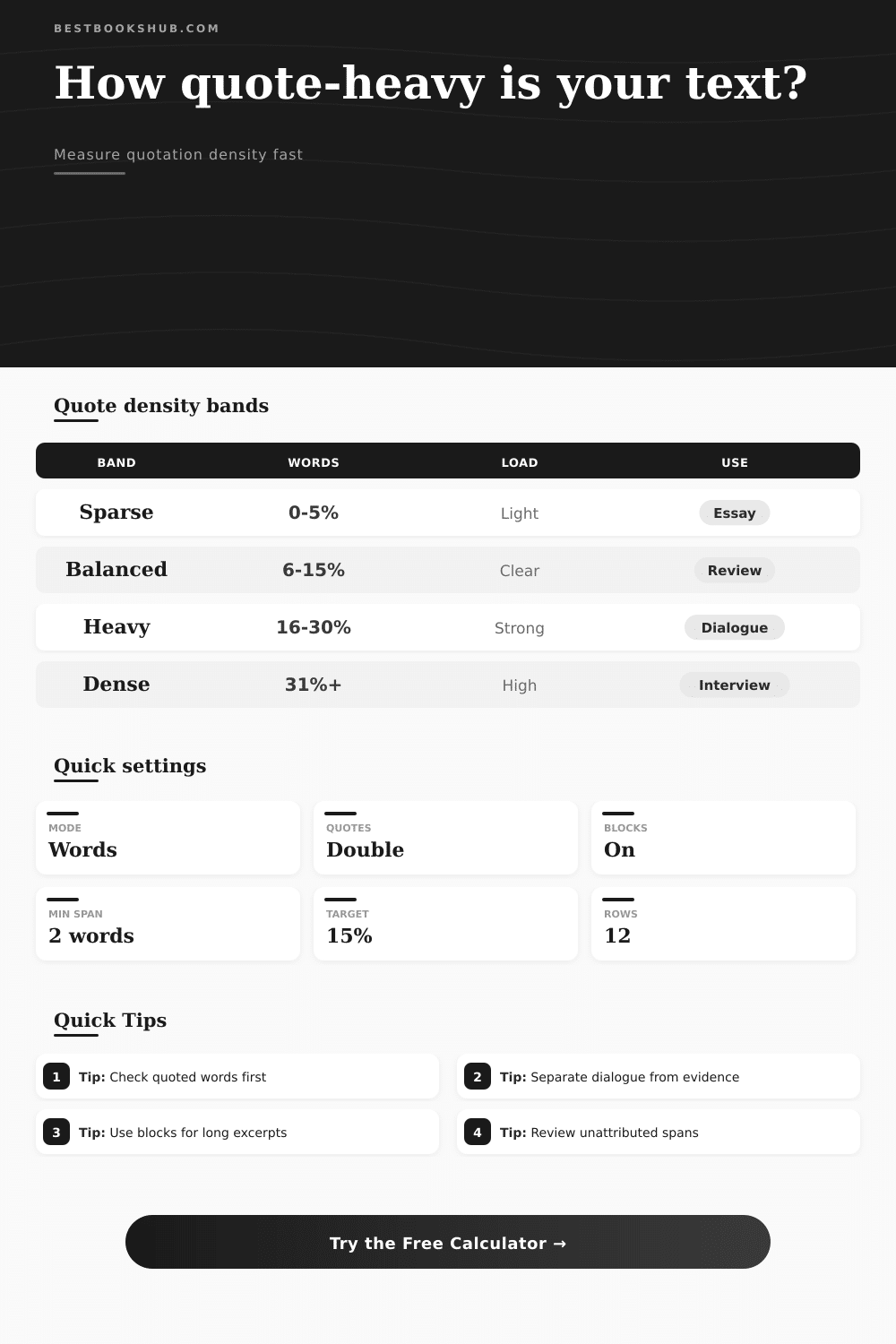
| Density band | Quoted-word share | Common signal | Revision check |
|---|---|---|---|
| Sparse | 0-5% | Mostly summary or analysis | Add textual evidence if the passage makes interpretive claims. |
| Balanced | 6-15% | Evidence supports original commentary | Keep transitions and source framing visible. |
| Heavy | 16-30% | Many examples or dialogue beats | Check whether quoted material is explained after use. |
| Dense | 31%+ | Interview, transcript, or overquoted analysis | Condense long excerpts unless the form requires them. |
| Writing context | Typical target | Span length | Useful setting |
|---|---|---|---|
| APA-style student essay | 5-15% | Short evidence phrases | Double quotes, 2-word minimum, attribution window 80. |
| Literary review | 3-12% | Brief excerpt snippets | Double quotes, all words denominator. |
| Critical analysis | 8-20% | Medium cited phrases | Count block quote lines if excerpts are set off. |
| Dialogue-heavy fiction | 25-60% | Many short speech turns | Double and single quotes if nested speech matters. |
| Interview transcript | 40-80% | Long answer spans | Block lines on, spans preview set high. |
| Teaching handout | 10-30% | Examples and model lines | Content-word denominator can clarify load. |
| Metric | Formula idea | Best use | Limit |
|---|---|---|---|
| Quoted-word density | Quoted words divided by denominator | Main balance check for essays and reviews | Depends on quote detection settings. |
| Span count | Each paired quote or block run | Find choppy quotation patterns | Short dialogue turns can inflate it. |
| Attribution coverage | Spans near source verbs divided by spans | Spot unsupported or floating quotations | Cannot understand source context. |
| Quoted sentence share | Sentences touched by quotes divided by sentences | Shows how widely quotes spread | Sentence splitting is approximate. |
| Detection option | Counts | Skips | When to choose |
|---|---|---|---|
| Double quotes only | Standard direct quotations | Single-mark emphasis | Most academic and manuscript drafts. |
| Double and single quotes | Nested speech and British style | Unmarked block excerpts | Dialogue scenes or UK-style samples. |
| Block quote marker | Lines beginning with > | Indented excerpts | Markdown notes, classroom drafts, web copy. |
| Indented blocks | > lines plus leading spaces | Inline quotes only if quote marks off | Copied drafts with set-off excerpts. |
DISCLOSURE: This post may contain affiliate links, meaning when you click the links and make a purchase, I receive a commission. As an Amazon Associate I earn from qualifying purchases.
You begin an essay confidently, without knowing how to speak in your own voice. Because you believe piling quotes on top of quotes will make you sound smarter, you fill page after page with direct quotations. More often then not, this results less from malice than from a lack of awareness. You are trying to show that you have done the reading. You attempt to hide your own interpretation behind words of others. Intent is seldom an issue; it’s always execution.
If you’ve buried your own analysis under too many quotations, you aren’t leading the reader anywhere; you follow the path already laid down by others. Quotation density isn’t a matter of style; it’s a measure of structure. This is something most writers guess at. They has a sense of when their page is too full of quotes but can’t put a number on it.
How to Balance Quotes in Your Essay
And that’s where our quote calculator comes in; plugging a few numbers in will run the math for you and turn your vague intuition into concrete percentage points. What’s the ratio of quoted material to your total text? How many attribution signals is there? Does it include block excerpts? In the end, it’s about finding the right balance, not maximizing the number of citations and not hitting zero percent, since some evidence are needed.
The sweet spot is totally dependent off the piece you’re writing: A dialogue-heavy scene from a novel will have a different texture than an interview transcript or an academic essay. And consider denominator. All those words include everything: your setup sentences, your transitions, and your closing thoughts. By all words, the tool tells you about the reader’s experience of actualy reading what you wrote.
Switching to just content words will remove the grammatical glue that binds your sentences together. Depending on whether your own writing tend to be wordy or not, this can either lower or raise your apparent load in an artificial way. It doesn’t matter much, but when comparing two version or sections it starts to add up. That’s where table on page comes in handy.
It breaks it down by genre. In general, essays tend toward the well-balanced band (six-15 percent quoted material). That means there’s sufficient text to back up what you’re saying while still leaving room for your own insights. For review-type work, which has more of an evaluation role than explanation, that number may creep downward yet again. On the other hand, if you’re doing something like dialogue, then thirty percent is par for the course.
Five percent quote density in a conversation would make you look silly and all your characters would sound as though they was narrating their conversations internally instead of actualy having one. The context matters. Most writers overlook another layer of stuff called attribution coverage. This tells you how close your quotation marks are to the word used to show who said it (argues, writes, recalls).
An orphaned quote… A quote just hanging there in space. Pulls the reader out of source and requires them to expend additional energy trying to recall who said what. Low attribution + high density = bad combo. If you’ve got lots of good sources but no frame for them, then they shouldn’t be part of your writing yet.
Don’t get fixated on the decimal point. The numbers are guidelines, not legal statutes. It’s okay if you have a little bit too much density. Just make sure to explain each of your quotes in detail after you quote them. The error is when you let the quotes drive the car and only comment on the view from the passenger seat.
Read through your previews. Glance at gaps where it feels like you’re leaving out parts. A bunch of small, unattributed snippets? Paraphrase some more; quote some less. Your writing is a conversation between you and your sources. Who’s doing most of the talking? Hear it with the density calculator.
1) Set the sliders to fit your project. 2) Paste in your draft. 3) Let the numbers settle. 4) Go back and edit till it sounds right on the page. Your argument should of lead, not follow.