Quotation Mark Pair Checker
Paste manuscript text to test paired quotation marks, nested dialogue, apostrophes, and mixed quote families.
📌Editing presets
🔍Quote scan controls
📊Checker spec grid
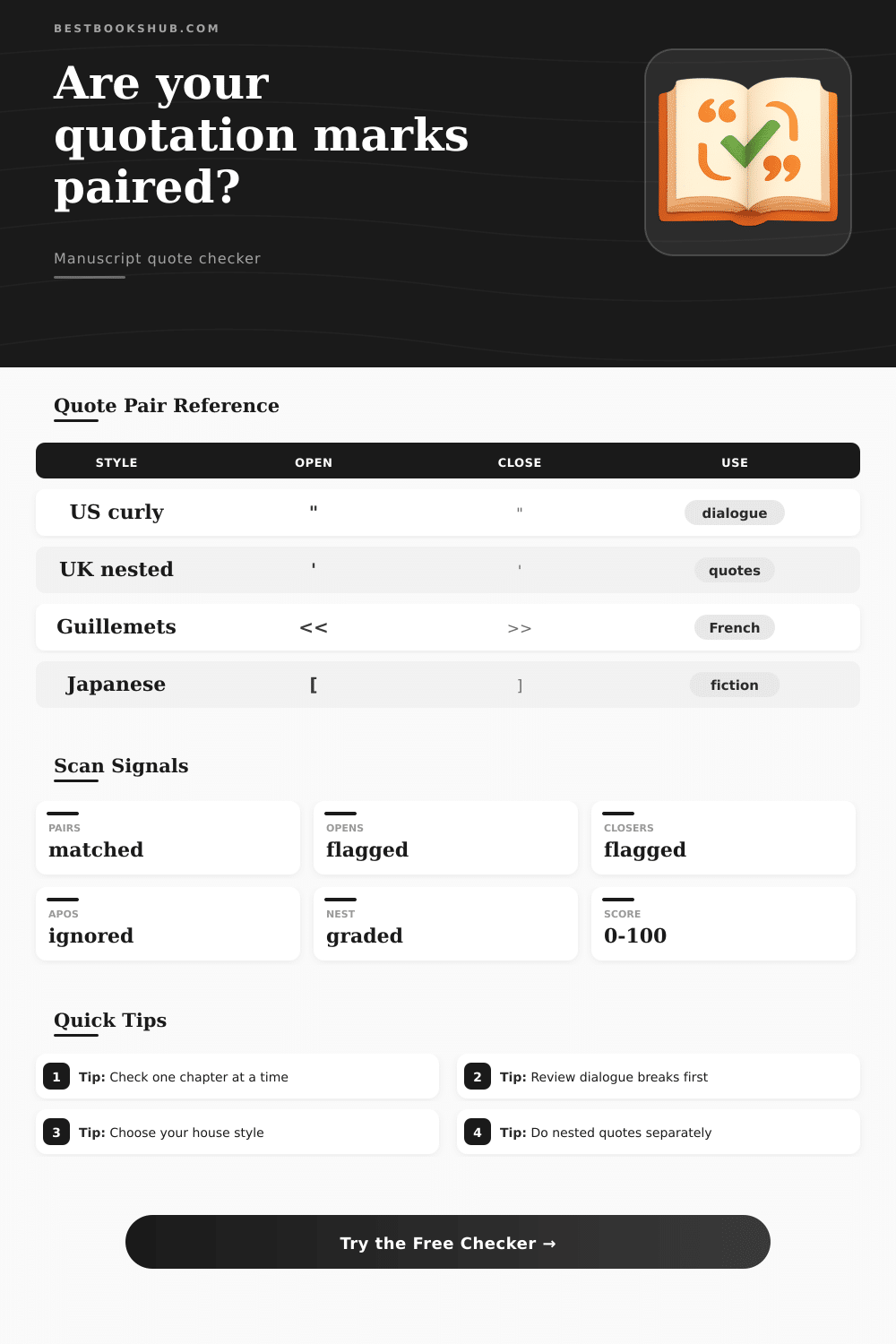
📘Quote family reference
| Quote family | Opening mark | Closing mark | Best use in manuscripts |
|---|---|---|---|
| Curly double | “ | ” | Primary dialogue in common US fiction style. |
| Curly single | ‘ | ’ | Nested quotation in US style or primary quote in UK style. |
| Straight double | " | " | Drafts, plain text exports, and markdown manuscripts. |
| Guillemets | « | » | Translated text that uses angle quotation pairs. |
⚖Comparison and style grid
| House style | Outer quote | Inner quote | Checker behavior |
|---|---|---|---|
| US curly | Double curly | Single curly | Flags reversed nesting and mixed straight marks. |
| UK curly | Single curly | Double curly | Allows apostrophes inside words without treating them as opens. |
| Straight only | Straight double | Straight single | Pairs symmetrical marks by stack order and context. |
| Mixed allowed | Any supported pair | Any supported pair | Scores only balance, orphan closers, and impossible nesting. |
🚦Issue severity table
| Signal | What it means | Penalty | First fix to inspect |
|---|---|---|---|
| Open quote debt | An opening quotation mark was never closed. | High | End of paragraph or interrupted dialogue. |
| Orphan closer | A closing quote appears before a matching opener. | High | Sentence start, pasted citation, or deleted speaker tag. |
| Mixed family | Smart, straight, or angle marks appear in the same role. | Medium | Paste boundaries from different editors. |
| Apostrophe collision | A single quote may actually be punctuation in a word. | Low | Contractions, possessives, and decades. |
📝Dialogue pattern reference
| Pattern | Example shape | Pair test | Common false alarm |
|---|---|---|---|
| Single speaker | Open, sentence, close | One opener and one closer | Closing mark placed after attribution punctuation. |
| Nested speech | Outer quote, inner quote, inner close, outer close | Stack closes in reverse order | Inner quote style copied from another house style. |
| Multi-paragraph speech | Open every paragraph, close only final paragraph | Allowed in chapter mode | Paragraph mode will flag intentional carryover. |
| Quoted title | Short quoted work inside prose | Same pairing rules | Apostrophes near title quotes look like single closers. |
💡Editor notes
DISCLOSURE: This post may contain affiliate links, meaning when you click the links and make a purchase, I receive a commission. As an Amazon Associate I earn from qualifying purchases.
Quotation marks is small, but they matter. They open and close dialogue. They enclose titles. They signal irony. Incorrect use of quotation mark trips up the reader. Unclosed quotes send you lurching into following paragraph without warning. Missing openers leave character spouting out of thin air. These mistakes goes undetected by the average reader, yet they’re right there in front of an editor’s eyes.
Pairs are not as simple as some might imagine. Before it’s published, how do you locate these breaks? You use this tool (the one up top). You load up a chunk of text, select a house style, and then paste in chapter. Next you sit back while the engine runs through it. When it’s done, you get a list of problems to fix along with confidence score. Visual hunting becomes editing based off data.
How to Fix Quotation Marks Easily
Most of the confusion begins here: What’s house style? In general, American fiction use double quotes on the outside and single quotes on the inside. In British publishing, they flip-flop. Even if you follow all those rules; say, using UK conventions while writing for an American audience, your editor would still note that it’s inconsistent. So the calculator lets you specify up front what style you expect to see. Then it compares your marks against that rule set. That way, if you really want to mix styles for translated text, or use straight quotes for code, for example, you don’t get a false positive.
There is nesting. A character quoting someone within his/her own speech requires correct alternating quote marks. Here’s the order: double/single/close-single/close-double. Get that wrong and punctuation gets all twisted up. Who’s saying what to whom? Confusion reigns. Stack errors are found because the scanner follows the opening-closing chain and knows the order matter. When a manuscript has many dialogues and citations, you must do more than just count quotes; you must know how they is nested.
What’s the wild card? They are apostrophes. Those little buggers appears as single quotes, but they’re not. If your tool thinks apostrophes are quotation marks, contractions and possessives will litter up your scan. Fortunately, there’s a setting for ignoring word-internal apostrophes, which filters out the noise and lets you hone in on real quote pairs. A slight tweak, but it saves hours of checking by hand. You should of not want to correct a contraction when the algorithm mistakenly believes it’s an unfilled speech tag.
Another source of frustration is dialogue carryover. A character in fiction can speaks through several paragraphs of conversation. The opening quote appears at the start and last close mark will come after the last paragraph containing that person’s speech. Anything in between will be flagged by a rigid scanner as having no closer. This is why the tool provides options to scan individual paragraphs or chapters. This way you choose the mode that matches your formatting conventions instead of having the software fight with you about it.
When you cut and paste into another app it’s common for different styles to emerge. Smart quotes behave differently on word processors then they do on email clients or plain text editors. All of a sudden, you have straight single quotes and curly double quotes in the same sentence. The checker points out the inconsistency, and lets you make things consistent. Consistency breeds trust. Uniform punctuation make reading smoother. It is a tiny detail, but it adds much to the sense of professional polish.
It is not meant to replace editorial judgement. It flags areas that you might want to pay attention to. If there’s a high confidence score, then all your pairs are consistent and seem like they’re in balance. If there’s a low score, it indicates particular lines whose quotes aren’t likely matching up or are missing. Still, though, you’ll have to read around. The software can’t tell if a quote makes semantic sense, just that it forms a structurally sound sentence. Consider it a punctuation architecture spelling checker.
The goal is clarity. Each mark should have a pair. Each nest of layers should be resolved properly. Let the computer count. Let it find pairs. All the tech stuff gets taken care of so you don’t have to spend brain power on rhythm, voice, and content. It’s about taking the friction out of your editorial process.
Once your quotes are paired, your reader stays immersed while reading them. They don’t pause in thought, wondering whose turn was it to speak next or whether this sentence went with that one. Immersion. That’s what good editing protects.