📖 Reading time planner
Quran Reading Time Calculator
Estimate Arabic recitation, translation reading, combined sessions, juz or surah ranges, ayah ranges, pages, repeats, tajweed pace adjustment, and a daily schedule.
Presets are practical planning examples. You can change any pace, range, repeat, page, or daily schedule field after loading one.
DISCLOSURE: This post may contain affiliate links, meaning when you click the links and make a purchase, I receive a commission. As an Amazon Associate I earn from qualifying purchases.
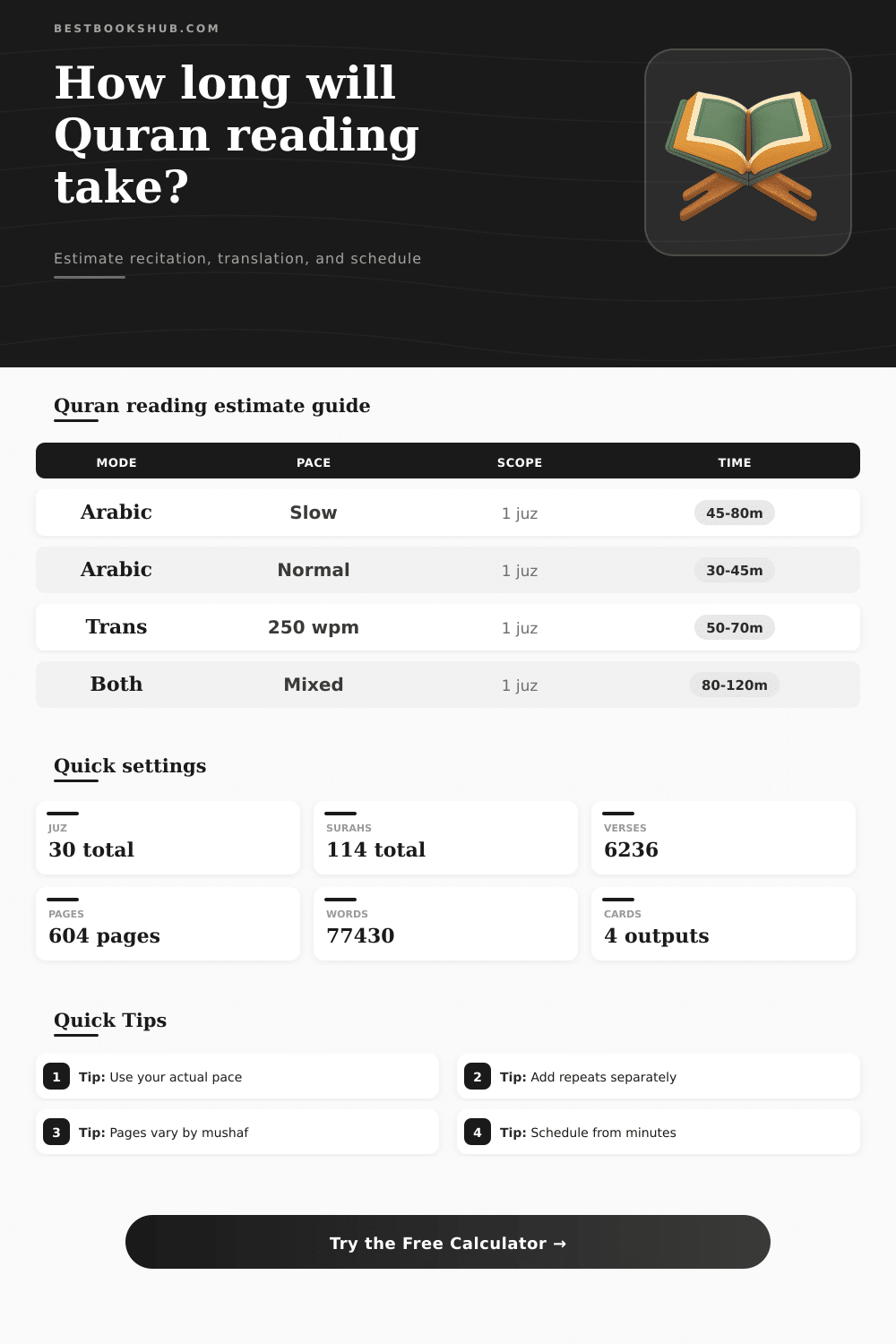
These tables are for calculation planning only. Actual reading time varies by recitation style, translation edition, page layout, pauses, and personal pace.
| Reading mode | Calculator inputs used | Best estimate driver | Variation note |
|---|---|---|---|
| Arabic recitation | Arabic words, recitation pace, tajweed adjustment, repeats | Words per minute or page-per-juz pace | Recitation style can change time substantially. |
| Translation reading | Estimated translation words and WPM | Reading speed and translation length factor | Translation editions differ in word count. |
| Arabic plus translation | Arabic time plus translation time | Combined minutes before buffer | Useful for side-by-side reading sessions. |
| Study mode | Combined time plus notes or pause percentage | Pause percentage and daily minutes | This is a time budget, not guidance. |
| Scope type | How amount is estimated | Typical use | Precision note |
|---|---|---|---|
| Juz range | Selected juz divided by 30 | Full-reading plans and daily schedules | Good for broad time planning. |
| Surah range | Verse-count share across selected surahs | Named surah groups and sections | Words and pages are proportional estimates. |
| Ayah range | Selected ayat within one surah | Short section estimates | Uses average words per verse within the surah. |
| Manual pages | Pages divided by 604 | Specific mushaf page assignments | Best when your page count is known. |
| Manual words or verses | Entered amount scaled to full text | Custom excerpts or copied counts | Most direct when you have exact counts. |
| Arabic pace profile | Model value | Approximate full Quran time | Use when |
|---|---|---|---|
| Slow measured | 90 Arabic words per minute | About 14.3 hours before adjustments | You want a conservative pace estimate. |
| Moderate | 130 Arabic words per minute | About 9.9 hours before adjustments | You read steadily without rushing. |
| Fluent | 170 Arabic words per minute | About 7.6 hours before adjustments | You need a faster planning scenario. |
| 30 min per juz | 900 minutes for full text | 15 hours before adjustments | You prefer a page or juz time rule. |
| 45 min per juz | 1,350 minutes for full text | 22.5 hours before adjustments | You want a measured page-based plan. |
| Preset | Default range | Default mode | Planning purpose |
|---|---|---|---|
| Juz Amma | Juz 30 | Arabic recitation | Short-surah section timing. |
| Al-Fatihah | Surah 1 | Arabic recitation | Very short passage timing with repeats. |
| Al-Baqarah 1-25 | Surah 2, ayat 1-25 | Arabic plus translation | Opening section time budget. |
| Surah Ya-Sin | Surah 36 | Arabic recitation | Single-surah estimate. |
| Translation 1 Juz | Juz 1 | Translation only | Reading speed and daily planning. |
This is a Quran reading time calculator. It estimate how long it will take based off your daily schedule. It also considers buffers, repeats, and range of ayahs, surahs, or juz you select. Finally, it accounts for both translation reading and Arabic recitation.
So many people starts reading the Quran with the best of intentions, only to find that an hour later they haven’t even finished what they thought was going to be a couple page. When you’re reading, time stretches out: some days you race through a page, other days the rules of tajweed and thinking about what you’re saying slow text down. Having a clear idea of how long it will take strike a balance between aspirations and realities, in a way that doesn’t diminish depth of the experience itself.
How to Plan Your Quran Reading Time
Speed. That’s the real variable nearly everybody undervalues. You don’t read novels at the same speed as you recite in Arabic. Reciting require you to slow down to understand meaning. You might pause for correct pronunciation or glide along if it is already familiar. Now multiply by Tajweed and the minutes tick up. Selecting a slower-paced style multiplies again, and what looked like a twenty-minute session becomes closer than forty. That’s why there are those layers in the tool. So you can see impact first, before starting.
Fifteen percent (ish) is hardly noticeable as a Tajweed tweak, but then observe how it builds up over whole juz. Another rhythm enters with translation. Your target language (English) usually runs longer than original Arabic, sometimes by half again as many words. Footnotes and commentaries run on for your eyes across the page in a new direction. And study mode makes this even bigger, because thinking through things happen at a different pace than reciting them. This isn’t bad planning, it’s just a reminder that different intentions demand different schedule.
Then there’s what it tells you. That’s where range selection come in. Juz are broad strokes, great for a month-long goal, but moving to the range of surah/ayah allow you to focus on a shorter sitting, say to review al-Kahf ahead of Friday, or get familiar with beginning of al-Baqarah. The calculator locks down around most common size mushaf (604 pages) because editions differ on page counts, but it still allows you to override it with your own count. It doesn’t let you make the common error: assume that because someone has a physical copy of the Quran, then it matches everyone else.
This is where estimation meets reality: daily planning. Sure, thirty minutes doesn’t seem like much, until you realize it can cover a surprising amount when repeated consistent. Remember, life happen, and your energy levels will vary. That’s why there’s a buffer percentage. Ten percent extra built-in goes a long way between days. More than anything, it is what separates plans that last from those that do not. Ones that fall apart after day five.
The same is true for repeats. A memorization routine that seems easy on paper doubles (or more) the time when you consider doing it seven or ten times. The moments that cannot be counted are equally as valuable. There are times when your heart softens and you linger for a few minutes longer. Then there are times when you feel mechanical and push yourself through to keep pace with the day. Both are worthy, but the estimate takes the guess work out of it, so you stop second-guessing if you are pushing too hard or not hard enough. You get in sync with what time allows rather than realizing midway into Ramadan that you got it wrong.
It’s not that this practice requires precise minutes on a clock face. It’s that creating some level of consistency makes the Qur’an a constant friend instead of a once-in-a-while acquaintance. That kind of relationship require a doable plan. When you realize what actualy consumes your time, then give the Book its due space… No more stealing from sleep and prayer. Every thoughtful calculation is rewarded with a sense of peace.