📖 Vocabulary rarity analyzer
Rare word percentage calculator
Paste a passage to estimate uncommon word percentage, classify words into frequency tiers, exclude names and acronyms, score vocabulary load, and compare the text with reader-level thresholds.
Load a realistic sample, then adjust the baseline, rarity threshold, and reader target. Each preset uses a different vocabulary profile.
DISCLOSURE: This post may contain affiliate links, meaning when you click the links and make a purchase, I receive a commission. As an Amazon Associate I earn from qualifying purchases.
This calculator is not a raw word-frequency counter. It estimates rarity by comparing each token with core, common, uncommon, rare, and specialist word tiers, then converts the tier mix into a vocabulary load score.
The strongest signal will appear after calculation.
| Rank | Word | Tier | Count | Share | Reason |
|---|---|---|---|---|---|
| Load a preset or paste text to see rare words. | |||||
| Tier | Typical signal | Examples | Calculator treatment |
|---|---|---|---|
| Core | Very high-frequency everyday words | the, said, make, people | Never counted as rare unless custom flagged. |
| Common | Familiar prose and school vocabulary | library, chapter, weather, explain | Adds light vocabulary load but not rare percentage. |
| Uncommon | Less frequent but broadly learnable words | harbor, symbolic, evidence, interval | Counts when threshold includes uncommon words. |
| Rare | Low-frequency literary or formal words | luminous, turbulent, antiquated, residue | Counts in the default rare percentage. |
| Specialist | Domain, technical, legal, or academic terms | jurisdiction, chloroplast, anaphora | Counts as the heaviest vocabulary load. |
| Reader target | Rare word band | Vocabulary load cap | Interpretation |
|---|---|---|---|
| Starter reader | 0% to 3% | 18 | New terms should be few and strongly supported by context. |
| Middle grade reader | 2% to 6% | 28 | Some unfamiliar words are fine when sentences stay clear. |
| Young adult reader | 4% to 9% | 38 | Moderate vocabulary stretch can work in narrative context. |
| General adult reader | 5% to 11% | 48 | Balanced adult prose with occasional specialized words. |
| Skilled adult reader | 8% to 16% | 62 | Dense literary, review, or nonfiction vocabulary. |
| Academic reader | 12% to 22% | 76 | Frequent technical and discipline-specific vocabulary. |
| Specialist reader | 18%+ | 90 | Expert-facing copy where rare terms may be expected. |
| Control | What it changes | Best use | Watch out for |
|---|---|---|---|
| Minimum word length | Removes very short tokens before tiering | Children's text, dialogue, notes | Can hide short rare names or terms. |
| Exclude names | Removes likely capitalized proper nouns | Fiction scenes, biographies, reviews | Sentence-start words are treated carefully but not perfectly. |
| Exclude acronyms | Removes all-caps abbreviations from rare counts | Reports, policies, technical copy | Acronyms may still need definitions for readers. |
| Unique mode | Counts each vocabulary type once | Vocabulary range checks | Can understate repeated difficult terms. |
| Custom rare terms | Forces selected words into specialist tier | Domain glossaries, classroom terms | Separate terms with commas or spaces. |
| Preset | Expected rare-word pattern | Primary signal | Suggested target |
|---|---|---|---|
| Early Reader | Low rare percentage with simple word choice | Any long unfamiliar story words | Starter or middle grade |
| Book Review | Moderate uncommon vocabulary | Literary terms and abstract nouns | General adult |
| Science Text | Specialist terms mixed with clear explanation | Domain vocabulary | YA, general, or academic |
| Academic Abstract | High rare and specialist density | Compressed formal terms | Academic reader |
| Policy Notice | Legal vocabulary raises load quickly | Formal and specialist terms | Skilled or specialist reader |
A rare word percentage calculator are a tool that will help you to determine the percentage of rare word in your writing. Many writers often finds themselfs struggling with the fact that there writing contains difficult vocabulary yet they do not have a way of measuring that. By using a rare word percentage calculator, you can determine the percentage of words within your text that is considered to be difficult to read due to its rarity.
Using this tool, you will be able to determine if your text is readable by an audience. To calculate the percentage of rare words within your writing sample, the software categorizes each word within the text as being core, common, uncommon, rare, or specialist words. Words that is categorized as being rare will contribute to the rare word percentage of your writing sample.
How to Measure Rare Words in Your Writing
The rare word percentage calculator software can categorize each word in this way, which will report to you the percentage of words that were categorized as being rare. The rare word percentage calculator software allow you to change the baseline that determines which words is considered to be rare. For instance, some word appear to be common in fiction writing yet they are considered to be rare in academic writing.
Each baseline can be selected, which allows you to determine the rare word percentage for different type of audiences. For instance, you could determine the rare word percentage of your text for both fiction and non-fiction audience to determine which audience would find your text to be more easily readable. Another feature of the rare word percentage calculator software is the ability to exclude name and acronyms from the rare word percentage calculation.
Names of individuals may contain words that appear to be rare yet they are not actualy difficult to read by audience member. The same is true for acronyms, which are only difficult for audience members that is knowledgeable about the term that are defined by those acronyms. Excluding these words ensures that the rare word percentage isnt too high for your writing sample.
Beyond the rare word percentage calculation is another value that the rare word percentage calculator provide: the vocabulary load score. The vocabulary load score takes into account the complexity of the words within your writing sample. Even with a low percentage of rare words, if the rare words are very long and complex, your vocabulary load score will be high.
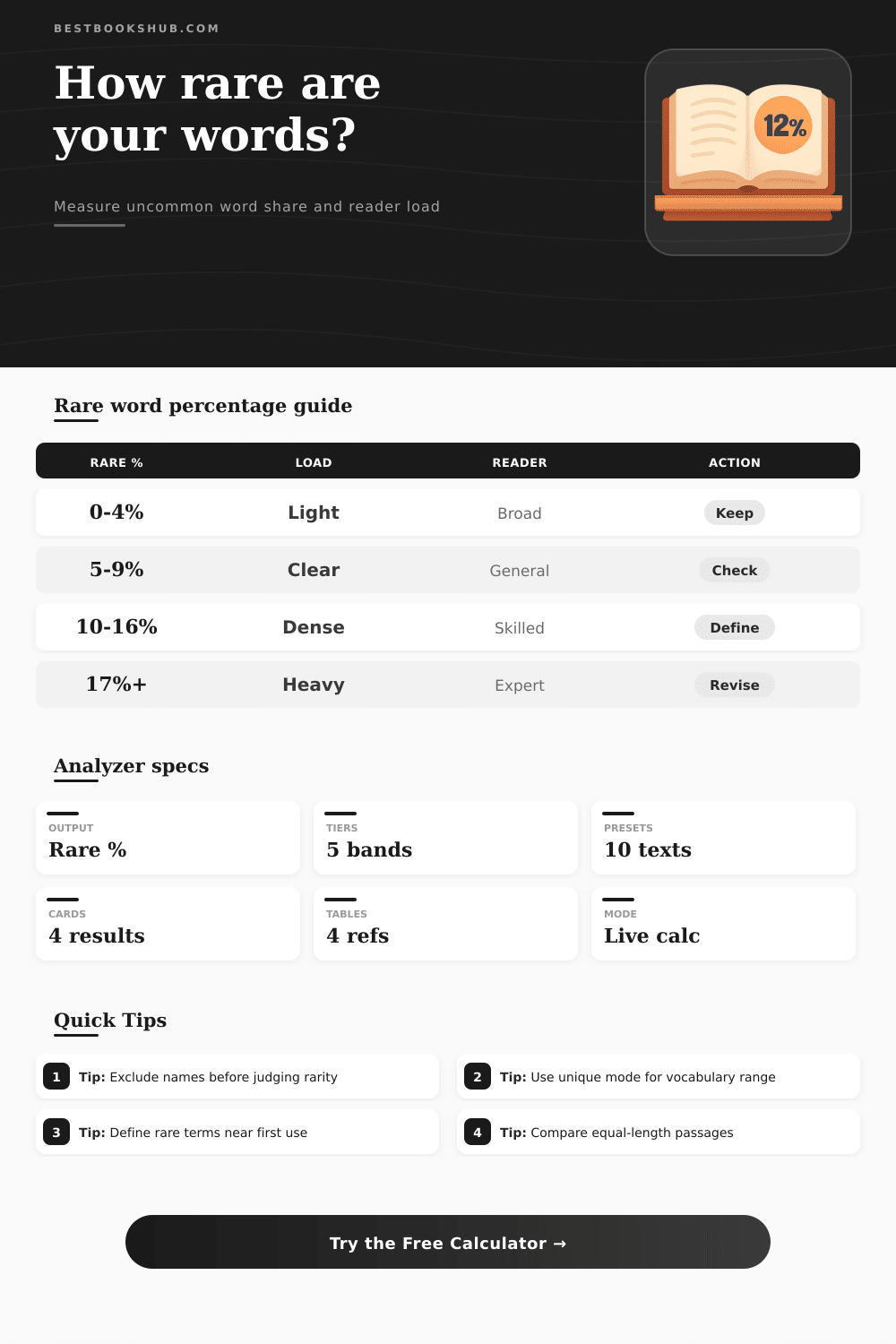
Thus, both the rare word percentage and the vocabulary load score should of be consider when analyzing your writing. Another feature of the rare word percentage calculator software is the inclusion of reference table that indicate which rare word percentages are associated with each level of reader. For instance, the rare word percentage of starter readers is low yet skilled adult readers can read texts that has higher percentages of rare words.
These reference tables allow you to compare your work to that of other writing samples to determine if your rare word percentage is appropriate for your target audience. For instance, if you are writing a novel that is targeted towards young adults, you could use these tables to determine if your rare word percentage is appropriate for that type of audience. It is not necessary for your rare word percentage to always be low.
Your rare word percentage calculator may reveal that your text include a higher percentage of rare words than you intended. In such cases, the rare word percentage calculator will provide a list of word that are flagged as rare. This list can help you to determine whether or not you wish to change those words to more common word within the language.
Finally, those who run the same passage through the rare word percentage calculator using different settings provide the most value. For instance, you may wish to run the same passage using different reader targets or rarity thresholds. By doing so, you can determine exactly when your passage become challenging for a reader.
Thus, using a rare word percentage calculator allows you to turn the writing and publishing process into a measurable process and to understand how much of the difficulty in your writing is due to your vocabulary.