🔊 Oral reading planner
Read-Aloud Pacing Calculator
Estimate spoken reading time, remaining sessions, finish date, page load, and pacing pressure from WPM, audience age, expression style, pauses, page count, word count, and weekly read-aloud rhythm.
Load a practical read-aloud scenario, then adjust words, pages, pauses, spoken pace, session length, and weekly cadence for your book or group.
| Read-aloud style | Typical WPM | Best use | Planning note |
|---|---|---|---|
| Gentle picture-book read | 90-120 WPM | Young listeners, repeated phrases, illustration stops | Add page pauses because pictures often carry meaning. |
| Expressive chapter narration | 120-150 WPM | Bedtime, family reading, classroom chapters | Use the balanced or character-voice multiplier. |
| Clear instructional read | 135-165 WPM | Class excerpts, tutoring, guided fluency | Keep breaks separate from spoken word time. |
| Rehearsal or familiar text | 165-210 WPM | Practice runs, older audience, known passages | Use only if comprehension remains easy. |
| Audience profile | Time multiplier | Why it changes pace | Use when |
|---|---|---|---|
| Ages 3-5 | 1.28x | Needs pointing, repetition, and more page-turn time. | Picture books, preschool groups, bedtime reading. |
| Ages 6-8 | 1.16x | Early readers benefit from clear phrasing and word support. | Early chapter books and read-along sessions. |
| Ages 9-12 | 1.06x | Mostly fluent listening with occasional explanation. | Middle grade novels and classroom chapters. |
| Teen or adult | 1.00x | Standard clarity without extra comprehension padding. | Book clubs, rehearsals, and older family reads. |
| Fluent familiar text | 0.94x | Known passages can move faster without losing sense. | Practice, rereads, and performance warm-ups. |
| Setting | Common range | Time effect | Best use |
|---|---|---|---|
| Light expression | 0.92x | Shortens narration by trimming dramatic stretch. | Practice pass or familiar passage. |
| Balanced narration | 1.00x | Neutral read-aloud pace with normal inflection. | Most novels and chapter books. |
| Character voices | 1.12x | Adds time for dialogue, emphasis, and reactions. | Humorous, dramatic, or dialogue-heavy books. |
| Dramatic performance | 1.28x | Raises total time through stronger phrasing and pauses. | Storytime, performance, or event reading. |
| Teaching or poetry | 1.45x | Allows repetition, call-and-response, and close attention. | Poems, lessons, and fluency work. |
| Session rhythm | Weekly sessions | Best session length | Planning cue |
|---|---|---|---|
| Bedtime read | 4-7 per week | 10-25 minutes | Short page targets protect the routine. |
| Classroom read-aloud | 3-5 per week | 15-35 minutes | Leave time for reactions or vocabulary. |
| Library or event series | 1-2 per week | 20-45 minutes | Chapter breaks matter more than page math. |
| Family weekend block | 1-3 per week | 35-90 minutes | Use longer sessions only for older listeners. |
DISCLOSURE: This post may contain affiliate links, meaning when you click the links and make a purchase, I receive a commission. As an Amazon Associate I earn from qualifying purchases.
There’s nothing worse for a parent then under-estimating story time. “Uh-oh, it’s almost bed-time,” you think as you open your big-picture book and there’s still cover left. It’s not usually because the book is too hard to read. The problem lie in its secret cost: performance. Reading out loud change how fast a book can be read.
People usually say they read something in X minutes based off the assumption of the number of words divided by how long it would take someone to speak them. That equation doesn’t account for humans paying attention though. As a reader, we don’t simply process data when we read aloud to kids. We slow down for new voices, wait for laughter, and pause for illustrations.
Why Reading Out Loud Takes More Time
To make room for all that emotional work, the calculator lets you plug those factors into the equation along with word count. Because narration is easier than dense dialogue. How fast you read it affects how much you understand and enjoy it. You might get through something faster if you read it quickly, but you lose texture of story.
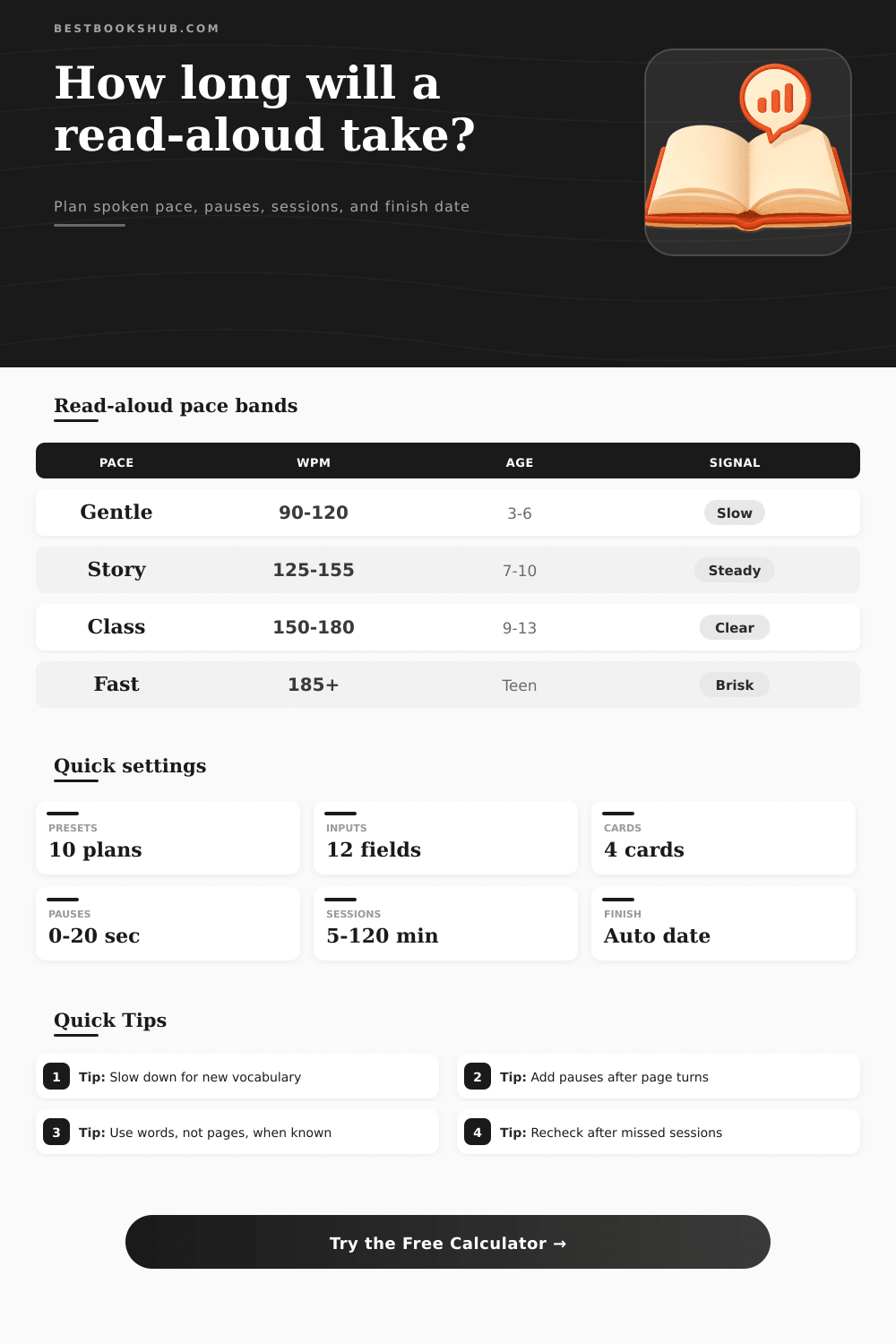
If your listener is younger than seven, slow down. This allow children to picture what they hear. These bands are clear in the reference table. Ninety words a minute is a gentle pace that leaves time to process, whereas quicker paces is more suitable for older teenagers who has already developed their vocabularies. You might miss details if you do not use the right pace, even though you might arrive at the end more quick.
Additionally, you need to factor in where the book’s structure take a break. Illustrations, page turns, and chapter endings require a momentary pause that isn’t reflected in word count. And if your story is going to be a multi-week series, all those little breaks will add up fast. Six seconds on each page doesn’t sound like much until you multiply it times two-hundred pages. That’s an additional twenty minutes of quiet reaction time, before you even get to chapter break.
That’s why so many projects fall apart when it comes to planning. Sure, you may want to pick a book because you love it, but does it fit in with your week? Is it too long for the limited time you have every day/night? Does it have to-dense chapters for just fifteen minutes per sitting?
The tool visualizes all of this by projecting a completion date based on how often you work on the project and how much time you spend on each session. That can help you modify your daily workload (to five minutes instead of ten) or shift to a different book (maybe one with fewer pages). A promise becomes something real on your calendar.
With this perspective, there’s no need to feel guilty about pacing yourself. Taking longer doesn’t mean you’re falling behind. You’re counting in human interaction. It’s a social act of reading out loud, it’s not a race against some page counter. Knowing how math works with pauses and expressions allow you to pick books according to what fits into your life. When the last word lands, you have more time left over for conversation.
You should of remember to check that finish date first, so you’ll know where the final page turn will land.