📖 Multi-formula readability lab
Readability consensus score calculator
Paste text to calculate FKGL, SMOG, ARI, Coleman-Liau, Dale-Chall proxy, optional LIX and RIX, then combine them with median, mean, or outlier-trimmed consensus logic.
Load a realistic sample, then adjust formula inclusion, aggregation method, sentence handling, difficult-word rules, and target audience.
| Formula | Grade score | Status | Inputs used | Consensus role |
|---|---|---|---|---|
| Run the calculator to compare formula scores. | ||||
| Formula | Main signal | Best for | Caution |
|---|---|---|---|
| FKGL | Sentence length and syllables | General prose grade estimates | Sensitive to long sentences |
| SMOG | Polysyllabic word count | Health, school, and public text | More stable near 30 sentences |
| ARI | Characters per word | Technical or typed documents | Can overrate long terms |
| Coleman-Liau | Letters and sentences per 100 words | Fast automated text checks | No syllable awareness |
| Dale-Chall proxy | Difficult-word share | Vocabulary accessibility checks | Proxy list is approximate |
| LIX/RIX | Long-word and sentence load | Cross-checking long-word density | Optional grade mapping |
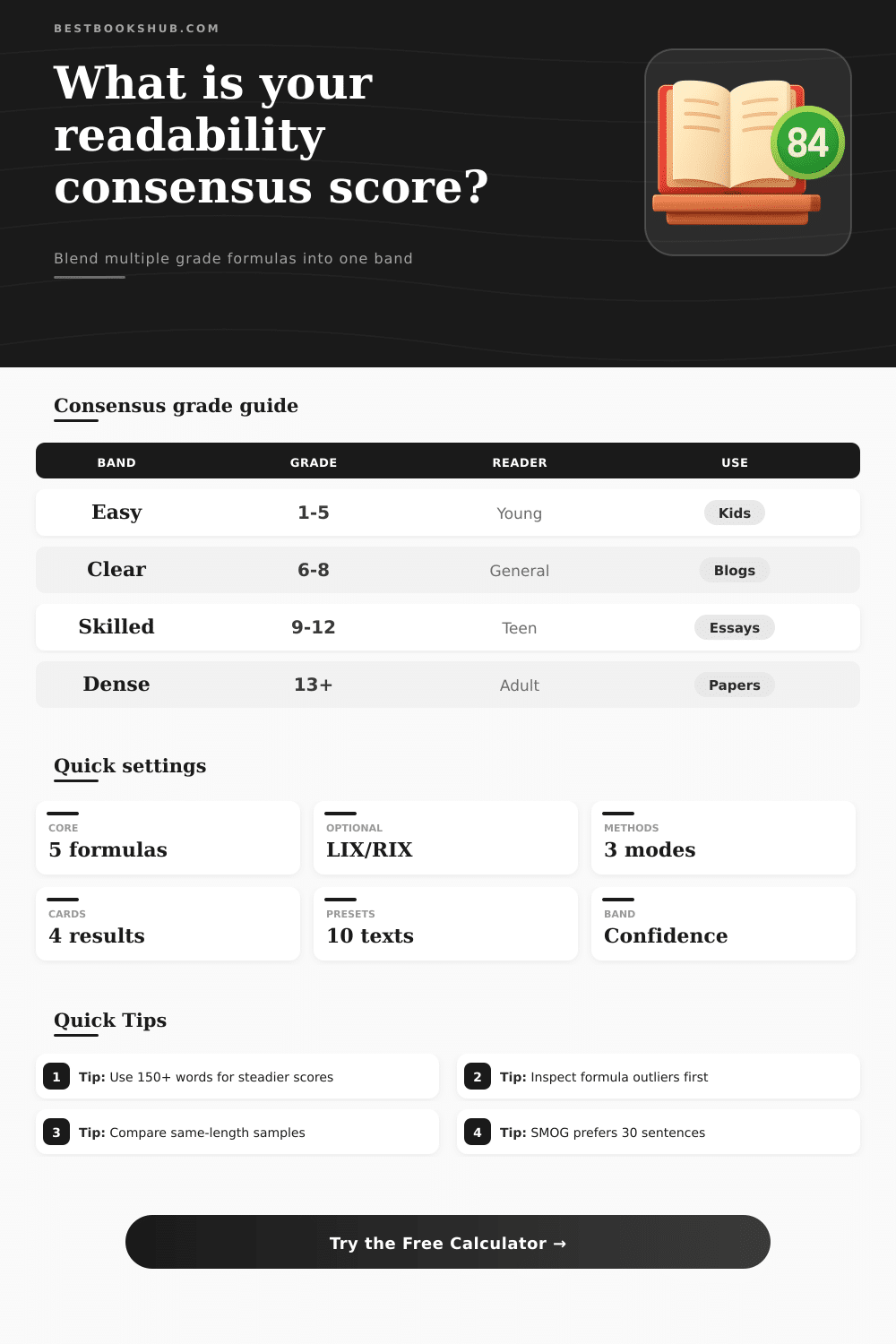
| Band | Consensus grade | Typical reader | What to inspect |
|---|---|---|---|
| Early / elementary | 1 to 5 | Children and beginning readers | Short sentences, familiar words, clear repetition |
| Middle / general | 6 to 8 | General web and middle grade readers | Moderate vocabulary with manageable sentence length |
| High school | 9 to 12 | Teen, essay, and adult general readers | Abstract terms, longer clauses, and paragraph density |
| College | 13 to 16 | College or specialist readers | Technical vocabulary and multi-clause sentences |
| Advanced | 17+ | Expert or legal readers | Formula outliers, jargon, and sentence compression |
| Sample size | Confidence effect | Best practice | Common issue |
|---|---|---|---|
| Under 100 words | Low confidence | Use only for quick screening | One sentence can distort results |
| 100 to 249 words | Moderate-low confidence | Compare similar excerpts only | SMOG may be unstable |
| 250 to 749 words | Good confidence | Strong for article or scene checks | Mixed dialogue and exposition can split scores |
| 750+ words | Strong confidence | Best for manuscript or report sampling | Very long documents may hide hard sections |
DISCLOSURE: This post may contain affiliate links, meaning when you click the links and make a purchase, I receive a commission. As an Amazon Associate I earn from qualifying purchases.
To find best fit for the passage in terms of potential readership, the readability consensus score calculator average out the biggies, identifying outliers and getting a sense of what reading level it’s probably written at. Who’s going to get this? You’ve got a draft of something, a legal notice, a blog post, a kid’s story, and you want to know: Will people read this thing, or are they going to be confused? According to one formula, an eighth grader. Another one tell you it’s college. What gives?
They don’t seem to agree so you guess. A consensus solution help, because rather than relying on the outcome of any single score, it takes a few different formulas and averages them out. That means it can identifies the outliers and you’re able to trust that the end result isn’t way off base.
How Readability Tools Work
Each formula weigh a different signal (characters? Long words? Syllables per word?). If they disagree, there’s likely a problem in that passage: jargon, perhaps, in short sentences. That conflict is flagged by calculator and you can rewrite with your eyes open.
Everything depends on sample size, since an out-of-whack single clause may skew a passage’s whole average. For best results, use the tool for texts of at least 150 words. Even better is comparing similar parts of the text: openings to openings, say, since genre tends toward similar difficulty. Matched passages clarifies the picture.
There are some pros. Punctuation is fine if you’re counting sentences, and clean prose is generaly fine. But dialogues and bulleted lists can throw off sentence counts; they’ll distort, which you could of fix by manually entering in the number or selecting a hybrid mode. The same applies to tricky words. Every three-syllable word is treated as a hard one with a strict syllable count, while a common-word list will forgives technical terms that educated users understand. Selecting the right substitute based off your audience avoids false positives.
There are multiple ways to reach consensus. Median prevents any one outlier from taking over the answer. Mean works beautifully when formulas already cluster. Trimmed consensus: drop the extremes at the beginning, average what’s left. These represent various philosophies of trust. A confidence band wraps around the answer and opens and closes depending on both sample size and spread. Band’s not decoration, it’s telling you your confidence in standing atop the answer.
You can use optional indexes from Denmark and Sweden if you included them. Think of the middle-grade novel. It may have high readability within range, but it can still read like a wall of words. The formula might have hit the mark on sentence length, but it failed to account for emotional concepts being too advanced for readers at this age. What readability measures is linguistic surface, not conceptual load. The best writers attends to both.
The same goes for parents who want to know how hard their kids must work to read whatever comes home from school. It is true for marketers looking to improve landing pages, and for lawyers tasked with making disclosures understandable to everyone. When it comes down to it, does the text reach the intended mind without resistance? That’s a question no single number can resolve entirely.
But the consensus provides a solid starting point and a guide to areas where the text pushes in different directions. And it’s never perfect. But it’s a silent belief that what you put down will be heard by whom you want to hear it. When the confidence band narrows and the agreement turns strong, that’s when you know the draft is right. Then it’s listening to the audience who shows up for your page.