📖 Readability Score Calculator
Analyze text complexity with Flesch-Kincaid, Gunning Fog, SMOG & more — paste any text to get instant scores
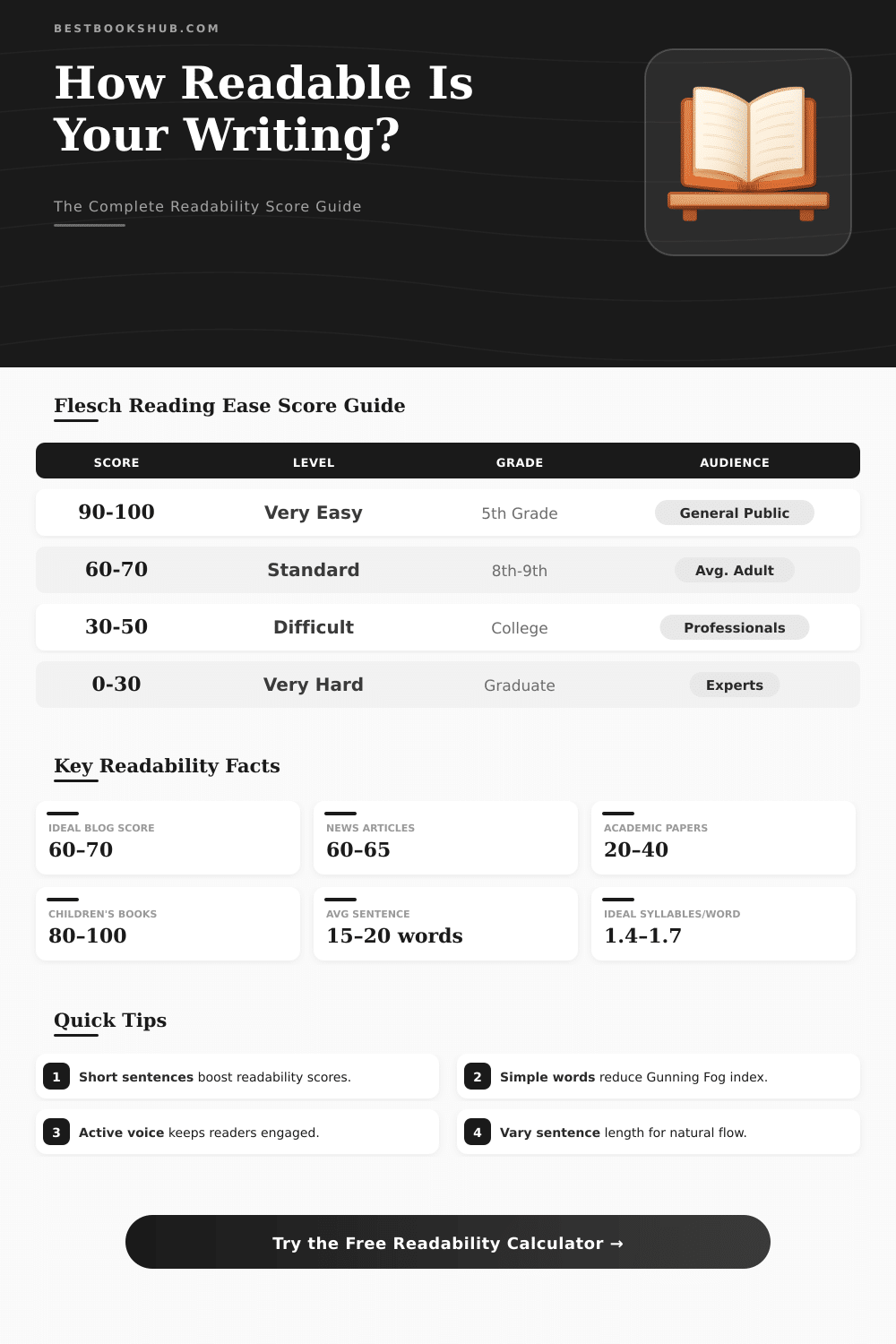
| Score Range | Difficulty | Grade Level | Typical Audience | Avg Sentence Length |
|---|---|---|---|---|
| 90 – 100 | Very Easy | 5th Grade | Children, General Public | 8 words |
| 80 – 90 | Easy | 6th Grade | Young Adults | 11 words |
| 70 – 80 | Fairly Easy | 7th Grade | Most Adults | 14 words |
| 60 – 70 | Standard | 8th–9th Grade | Average Adult | 17 words |
| 50 – 60 | Fairly Difficult | 10th–12th Grade | High School | 21 words |
| 30 – 50 | Difficult | College | Educated Adults | 25 words |
| 0 – 30 | Very Difficult | Graduate | Subject Experts | 29+ words |
| Fog Index | Reading Level | Grade | Example Publication |
|---|---|---|---|
| 6 | Very Easy | 6th Grade | TV Guide, The Bible |
| 8 | Easy | 8th Grade | Reader's Digest |
| 10 | Moderate | 10th Grade | Time Magazine |
| 12 | Standard | High School | Newsweek |
| 14 | Difficult | College | Academic Journals |
| 17+ | Very Difficult | Graduate | Scientific Papers |
| Metric | Formula | Range | Best For |
|---|---|---|---|
| Flesch Reading Ease | 206.835 – 1.015(W/S) – 84.6(Sy/W) | 0 – 100 | General content |
| Flesch-Kincaid Grade | 0.39(W/S) + 11.8(Sy/W) – 15.59 | 0 – 18+ | US grade level |
| Gunning Fog | 0.4[(W/S) + 100(CW/W)] | 0 – 20+ | Business writing |
| SMOG Index | 3 + √(polysyllables × 30/S) | 0 – 20+ | Health materials |
| Coleman-Liau | 0.0588L – 0.296S – 15.8 | 0 – 16+ | Digital text |
| Automated Readability | 4.71(C/W) + 0.5(W/S) – 21.43 | 0 – 14+ | Computer analysis |
| Content Type | Flesch Ease | FK Grade | Fog Index | Audience |
|---|---|---|---|---|
| Children's Books | 80 – 100 | 1 – 5 | 4 – 6 | Ages 6–12 |
| Blog / Web Content | 60 – 70 | 6 – 8 | 8 – 10 | General Public |
| News Articles | 60 – 65 | 7 – 9 | 9 – 11 | Adults |
| Business Writing | 55 – 65 | 8 – 10 | 10 – 12 | Professionals |
| Marketing Copy | 65 – 75 | 6 – 8 | 7 – 9 | Consumers |
| Technical Manuals | 40 – 55 | 10 – 12 | 12 – 14 | Trained Users |
| Academic Papers | 20 – 40 | 12 – 16 | 14 – 18 | Researchers |
| Legal Documents | 10 – 30 | 14 – 18 | 16 – 20 | Legal Experts |
Readability deals with how simply one can read and understand some text. It relates to the features of the text itself, and one measures it by tools like the amount of syllables in a phrase or the range of used words. Such tools help to guess if the script is easy or difficult.
DISCLOSURE: This post may contain affiliate links, meaning when you click the links and make a purchase, I receive a commission. As an Amazon Associate I earn from qualifying purchases.
Readability Score methods roughly guess what education level some require to read a piece of text without effort. A program checks English text and guesses the easy reading or the trouble according to known readability formulas. The result shows what readers most likely can understand it, with details about their school grade and age.
Readability: How We Test If Text Is Easy to Read
There are several well known formulas for that. Between them two popular are the tests Flesch-Kincaid for reading ease and for grade level. Even Microsoft Word shows such scores after control of spelling and grammar.
One also mentions the Gunning Fog Index, the SMOG formula, the score Dale-Chall and the readability chart of Fry. Which one you use, depends on the field and the style of writing. The Flesch-Kincaid Readability Score rates more highly texts with long phrases and difficult words.
Not always a high score shows that the content truly is easier to read. Methods like those of Flesch, Hemingway or the Fog use scores to judge that. A person could write nonsense and cheat the tools.
Also, the Readability Score commonly does not pay attention too the logical tie and the link of ideas, that is key in good writing.
There are free online tools for readability that right away show the education level of the script and the most difficult phrases. Also APIs help add Readability Score rating in pages, systems for management of content or other apps. That technology works well for checking thousands of web pages searching bad reading parts or for quickly scanning a book and finding theheavy sections.
Lyman Bryson from the Teaching School of Columbia University found that many adults suffered because of poor skill to read, caused by bad teaching. Although schools for a long time try to teach clear and easy writing, Bryson found that that happens rarely. He noted that such language requires discipline and art, that not many creative folks manage to reach.
The target group of the text also matters. Just the age can a lot affect the readability. The kind of font and its size work as factors.
Similarly, the background color and the color of the text play a role. In scientific writing, one should keep the reading level as low as possible, which is helpful. It results in clear, readable and simple text, that helps to spot weak or unoriginal work.
Academic writing usually requires formal language, and although formality does not always cause more difficult readability, it commonly lines up with it.