📚 Online Reading Age Calculator
Paste any text to instantly calculate its reading age, Flesch-Kincaid grade level, and readability score
Most Widely Used
0–100 Scale
Complex Word Focus
Health Comms Standard
Character-Based
Letter Count Method
in This Tool
UK Year System
| Reading Age | UK Year Group | US Grade | FK Grade Level | Flesch Ease Score | Typical Text Examples |
|---|---|---|---|---|---|
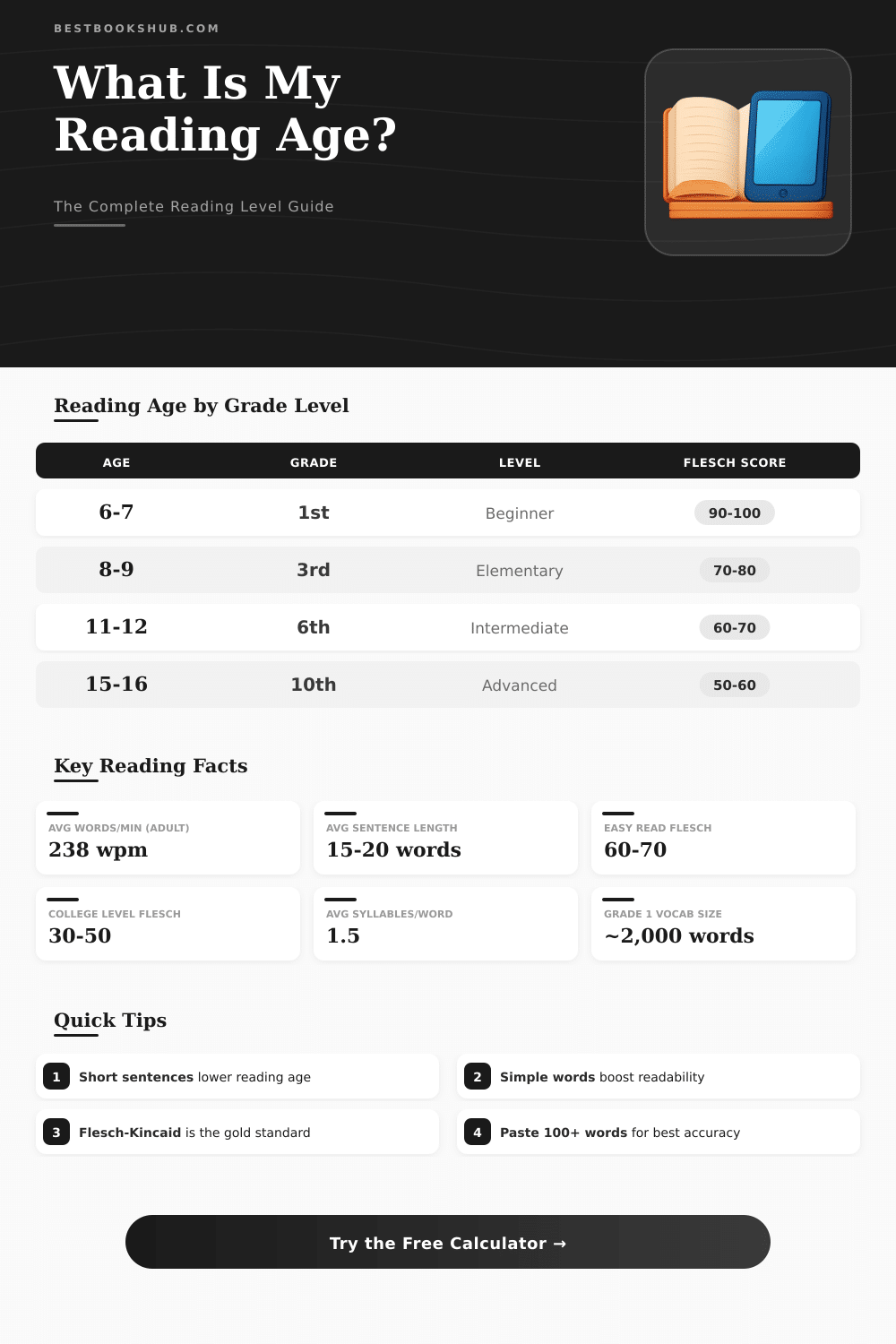
| 5–6 | Reception / Yr 1 | Kindergarten | K (0–1) | 90–100 | Dr Seuss, early readers |
| 7–8 | Year 2–3 | Grade 2–3 | 2–3 | 80–90 | Biff & Chip, Roald Dahl easy |
| 9–10 | Year 4–5 | Grade 4–5 | 4–5 | 70–80 | Diary of a Wimpy Kid |
| 11–12 | Year 6–7 | Grade 6–7 | 6–7 | 60–70 | Harry Potter, Narnia |
| 13–14 | Year 8–9 | Grade 8–9 | 8–9 | 50–60 | Hunger Games, Twilight |
| 15–16 | Year 10–11 | Grade 10–11 | 10–11 | 40–50 | Newspaper broadsheet, GCSE texts |
| 17–18 | Year 12–13 | Grade 12 | 12–13 | 30–40 | Quality press, A-level texts |
| 18+ | University | College+ | 14+ | 0–30 | Academic journals, legal docs |
| Score Range | Difficulty | Reading Age | Avg Sentence Length | Avg Syllables/Word | Recommended For |
|---|---|---|---|---|---|
| 90–100 | Very Easy | 5–6 | 8 words | 1.1 | Children, early learners |
| 80–90 | Easy | 7–8 | 11 words | 1.2 | Beginner adult readers |
| 70–80 | Fairly Easy | 9–10 | 14 words | 1.3 | Consumer-facing content |
| 60–70 | Standard | 11–13 | 17 words | 1.4 | General public, NHS target |
| 50–60 | Fairly Difficult | 14–15 | 21 words | 1.5 | Secondary school, quality press |
| 30–50 | Difficult | 16–18 | 25 words | 1.7 | A-level, professional readers |
| 0–30 | Very Difficult | 18+ | 29+ words | 2.0+ | Academic, legal, scientific |
| Formula | Output Type | Best For | Min Words Needed | Accuracy Rating |
|---|---|---|---|---|
| Flesch-Kincaid Grade | US Grade Level | General text, education | 100+ | ★★★★☆ |
| Flesch Reading Ease | 0–100 score | Web copy, plain English checks | 100+ | ★★★★★ |
| Gunning Fog Index | Grade / Age | Business writing, journalism | 100+ | ★★★★☆ |
| SMOG Index | Years of education | Health information, patient docs | 30 sentences | ★★★★★ |
| ARI | Grade Level | Real-time / typed text | 50+ | ★★★☆☆ |
| Coleman-Liau | Grade Level | Short texts, letters | 50+ | ★★★☆☆ |
| Text / Publication | Reading Age | FK Grade | Flesch Ease | Text Type |
|---|---|---|---|---|
| The Very Hungry Caterpillar | 5–6 | 0.5 | 97 | Picture Book |
| Charlie and the Chocolate Factory | 8–9 | 4.2 | 82 | Children’s Novel |
| Harry Potter & the Sorcerer’s Stone | 10–11 | 6.1 | 72 | Middle Grade Fiction |
| The Hunger Games | 12–13 | 7.5 | 65 | YA Fiction |
| The Guardian (average article) | 14–15 | 10.3 | 55 | Broadsheet Newspaper |
| NHS Patient Leaflet (target) | 11–12 | 6–8 | 60–70 | Health Communication |
| A-Level English Exam Paper | 16–17 | 12.0 | 38 | Academic Assessment |
| Typical Legal Contract | 18+ | 15+ | 12 | Legal / Technical |
| Scientific Journal Article | 18+ | 16+ | 8 | Academic Research |
The Reading Age deals about something, what interests parents, teachers and each that cares about the learning of children. One defines the Reading Age level according to the skills of typical folk in a certain year. Usually in testing one used the level of average ten-year-old In United Kingdom the middle Reading Age of adults is about nine years, what seems strange, even so it is a real fact.
DISCLOSURE: This post may contain affiliate links, meaning when you click the links and make a purchase, I receive a commission. As an Amazon Associate I earn from qualifying purchases.
Children usually learn to read in six until seven years. One considers that normal cause. The usual range for start reading is four until seven years.
When and How Children Learn to Read
At that stage read want to say can understand text from everyday life, for instance a sign or a poster. Sometimes schools alter the meaning of read, so that it maen can read only that, what they self prepare for the courses.
Even so some children grasp early. Even three- or four-year-olds fit to start, especially if one reads to them often. Early hearing of books helps them quickly learn the effects.
But not every child follows the same timetable. In same family one can read already in kindergarten, while brothers requires more time. That is perfectly in order.
Every child moves according to his own speed, and nothing bad happens, if one starts in three or in seven years.
When a child did not reach basic reading in eight years, it maybe requires extra support. Learning problems like dyslexia can happen, but one can treat them.
Yet before children self read, the base creates itself soon. In three years many children already control the main parts of there language and learn around seven thousand fresh words yearly. The language skills are built in, because read builds on rich words.
The language and the reading skills are closely linked, and strengthen one back the second. In the preschool times children can play in listening games, that strengthens their sound skill. Sing lullabies and nursery rhymes build trust in sounds.
Usually one learns to sing the alphabet in the end of preschool. That is good chance for children to know at least the half of the letters and try to write his name. Around that age one starts formally the sounding of words.
The level and the content of read both belong to the same context. A child can read in high grade, yet not ready for the themes in books for bigger kids. Book after book, made for ten until twelve years, are great according to content, but those for youngsters store ideas, that older ones no longer understand.
There are reading tools for children of three until five years, for checking the first steps. Programs for ages of two until thirteen help children cross every step of sounds until they readwell.
Read to children stays useful even when they already read on their own. Shared read creates nice moments and chances to talk about the events in the story. When children already know the basics, they can pick up new words from the world or search them in a dictionary.
In six years one yet is quite a lot young, and not easily reading here is entirely usual.