📚 Bucket list reading planner
Reading bucket list time calculator
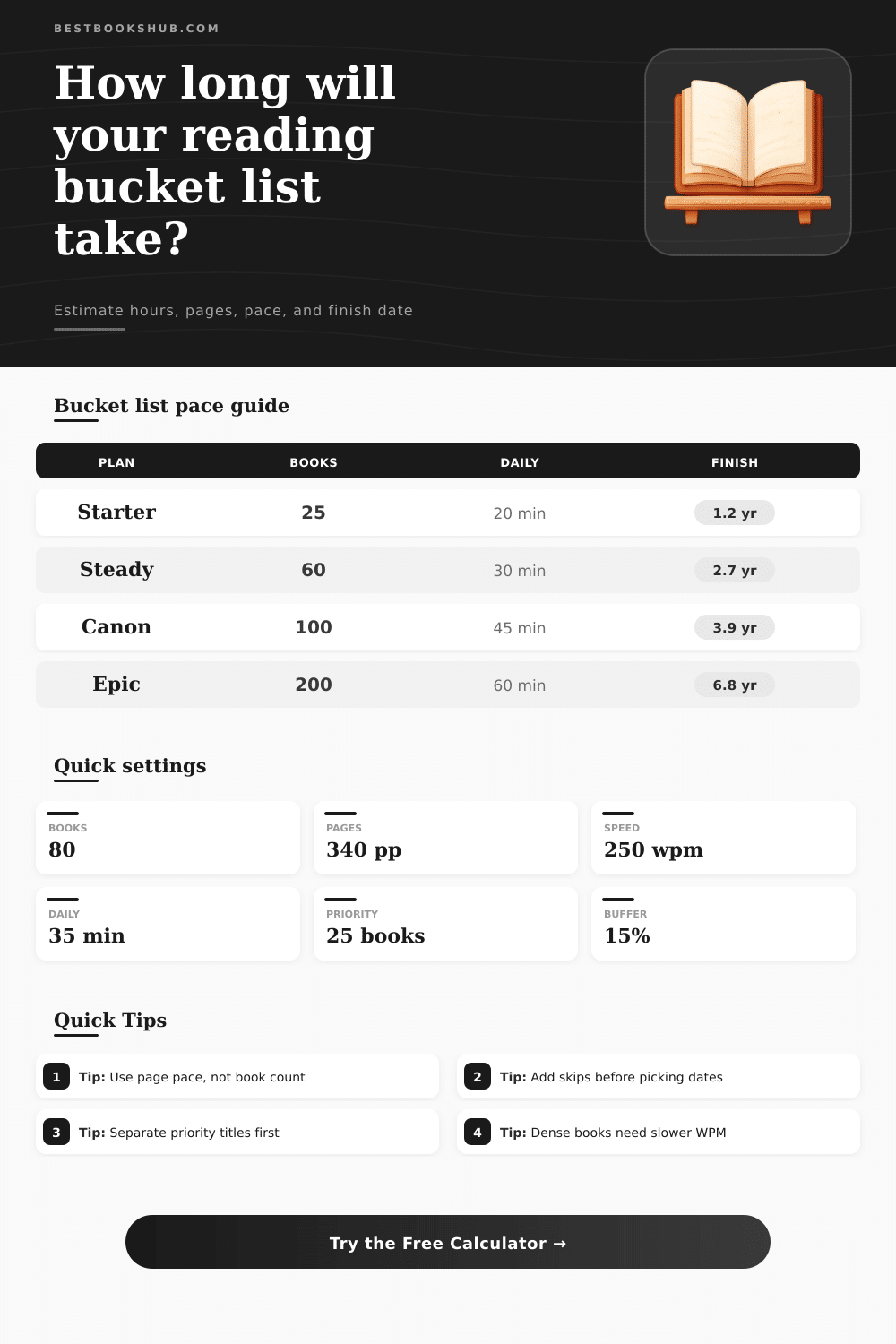
Estimate how many hours, pages, sessions, active reading days, and calendar days your bucket list needs, then see a completion date adjusted for genre mix, rereads, skips, and priority books.
Load a scenario, then tune the list count, pages, speed, daily minutes, priority titles, rereads, skips, and start date.
| Genre mix | Pace factor | Typical WPM feel | When to use it |
|---|---|---|---|
| Light novels and fast genre reads | 1.12x | Faster than your baseline | Thrillers, romance, familiar series, easy rereads. |
| Balanced fiction and nonfiction | 1.00x | Your normal sustained pace | Mixed lists with average page density. |
| Literary fiction and classics | 0.86x | Slower sentences and closer attention | Canon lists, older prose, rereading for detail. |
| General nonfiction and memoir | 0.92x | Moderate slowdown | History, biography, essays, idea-heavy books. |
| Academic or study reading | 0.60x | Notes, pausing, and rechecking | Philosophy, theory, textbooks, course reading. |
| Long fantasy and dense series | 0.88x | Long chapters and world detail | Doorstops, epic series, complex invented terms. |
| List size | At 250 pages/book | At 350 pages/book | At 550 pages/book |
|---|---|---|---|
| 25 books | 6,250 pages | 8,750 pages | 13,750 pages |
| 50 books | 12,500 pages | 17,500 pages | 27,500 pages |
| 100 books | 25,000 pages | 35,000 pages | 55,000 pages |
| 200 books | 50,000 pages | 70,000 pages | 110,000 pages |
| Daily minutes | 250 WPM at 280 words/page | Books/year at 340 pages | Planning note |
|---|---|---|---|
| 15 minutes/day | 13 pages/day | 14 books/year | Good for a tiny must-read list. |
| 30 minutes/day | 27 pages/day | 29 books/year | Steady enough for most personal lists. |
| 45 minutes/day | 40 pages/day | 43 books/year | Strong pace if sustained most weeks. |
| 60 minutes/day | 54 pages/day | 58 books/year | Useful for a challenge or sabbatical plan. |
| Buffer setting | What it models | Effect on finish date | Best fit |
|---|---|---|---|
| Skip 10% of list | You will abandon lower-priority titles | Finish date moves earlier | Large lists with flexible edges. |
| No buffer | Every listed book is read once | Clean but optimistic | Short, highly curated lists. |
| Add 10% delay | Library waits, breaks, interruptions | Finish date moves later | Normal long-term planning. |
| Add 25% buffer | Life changes and new additions | Meaningfully later | Multi-year bucket lists. |
DISCLOSURE: This post may contain affiliate links, meaning when you click the links and make a purchase, I receive a commission. As an Amazon Associate I earn from qualifying purchases.
The books on your bookshelf is staring back at you in silent judgement. There are the ones you impulsively purchased, the classics you’re “supposed” to get through, and the fat non-fiction door stops collecting dust in your library queue. It’s all too obvious what’s on the list. What isn’t is when you’ll ever reach the end.
When you turn your paper pile into measurable time, then you can know. The calculator does hard work for you after you input your details (it spares you the vague worry of having a never-ending backlog). With how much time you can devote every day and how fast you read, it turns your dream list into real calendar date.
How to Finish Your Reading List On Time
The conventional way most of us approach planning our reading life involve counting books: one book done = check! One thousand-page fantasy epic = check! But this doesn’t work because it’s treating a thousand-page fantasy epic like a thin mystery novel. Instead, rethink in terms of volume of consumption rather than units of completion.
It wants two data points: average pages per book and words per page. Then it uses a genre mix factor. Why? Because some genres requires you to process more information (like a dense philosophical text), while others is lightweight (light thriller). Don’t neglect density, or you’ll overestimate how much you get through by a huge amount.
This is especially true if you’re a person who reads at different speeds… And most people are! You read faster or slower depending on several things. It depends on how hard the text is, how tired you are, and even font size of the book you are holding. The calculator lets you choose a starting “words per min” rate but the actual magic comes from tweaking it up or down based off difficulty. For instance, if you tend to read study/academic material, it might only be 1/2 as fast as escapist novels. That’s where the genre adjustment comes into play.
You shouldn’t build your schedule on an assumption of your peak performance, as most of your days will be much more modest. Second, we don’t read every single day at full speed all the time. Work gets in the way, we take trips, we get tired. That’s why buffer settings is there, they smooth out life while still avoiding any need to manually fiddle with setup.
There’s a 10% delay buffer for days when you’re just not feeling it or something held from library takes longer than expected. Or hey, sometimes you skip books if you’ve got a huge list. And that’s okay! Abandoning the least-important ones actualy shifts your finish date a lot sooner. It’s not giving up; it’s curating.
The psychology of which books are chosen shifts. Right now, you probably have twenty or thirty books that really mean something to you. The calculator puts those into their own category. This shows that you’ll get through them sooner. That near term goal makes the bigger list not so daunting, it’s doable and you’re getting a win before reaching the distant finish line.
Make it an appointment, and don’t negotiate on that appointment. For instance, reading for just 30 minutes each day can help you maintain momentum without it becoming a chore. Those 30-minutes adds up fast. If you read fifteen minutes vs. 45-minutes each day, the difference isn’t linear; it’s compounded. That becomes the difference of finishing your list in two years, different than five years. Every day, consistency will beat intensity.
In practice, this shows up as reference tables on the page that quickly lay out the effect of various daily habits on annual output. You’ll see if you’re way off from what you expect (for instance), with three hours of reading per day, your plan is probably going to come crashing down. Designing a schedule that withstands your worst days are a sign of realistic pacing. The tool will show you exactly where the math falls apart and helps you find that sweet spot.
You should of used it earlier. Making a list is fun. Crossing things off of lists is even more fun. Having a plan to recover the time you felt ambition took from you makes you feel better about time. No matter what kind of reader you are (habit, escape, knowledge) the math still works.
Turn the mountain into pages. Measure the pages against how fast you actualy read. Leave a bit extra for margin of error. When you stop thinking about the shelf as a monument and begin thinking about it as a project with an end-date, it looks a lot less daunting. And your future self will thank you for getting started today.