📖 Time budget planner
Reading budget by time calculator
Turn real reading minutes into page capacity, book progress, weekly sessions, and deadline pressure with pace, difficulty, notes overhead, missed-day risk, and buffer included.
Choose whether you are spending a fixed time budget or solving for the time needed to finish a target. The calculator keeps the same pace and buffer assumptions in both directions.
| Weekly time | Study pace | Novel pace | Light pace | Useful for |
|---|---|---|---|---|
| 75 minutes | 20 pages/week | 53 pages/week | 75 pages/week | Maintenance reading, short chapters, or a small book over a month. |
| 150 minutes | 40 pages/week | 105 pages/week | 150 pages/week | One standard novel monthly, with a little buffer. |
| 250 minutes | 67 pages/week | 175 pages/week | 250 pages/week | Book club reading, coursework, or two lighter books monthly. |
| 420 minutes | 112 pages/week | 294 pages/week | 420 pages/week | Strong challenge pace or a dense semester reading block. |
| 700 minutes | 187 pages/week | 490 pages/week | 700 pages/week | Vacation reading, research sprints, or an intensive catch-up week. |
| Reading format | Typical pace | Overhead to add | Best budget use |
|---|---|---|---|
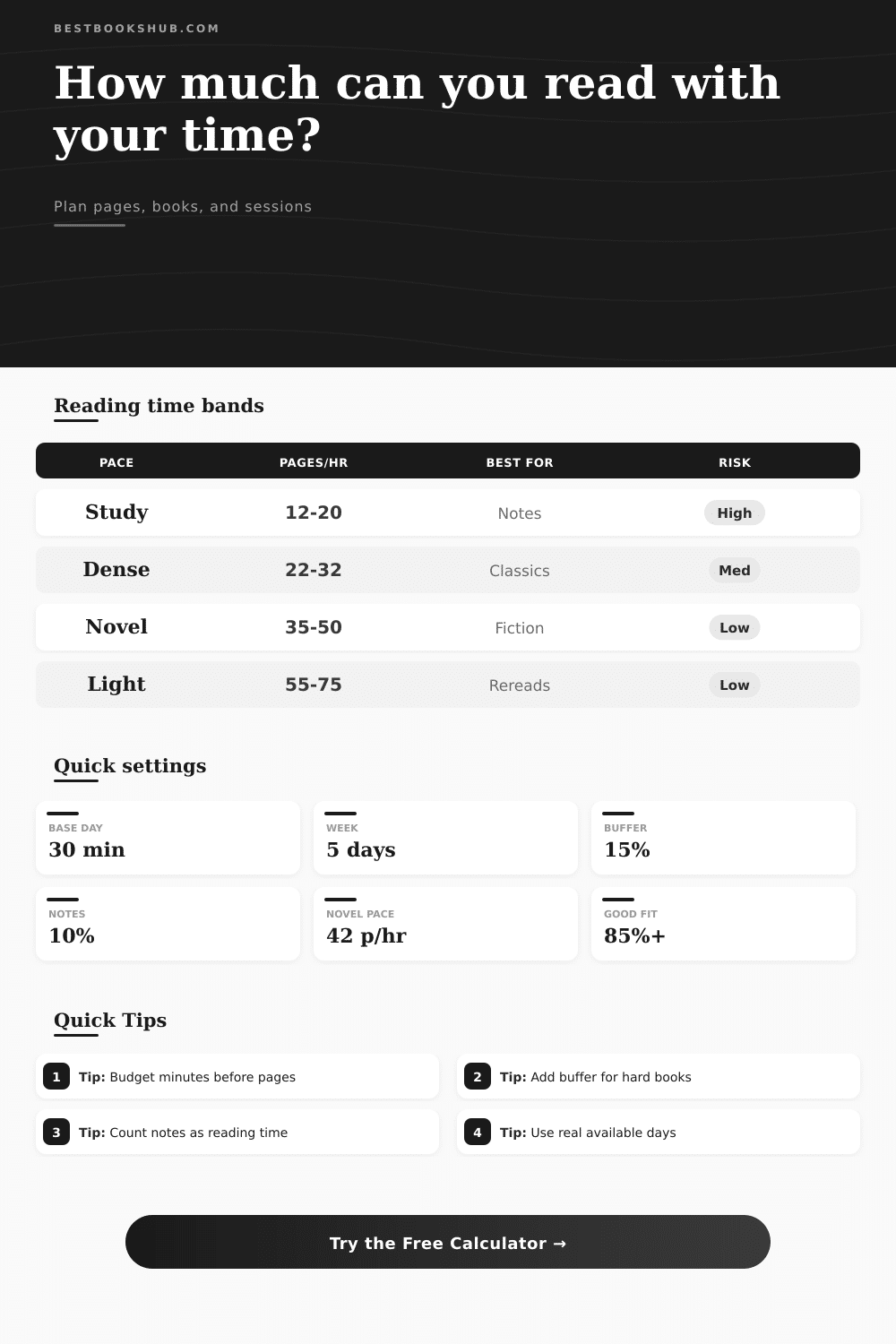
| Trade fiction | 35-50 pages/hour | 0-10% | Good baseline for recreational reading and book-count goals. |
| Literary classic | 22-32 pages/hour | 10-20% | Use extra buffer when language, references, or long chapters slow you down. |
| Textbook chapter | 12-22 pages/hour | 25-50% | Notes, rereads, diagrams, and problem sets often dominate the time budget. |
| Research article | 8-18 pages/hour | 35-60% | Abstract, methods, tables, and citation chasing require slower planning. |
| Audiobook equivalent | 70-110 pages/hour | 0-10% | Best when listening time is protected and chapter navigation is simple. |
| Scenario | Time budget | Likely capacity | Planning note |
|---|---|---|---|
| Lunch break reader | 20 min x 5 days | 60-80 novel pages/week | Works best with a book that is easy to restart mid-chapter. |
| Book club deadline | 45 min x 5 days | 130-170 pages/week | Enough for many monthly picks if the first week starts promptly. |
| Class reading block | 70 min x 5 days | 75-130 study pages/week | Notes and review should be treated as part of the reading budget. |
| Weekend stack | 120 min x 2 days | 120-170 novel pages/week | High individual sessions, but fragile if one weekend day disappears. |
| Annual challenge | 35 min x 5 days | 6,000-7,000 pages/year | Consistency matters more than occasional long catch-up sessions. |
| Adjustment | Use when | Typical range | Calculator effect |
|---|---|---|---|
| Difficulty | The prose, topic, or layout slows normal pace. | -10% to +50% | Changes effective pages per hour before capacity is calculated. |
| Notes overhead | You annotate, summarize, highlight, or pull citations. | 10% to 50% | Reserves part of each session for work around the text. |
| Reread allowance | You expect lookups, rechecking, or dense arguments. | 5% to 35% | Reduces net page output from the same reading minutes. |
| Reliability | Your available reading days are not all guaranteed. | 70% to 98% | Counts only the portion of scheduled days likely to happen. |
| Planning buffer | You want a target that survives interruptions. | 5% to 30% | Adds extra time to the target side of the calculation. |
DISCLOSURE: This post may contain affiliate links, meaning when you click the links and make a purchase, I receive a commission. As an Amazon Associate I earn from qualifying purchases.
Reading goals that are based off number of pages tend not to work. “I’m going to read 50 pages each evening” sounds like a good plan… Until your day gets away from you and you can only fit in 20 minutes. Bam: out the window goes the math.
Instead, begin with the minutes available to you, and adjust number of pages accordingly. It will change reading from an achievement metric into a realistic part of your week. But more importantly, the calculator does all those tricky conversions for you. You won’t have to wonder if 30-minutes per chapter is enough. Instead, it’ll ask what time you actualy have available. Forcing you to admit your real capacity.
Make Your Reading Plan Realistic
Chances are you’re overestimating how much bandwidth you really have each day, assuming everything will run smoothly on a perfect night. To balance your optimism, the tool includes a reliability factor. Say you enter “five days per week” as your reading goal, but you realize that half of that time will be lost to social events, fatigue, or other things. Set the reliability lower and you’ll have a realistic number to aim for, a minor tweak that will prevent you from feeling like a failure on Tuesday.
The other variable that needs some detail is pace. A long, complex book of philosophical texts should not be read at the same pace as a beach read, doing so in your plan will only lead to stress. That’s what the inputs are for: they let you account for overhead and difficulty level. Highlighting, noting things down, pausing to look up words, all of that takes time too, just as much as it takes time to turn the next page. A buffer for annotation recognizes that reading is rarely just taking in information but instead an active process. And if you don’t account for that overhead, then you end up with study session running long. Because you’re not simply moving your eyes across the page; you’re processing information.
And its output shows your total capacity in pages and translates that into book equivalents. It may be gratifing to see that your time allocation means you’ll finish six books a week, but breaking it down will tell you if that allows for re-reading tricky passages or taking many notes. You can use their reference table on the page to get a sense of average paces for different kinds of reading matter: while most people read about forty pages an hour when they’re reading a normal novel, more technical subjects can lowers this dramatically. If you match the kind of stuff you put in with what you’ll actually be reading, then the plan won’t implode under its own mass.
Intensity isn’t as important as consistency Reading for two hours on a Saturday doesn’t feel like work, and it might make you feel productive, but I doubt you’ll enjoy it or remember much afterward. Breaking up your sessions into smaller bits over several days creates a more sustainable habit. Whether you want a weekly plan or a yearly plan, the calculator tell you how many sessions you can squeeze into your schedule. If you’re intimidated by the sheer number of sessions needed, use this tool to find ways to cut back. Can you decrease the buffer time for lighter books? Are there certain weeks that you know will be lean?
A reminder: It’s okay if you don’t get to read every book in your TBR pile. That is why it is called a to-be-read list. Plans can be as detailed as you want, but real life will mess them up anyway. Good budgets account for friction. Setup time, finding your place, and getting into the flow take minutes that add up over the course of the month. If we include an additional few minutes each session (as a setup cost), the final number feels more realistic, and fits in line with our experience. The target matches your actual behavior, and you stop fighting your schedule; you work within it.
It all comes down to not burning out before finishing what you started. Base your goals on the time you actually have rather than an arbitrary number of pages. This creates a system that handles expected or unexpected delays and times when life gets hectic. Instead of focusing on the outcome, the how. You take back control of the process.
Begin with whatever minutes you have, account for the kind of book it is, and let the rest take care of itself. That’s how you turn reading into a constant practice, as opposed to a mad dash to meet some made-up deadline. You should of used this sooner.