📚 Reading circle planner
Reading circle rotation calculator
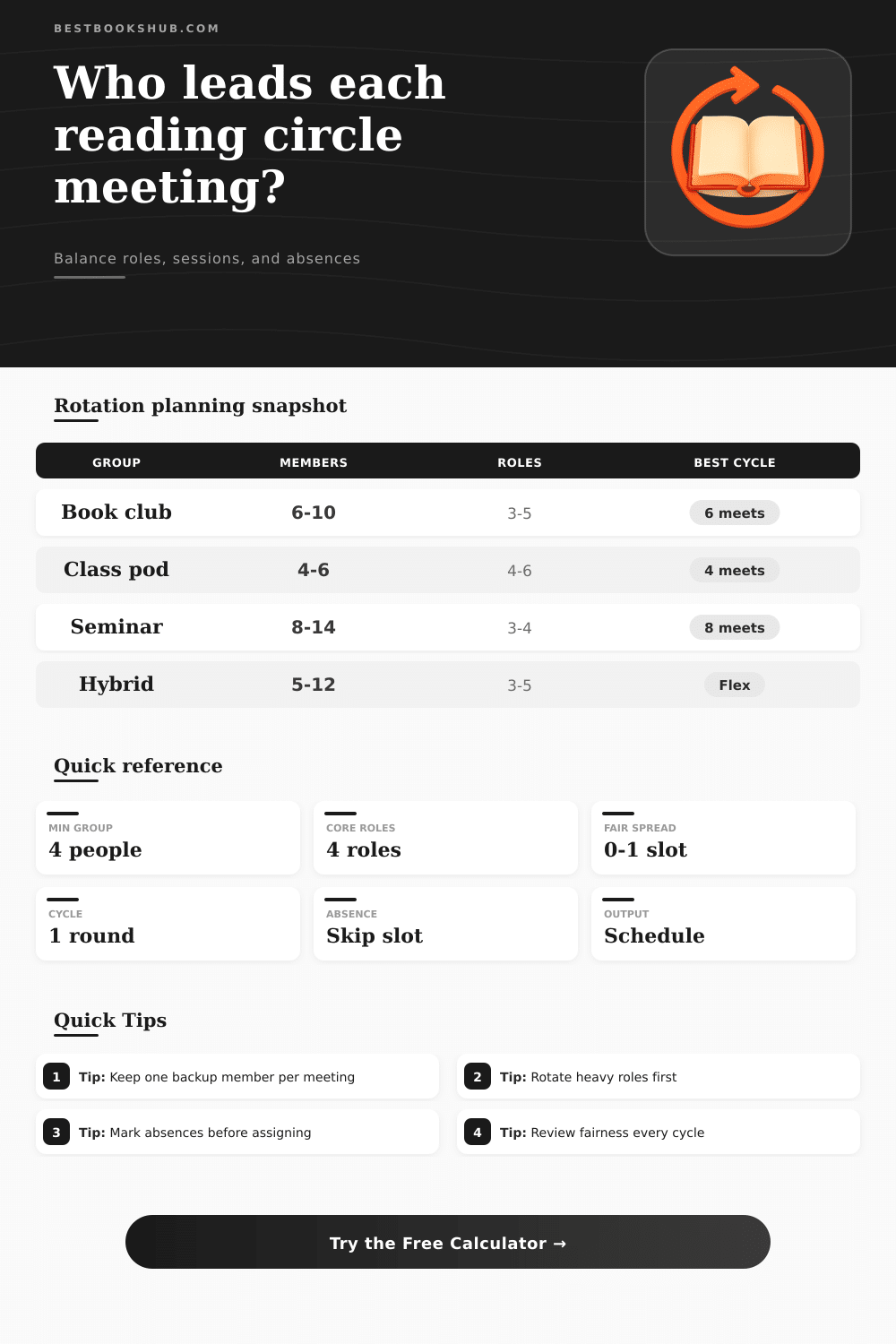
Build a fair meeting-by-meeting role rotation for book clubs, literature circles, seminar pods, and classroom reading groups.
| Group type | Typical members | Suggested roles | Rotation target |
|---|---|---|---|
| Adult book club | 6 to 12 | Facilitator, opener, passage picker, connector | Every member leads once per cycle |
| Classroom literature circle | 4 to 6 per pod | Leader, summarizer, word finder, illustrator, connector, questioner | One role per student per meeting |
| Seminar discussion | 8 to 16 | Moderator, evidence lead, question lead, synthesis lead, timekeeper | Heavy roles separated by at least one meeting |
| Family reading night | 3 to 7 | Reader, recapper, question asker, quote keeper | Simple role handoff with backup duty |
| Role set | Included roles | Best for | Load note |
|---|---|---|---|
| Classic book club | Facilitator, summarizer, passage picker, connector | Adult clubs and library groups | Facilitator usually needs extra fairness tracking |
| Literature circle | Discussion leader, summarizer, word finder, illustrator, connector, questioner | Classrooms and youth groups | Six roles work best with four to six members |
| Seminar discussion | Moderator, evidence lead, question lead, synthesis lead, timekeeper | Advanced courses and professional reading groups | Evidence and synthesis roles can be treated as heavy |
| Light rotation | Host, discussion starter, quote keeper | Small casual clubs | Easy to rotate without double duties |
| Member count | Role count | Meeting pattern | Fairness check |
|---|---|---|---|
| 3 to 4 | 3 | One role each, rotate backup informally | Watch for repeated facilitator turns |
| 5 to 6 | 4 to 6 | One responsibility per person | Best balance usually lands within one slot |
| 7 to 10 | 4 to 5 | Some members rest each meeting | Track rest turns as well as role turns |
| 11 to 16 | 4 to 6 | Use pods or a backup column | Review load after every full cycle |
| Absence pattern | Calculator behavior | Best adjustment | When to review |
|---|---|---|---|
| One known absence | Skips that member for the listed session | Give the missed role later if fairness spread grows | After the next meeting |
| Frequent travel | Eligible members absorb more active slots | Use backup duty to soften the load | Every three meetings |
| Late new member | Add the name and recalculate remaining meetings | Start with a lighter support role | After one full round |
| Small group absence | Double roles may appear if too few members are present | Reduce role count for that meeting | Before publishing schedule |
DISCLOSURE: This post may contain affiliate links, meaning when you click the links and make a purchase, I receive a commission. As an Amazon Associate I earn from qualifying purchases.
The thing about most book clubs: They begin with the best of intentions, and they die quietly when someone feels resentful of who’s doing what work. You’ve been in a club like this before. The organizer steps up to be the facilitator, and the chapter summarizer assume responsibility because nobody wants to plow through a thick passage. The breakdowns aren’t usually malicious; they’re mathematical. More accuratley, they are the hidden math of an unwritten agreement that decides everyone’s role when life gets in the way and schedules clash.
But how do we solve this? How do we distribute responsibilities in a way that honors how much preparation time each role takes; which is to say: leading versus highlighting a passage? read? That’s where rotation calculator comes in.
How to Share Book Club Work Fairly
Instead of viewing roles as check boxes, the rotation calculator treat them like weighted assets. Because leading a conversation is a heckuva lot more work than calling out a passage for someone else to highlight, you’ll want to give the facilitator role more weight (typically one point two five times, or even twice, what you’ve assigned a connector or quote keeper). Then when the tool spits out your duties, the guy who opens and closes every meeting isn’t saddled with 10 tasks by end of the month, while most quiet among us has just four.
Informal systems always break down in absence. Inevitably, at some point one of your key people will miss a meeting and rest of the group falls back on their go-to person to cover the gap. Once. Twice. Then that go-to person gets sick of it and doesn’t show up anymore.
Upfront, the calculator requests known absences so you can plan accordingly, not wishfully thinking everyone will be there perfectly. When someone can’t make it, the calculator skip over their slot and moves those tasks based off a least-loaded rule. Even when life gets in the way, the schedule stays fair. What was a potential source of friction becomes an expected logistical adjustment.
And when you pick what sort of rotation mode you use, that will change how your meeting feel. If you’re aiming for overall balance, i.e., if you have a long-running club where everyone want it to be consistent… Then choosing the balanced load approach make the total amount of work even throughout the whole term.
If you’re going for role-fairness; i.e., you don’t want one person constantly doing all the light roles while others get to talk about deep analysis, then you’ll go with a rotation order that’s role-based. With winding order, you avoid having the exact same three people talking to each other, or everyone sitting in the same seating pattern. Just by switching up the order slightly, you keep the energy of the group feeling fresh.
On the page are also handy reference tables that give you an idea of how much wiggle room there is with various group sizes. If you have a group of just four people, for instance, each role is weighted more heavily. While larger groups like seminars may be able to get away with spreading out roles (though even then, one must watch that people don’t slip into observer mode), smaller groups has less room for error because every role carries more weight per person. There’s a difference between what will work for an informal adult book club and what will work for a formal classroom literature circle, and those pressures shows through in the presets.
In the end, however, fairness isn’t just a nice idea for a book club: it’s an essential ingredient of any sustainable reading group. If participants knows that everyone shares the workload equally, they’re more likely to dive into the text; instead of fretting over whose turn it is to host next meeting. The calculator lays out the schedule beforehand to provide clarity and visibility. This eliminates guessing about who is responsible for what and ensures the discussion revolves around the book, not the logistics. Without this sense of equity, the circle wouldn’t of keep spinning.