📖 Reading load lab
Reading Time With Comprehension Calculator
Estimate how long a passage takes when pace, density, rereads, and note-taking all compete for the same reading window.
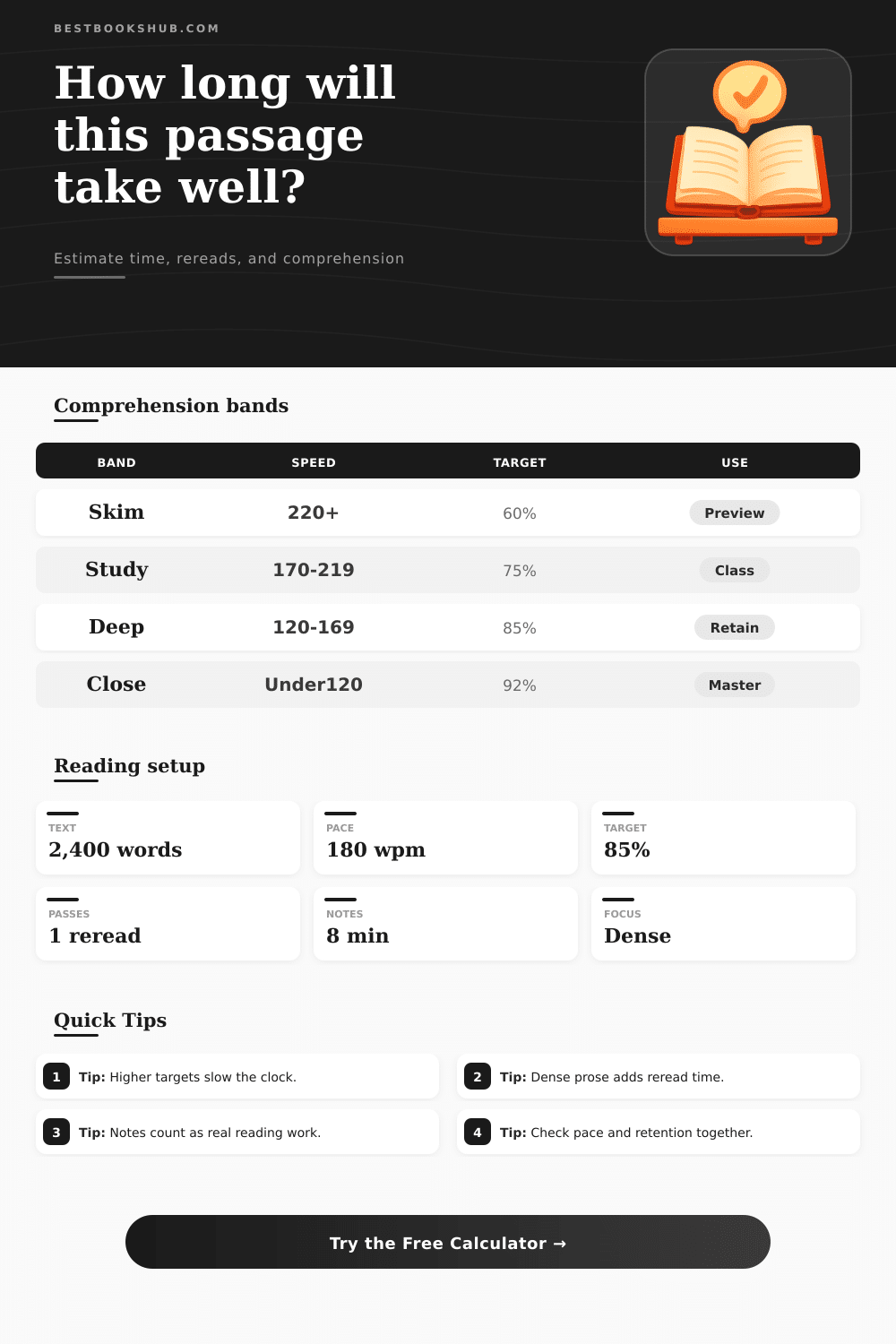
| Intent | Target | Rereads | Best use |
|---|---|---|---|
| Preview read | 60% | 0 | Scan first |
| Study read | 75% | 1 | Class chapter |
| Review read | 85% | 1-2 | Retain ideas |
| Mastery read | 92% | 2+ | Exam prep |
| Density | Factor | Drag | Typical fit |
|---|---|---|---|
| Light prose | 0.92 | Low | Fiction |
| Standard prose | 1.00 | Balanced | Articles |
| Dense prose | 1.16 | High | Nonfiction |
| Scholarly prose | 1.30 | Very high | Journals |
| Word load | Time | Fit | Signal |
|---|---|---|---|
| Under 1,000 | 5-10 min | Quick pass | Light note |
| 1,000-2,500 | 12-30 min | Chapter | One reread |
| 2,500-5,000 | 25-60 min | Study block | Notes grow |
| 5,000+ | 60+ min | Long read | Split it |
DISCLOSURE: This post may contain affiliate links, meaning when you click the links and make a purchase, I receive a commission. As an Amazon Associate I earn from qualifying purchases.
As difficult as it might seem to estimate the reading time that is require to read a certain text, such an estimation is based upon the understanding that a persons will require in order to read the text. For instance, it is likely that an individual will scan a novel quick to survey the chapter that is to be read, but may take more time to read an academic paper. Furthermore, a person level of understanding of the text may make it difficult for some to accurate estimate the time that will be required to read a text, as well as there ability to take notes and how many times they will need to reread the text.
The calculator that the article provided can calculate the reading time for a text based off several different input from the reader. Such inputs may include the word count of the text, the reading pace that an individual plan to utilize, the comprehension level of the reader, and the density of the text that is to be read. Each of these factor will have an impact upon the reading time that the calculator will determine for the individual reader.
What Affects Reading Time
For instance, a reading pace of two hundred word per minute may be enough for an individual to read a novel, but may not be enough to read scholarly articles with heavy concept that are required to be comprehended. Furthermore, the comprehension target that an individual selects will have an impact upon the reading time that is calculated. For instance, if an individual intends to achieve a comprehension rate of seventy-five percent, it is likely that an individual will be able to reach that comprehension in one reading pass of the text with light notes.
However, if an individual intends to comprehend a text to ninety percent, it is likely that it will take more reading time to reach that comprehension percentage. Thus, the comprehension percentages will impact the reading time required. Individual reading session may be complex, as the individual may scan a text to review what will be read, but later return to that text with the intention of deep reading it.
Thus, the tool accounts for the potential shift in reading intentions for that individual reader. Thus, the time to read a text is honest presented for the reader in this instance. Additionally, the density of the text can also have an impact upon the reading time for the text.
For instance, light prose may allow for an individual to read a text at a faster rate then dense or scholarly texts. The reference table that are provided on the tool will help readers to understand the various pausing rates for different type of texts. Another factor that individuals often ignore is the time that will be required for note-taking.
While it may seem like wasted time, note-taking is an essential part of reading and comprehension of a text. If individuals leave space for note-taking in their reading session, it is likely that their reading time will be sufficient for that purpose. Thus, the time required for note-taking also impact the reading time.
Another error that many individuals make is assuming that a higher comprehension percentage will produce better reading results. However, if an individual is fast-reading a text, very high comprehension percentages may require too many note-taking for that individuals reading speed. Thus, the tool will reflect that if the comprehension percentage and reading speed is not balanced for an individual reader.
Thus, the tool will encourage an individual to change one variable rather than both variables. The length of the text also will have an impact upon the reading time. For instance, short texts that contain fewer than one thousand word may not necessarily require the same amount of note-taking as texts that is over a few thousand words.
Thus, a word load table is included that allows for the division of these long texts into separate reading sessions. Finally, once all variables have been accounted for in the reading time calculator, an individual will have an estimate of the time that will be required to read that text. However, if the reading time estimate is greater than the time that individual expects, then the comprehension target can be lowered or the number of rereads of the text can be lowered.
While it might be tempting to try to read the text at a faster rate, that will only lead to decrease comprehension of the text. Thus, adjusting these two variables will allow for an individual to ensure that their reading session is productive but not too much demanding for that reader.