📊 Reading rhythm lab
Reading consistency score calculator
Score your weekly reading rhythm from planned days, actual sessions, reading minutes, streak health, missed days, pages finished, and how steady each session feels.
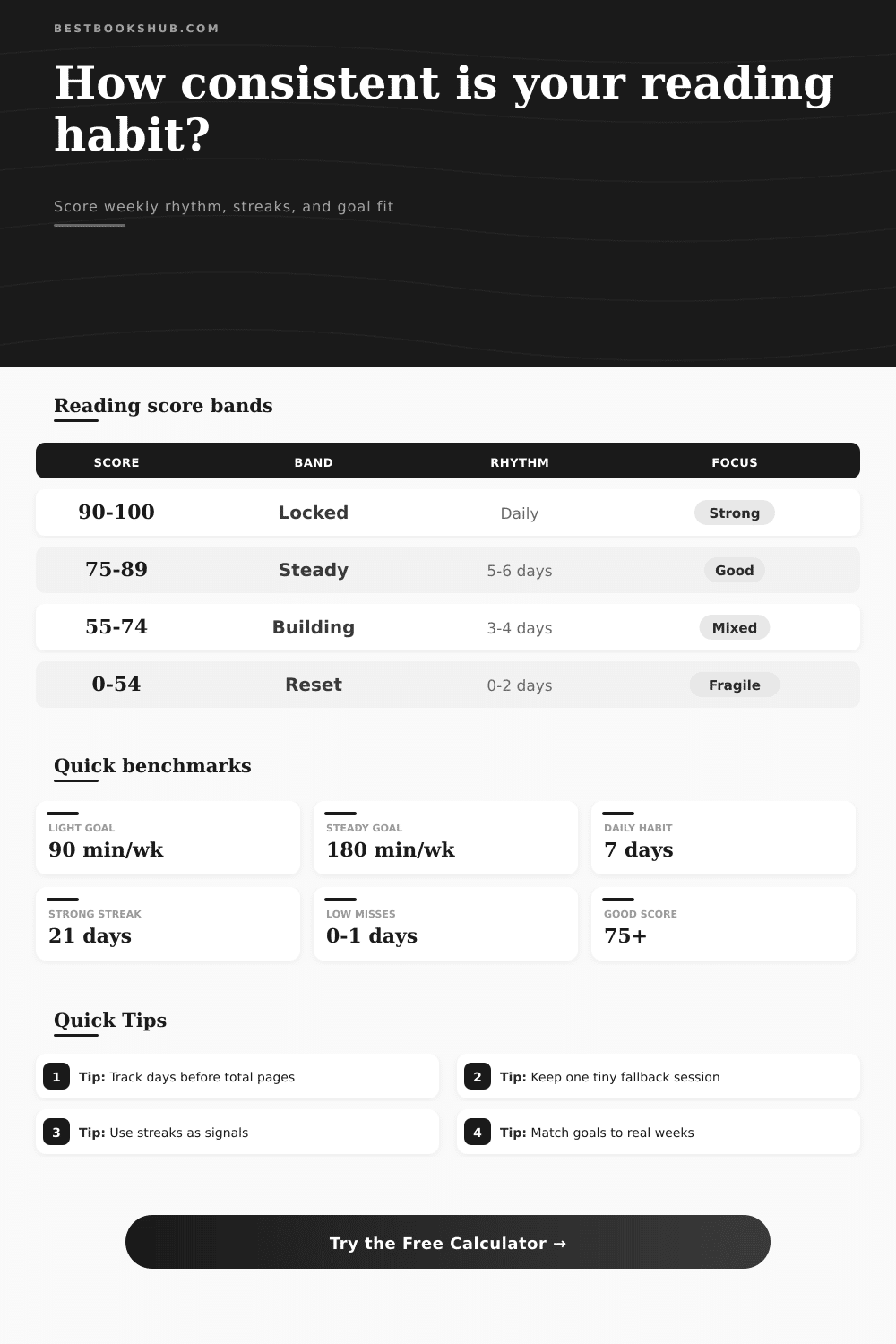
| Score range | Band | Typical weekly rhythm | What it usually means |
|---|---|---|---|
| 90-100 | Locked In | Daily or near-daily reading | Your schedule, volume, streak, and recovery all support the goal. |
| 75-89 | Steady Reader | Five to six days with reliable sessions | The habit is durable, though one score area can still be tightened. |
| 55-74 | Building Rhythm | Three to four days or uneven session lengths | You are reading, but missed days and volume gaps still shape the week. |
| 35-54 | Fragile Habit | One to three reading days with recovery gaps | The plan likely needs a smaller baseline or a clearer fallback session. |
| 0-34 | Reset Mode | Rare reading or repeated missed plans | A tiny daily target may work better than a large weekly promise. |
| Cadence | Sessions | Minutes per session | Weekly total |
|---|---|---|---|
| Daily micro habit | 7 | 10-15 | 70-105 minutes |
| Weeknight reader | 5 | 25-35 | 125-175 minutes |
| Deep weekend reader | 2 | 75-120 | 150-240 minutes |
| Commute audiobook | 5 | 20-45 | 100-225 minutes |
| Study block plan | 4 | 45-60 | 180-240 minutes |
| Reading goal | Useful target | Consistency risk | Best fallback |
|---|---|---|---|
| One casual book monthly | 60-90 pages per week | Low if sessions happen three days | One chapter or 10 minutes |
| Two books monthly | 130-180 pages per week | Moderate without weekday sessions | Fifteen pages before bed |
| Assigned class reading | 150-250 pages per week | High if postponed to one block | Twenty-five focused minutes |
| Audiobook progress | 180-300 minutes per week | Low when tied to commute time | One short walk chapter |
| Slump recovery | 35-70 pages per week | High if the target feels performative | Five pages with no catch-up |
| Preset | Pattern | Typical score driver | Watch point |
|---|---|---|---|
| Morning Pages | Short daily print sessions | High adherence and streak health | Protect the start time |
| Weekend Sprinter | Large blocks on two days | Strong volume alignment | Low day frequency can weaken rhythm |
| Audiobook Commuter | Repeated listening windows | Easy recovery after missed days | Trips or remote weeks may interrupt it |
| Exam Prep Reader | Study blocks with page targets | Clear sessions and pages | Erratic blocks can inflate fatigue |
| Reading Slump Reset | Very small daily targets | Recovery and habit restart | Avoid adding catch-up pressure too soon |
DISCLOSURE: This post may contain affiliate links, meaning when you click the links and make a purchase, I receive a commission. As an Amazon Associate I earn from qualifying purchases.
We’re conditioned to read as a sprint. Unfortunately, life throws curves at us that throw off our game. You’ve committed to reading one page per hour every night. But then life happens. You only have 20 minutes. It’s the weekend and you binge out in a fit of desperation. Why? Because your plan is unworkable day-to-day.
This is where consistency metrics comes in. They measure not the number of pages we turn… But whether or not we showed up. Showing up are more important than turning pages, it creates a sustainable habit. So after you plug in how many days per week you want to “work out,” the calculator does the math (and reminds you that one extra day isn’t going to make a difference). It then compares your planned number of days with actual number of sessions, and how well your streak stay healthy compared to how fast it recovers after a break.
Make Reading Easy and Consistent
People who read tend to fixate on their page count or minutes, but these aren’t long-term habit metrics. Three days in a row is nice, until you go four days without reading and break the neural pathway. The calculator tell you when you’re getting fragile, before you realize it’s a problem.
Daily micro-habits versus weekend sprints. One person reads 20 minutes per day, another read for two hours on Saturday. They’ve both hit the same volume, but your brain will treat those two schedule differently. Motivation behaves more like the weather; routine feels like architecture. When you’re busy, or tired, it’s there standing up for you. Even though you have a high overall minute count, the tool will give a lower score to an uneven pattern, forcing you to face facts about your schedule.
Missing a session can snowball. Skipping this week leads to missing next week. Because of this, recovery is an overlooked factor for habit formation: Long gaps between recoveries can be punished by the calculator, as these represent a brittle plan. If one miss ruins your week, then you’ve got a big goal which should of been scaled down with a smaller baseline.
Even if all you have time for is ten minutes, that’s better than nothing, keeping the chain alive. Your brain remembers you’re a reader, even on bad days.
What’s the friction that prevents you from reading? What stops you from reading more? Time isn’t as big of a killer for habits different than friction. (It’s hard to open up a thick textbook when you’re scrolling through social media.) If your book is buried in another room, you won’t read it. You won’t pick them up. If your audiobook app requires three password resets, you will listen to music instead. Then turn on some music.
Make it easy. Place your e-reader on the nightstand with it turned on. Have a paperback on your pillow. Make the behavior you want easiest to do. It’ll become the easiest way. The tool calls out some of these common pitfalls with presets. For exam prep, people tend to schedule long blocks that don’t work come finals week. Commuters need plans that adapt to unexpected changes. And family read-alouds revolves around unpredictable energy levels of kids; every context has its own set of risks.
If your plan lacks elasticity, your consistency score might drop to zero during a crisis. Plan for six days when you can only manage five; view the sixth day as bonus time. The score isn’t a grade, it’s a diagnostic. If your score is low, that doesn’t mean you’re doing it wrong; it means you need to add some more redundancy or reduce amount of friction in your system. Tinker with the inputs: shorten the sessions or make them happen more often. Observe how the score changes. Eventually it will stabilize at a rhythm that accommodates your real life, not your imagined one.
Stop trying to remember to do something. Make it who you are. That’s when habits stick. You don’t read more; you stop trying to remember to read.