📚 Corner capacity planner
Reading Corner Capacity Calculator
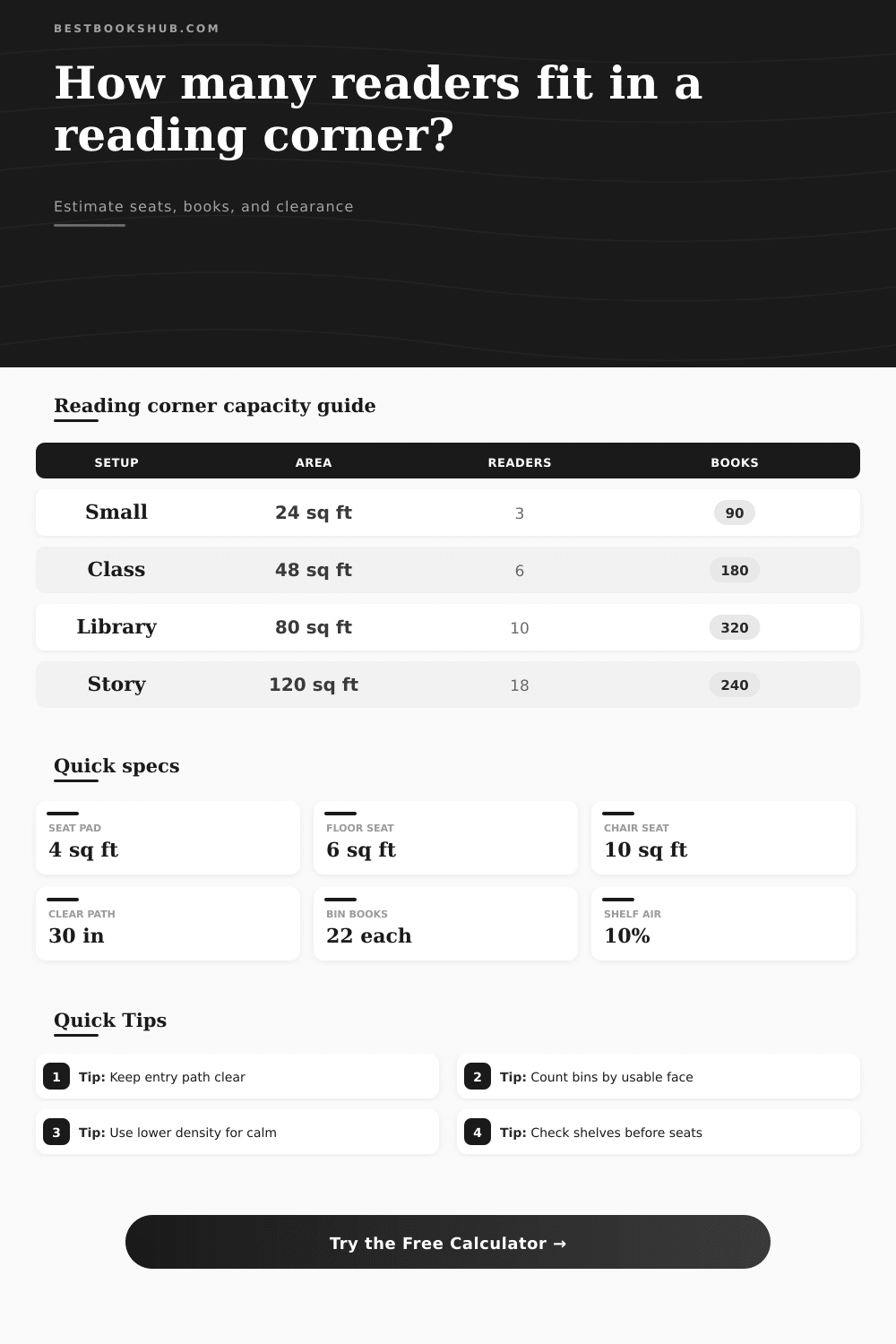
Estimate how many readers, books, book bins, and shelf rows a reading corner can hold while preserving clear walking space and a calm layout density.
| Seating style | Area per reader | Best use | Capacity note |
|---|---|---|---|
| Floor cushions | 6 sq ft / 0.56 sq m | Elementary classroom corners | Good capacity when shoes, bags, and bins are outside the rug. |
| Mixed stools and cushions | 8 sq ft / 0.74 sq m | Flexible library corners | Allows varied posture without turning the space into a crowded row. |
| Chairs or lounge seats | 10 sq ft / 0.93 sq m | Independent reading nooks | Works best with a wider entry path and side clearance. |
| Bench seating | 5 sq ft / 0.46 sq m | Wall-backed corners | Efficient when readers share a long cushion and storage sits below. |
| Story circle | 7 sq ft / 0.65 sq m | Read-aloud groups | Includes teacher sightline and a looser central floor shape. |
| Quiet low-density nook | 12 sq ft / 1.11 sq m | Calm zones and older readers | Prioritizes comfort, fewer seats, and better personal space. |
| Book format | Average spine | Books per 36 in row | Weight per 100 books |
|---|---|---|---|
| Picture books | 0.42 in / 1.1 cm | 77 after air space | 55 lb / 24.9 kg |
| Early readers | 0.45 in / 1.1 cm | 72 after air space | 40 lb / 18.1 kg |
| Chapter books | 0.62 in / 1.6 cm | 52 after air space | 60 lb / 27.2 kg |
| Trade paperbacks | 0.75 in / 1.9 cm | 43 after air space | 80 lb / 36.3 kg |
| Hardcovers | 1.10 in / 2.8 cm | 29 after air space | 160 lb / 72.6 kg |
| Graphic novels | 0.38 in / 1.0 cm | 85 after air space | 85 lb / 38.6 kg |
| Corner size | Typical setup | Estimated readers | Storage fit |
|---|---|---|---|
| 4 x 5 ft / 1.2 x 1.5 m | One chair plus small bin | 1 to 2 | 40 to 80 books with bins only |
| 6 x 6 ft / 1.8 x 1.8 m | Small classroom rug corner | 4 to 5 | 120 to 180 books with short shelves |
| 8 x 8 ft / 2.4 x 2.4 m | Full classroom reading zone | 7 to 9 | 200 to 320 books with shelves and bins |
| 10 x 10 ft / 3.0 x 3.0 m | Library bay or larger calm zone | 10 to 14 | 320 to 520 books depending on format |
| 12 x 10 ft / 3.7 x 3.0 m | Story circle with browsing wall | 14 to 18 | 250 to 450 books with looser circulation |
Capacity is based on open floor area after storage, entry clearance, obstacles, and a comfort buffer. Lower-density settings are better for quiet reading.
DISCLOSURE: This post may contain affiliate links, meaning when you click the links and make a purchase, I receive a commission. As an Amazon Associate I earn from qualifying purchases.
Shelf capacity uses spine width and a 10 percent browsing air gap. Bin capacity is added separately because front-facing storage behaves differently from shelf rows.
A reading corner can have enough square footage but still feel blocked if the entry lane crosses seating. Keep the path near the outside edge when possible.
Use the rotation share when the full classroom or home collection does not need to sit in the corner at one time.
So here you are, at the uncomfortable junction of bookshelf and radiator. Can someone really sit down there and read? It’s one version of constant issue faced by parents, teachers, and librarians who is desperate to add a comfy reading nook but have square-footage that won’t accommodate their ambitions. Adding storage compounds the difficulty, and there just isn’t enough room before you even put a cushion in the area.
How do you reconcile your wish to have lots of books AND leave some breathing space so people (bodies) can sits down? You can plug in your dimensions and let the calculator do the math (see the one up top?); there’s no need to try to do the conversion and coefficient guesswork that typically throws people off.
How to Plan a Cozy Reading Nook
First, it asks what shape your floor plan is, such as a straight rectangle or an L-shaped alcove with a sloping ceiling. The usable area goes down fast if your furnitures has to bump around walls and radiators. Enter the length and width, but the tool doesn’t simply multiply; first, it takes away space required for fixed obstacles and entry paths.
And that’s where most people go wrong. They assume they have X amount of square footage, so that’s how many chairs their room can hold. But if they don’t set aside a thirty-inch wide path for entering and exiting, the reading corner become a trap. The kids gets stuck, the books get knocked over, and poof!, the serene mood is gone.
After that it calculates density; how many readers can be seated in the space, given the type of seat they’ll use. Kids sitting cross-legged on the floor are closer together (hence fewer square feet needed) than kids sitting in chairs. To give readers a little personal space (that’s why we call this a “buffer”): a typical estimate of six square feet per child for floor cushions. Chairs require more space because they need pull-out clearance and shoulder room.
Depending on your choice of furniture, the calculator tweaks its recommendation: a full lounge seat takes up slightly more space then a stool, which takes up slightly more space than a floor cushion. It also adds a comfort buffer (by default ten percent, but you can change it), so that the density is low enough for actual relaxation. Want a super-high energy story circle? Reduce the buffer; want a quiet zone where kids work independently? Increase it. Sometimes it’s just those couple of extra inches per kid that make the difference between a comfortable space and a cramped one.
The other side of the equation is storage. Efficient-looking shelves are great, until they get in the way of sight lines or encroach upon the seating zone. Because books-in-bins and books-on-shelves behave differently, the calculator treats them as separate variables, asking about both book bins and shelf dimensions. While bins hold fewer books, they let kids see those books up-front, encouraging them to browse. In contrast, shelves holds more books, though only at the cost of deeper floor space. Calculating capacity means considering both spine width and adding an extra ten percent “air gap” so the books don’t jam together.
Why? It’s a little thing, but it matters. Give ’em breathing room and nobody browses; no breathing room and nobody gets access to the books. Finally, set your desired books-per-corner goal and find out whether your existing configuration allows for rotation. Shortfall? It is time to start curation and/or consider adding yet another bin.
The trick isn’t packing in as many people as possible, it’s arranging for the space to flow. You want readers to linger in the reading corner, not jam up traffic. On the previous page, I lay out typical configurations, illustrating how a six- by six-foot section could accommodate four readers with short bookshelves, and an eight- by eight-foot one would hold just under twice that many (with ample room between them). Those figures are benchmarks; use them to compare what you came up with.
Are the figures low? You may have overestimated the storage space. High? You’re probably forgetting about clearance. The sweet spot is when the seating feels comfortable but not cramped. The book collection shouldn’t feel overwhelming, yet it should be right there in view.
In the end, the most comfortly nooks to read in seem like they happened by accident, like those cushions had been sitting there, patiently waiting to be sat on. The planning wasn’t careless, which is why it doesn’t look planned. Measure twice, cut out the obstacles, leave yourself a little clearance, and then fill that area with as many soft things as you can fit: Books! Pillows!
The math helps you get there. It converts that worry about how will we ever get everybody in here into a nice neat list of numbers that you can believe in. If the equation is right, then so will the coziness. And before you know it, you’re left with a cozy spot where kids will opt to sit rather than joining the hubbub in the middle of the classroom. It is a place that seems somehow big enough for everyone, even though it holds lots of people; and quiet despite a crowded classroom; and welcoming enough that anyone would want to spend time there. It’s worth every extra minute of measuring.