📚 Reading performance lab
Reading efficiency calculator
Estimate useful reading speed by combining words per minute, focus quality, comprehension, rereading, breaks, and deadline pressure into one practical reading plan.
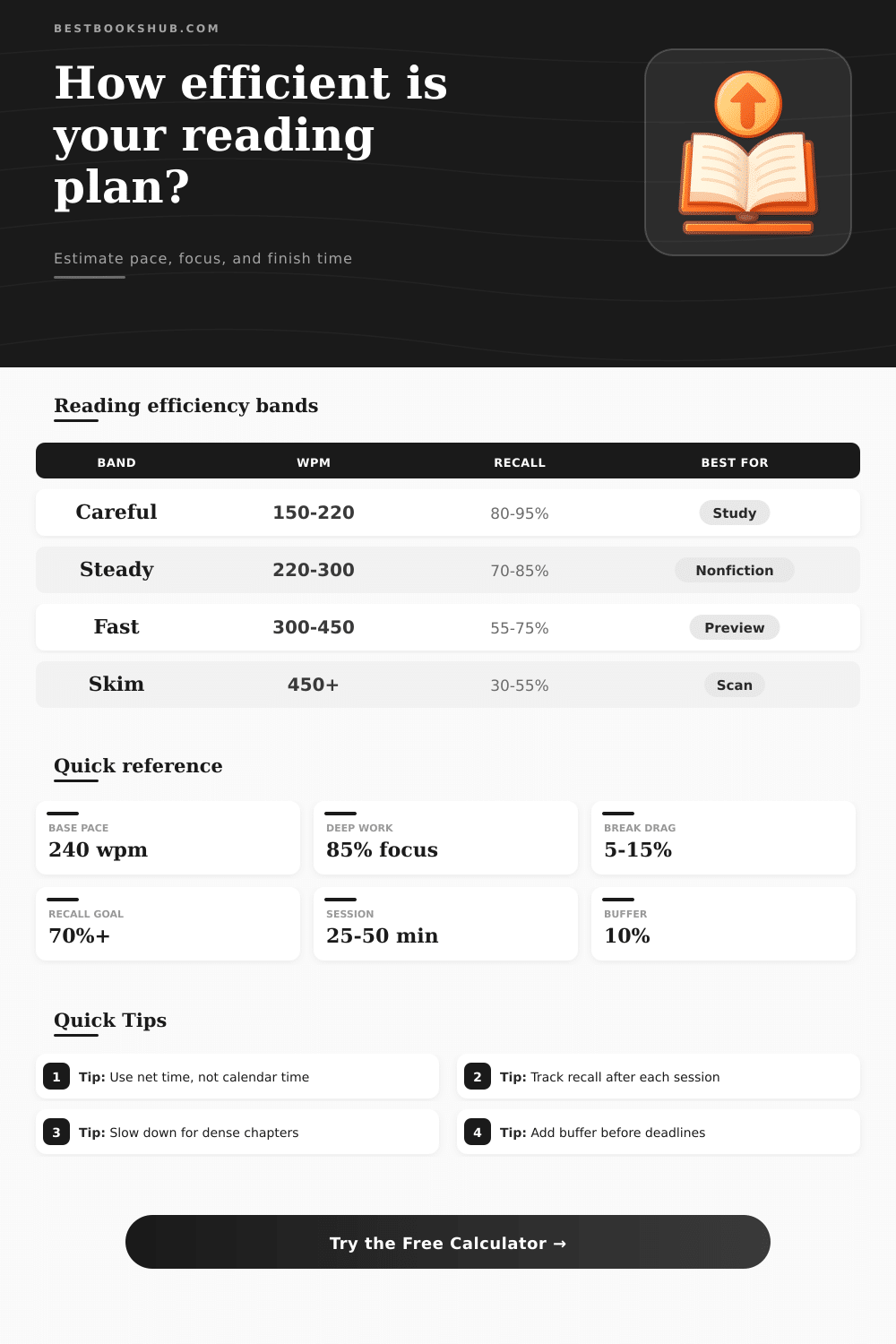
| Reading mode | Typical raw speed | Recall range | Best use |
|---|---|---|---|
| Careful study | 150-220 wpm | 80-95% | Textbooks, arguments, technical passages |
| Standard engaged reading | 220-300 wpm | 70-85% | Most nonfiction and serious essays |
| Fluent leisure reading | 280-380 wpm | 60-80% | Fiction, memoir, familiar subjects |
| Preview or survey pass | 350-500 wpm | 45-65% | Finding structure before a deeper pass |
| Skim and scan | 500+ wpm | 30-55% | Locating facts, names, or sections |
| Session length | Break pattern | Good for | Planning note |
|---|---|---|---|
| 20-25 minutes | 5 minutes | Dense study or low energy | Use more sessions and expect less fatigue |
| 35-45 minutes | 7-10 minutes | Balanced daily reading | Works well for nonfiction and notes |
| 50-60 minutes | 10-15 minutes | Immersive fiction or long chapters | Best when distractions are already controlled |
| 75-90 minutes | 15-20 minutes | Deadline reading blocks | Add buffer because recall can fade late |
| Book format | Typical words/page | Reading load | Use in calculator |
|---|---|---|---|
| Trade fiction | 250-300 | Moderate | Use 275 when page density is unknown |
| Academic textbook | 400-550 | Heavy | Increase density and notes together |
| Mass market paperback | 220-260 | Light to moderate | Lower words per page if margins are tight |
| Illustrated nonfiction | 150-250 | Variable | Use lower words but add lookup time |
| Research paper PDF | 600-800 | Very heavy | Use high density and detailed notes |
DISCLOSURE: This post may contain affiliate links, meaning when you click the links and make a purchase, I receive a commission. As an Amazon Associate I earn from qualifying purchases.
Have a 300-page textbook for your test in two days? Do you start panicking as soon as you see those last three hundred pages? Your eyes starts flipping through book at light-speed… Without tracking anything on the page. You think “I’m reading really fast! I must be making progress!
Unfortunately, reading faster isn’t automatically better if your recall drops. Efficient reading isnt about how many pages per minute you read; it’s about how much you remember once you close book. Once you enter your estimated pace and page-count into the calculator, itll do the math for you. You don’t need to guess at conversions or coefficients.
How to Read Better for Tests
If you’re typical, you has one fixed reading speed. It’s like you’re either 5’7″ or 6’1″. It doesn’t matter if you’re struggling through a complex philosophy essay or devouring a murder mystery. Most folks don’t realize that what actualy happens while they’re reading (and their speed) depends entirely on the material.
A paragraph full of equations or complex legal text will put a heavier strain on your mind than something light and fluffy. You can’t just recognize the same pattern and keep chugging along. Instead, your brain must stops, reconfigure and parse unfamiliar ideas.
The problem is, few study plans factor this into their schedules. Everything looks great on paper … until you try doing it and notice how much denser material slow you down. Which is why stuff like annotation intensity and text density matter. This is because you are not just reading words; you are interacting with them.
When you highlight important arguments, look up unknown terms, take structured notes, etc., your raw speed will plummet. Which isnt a bad thing! That’s the price of comprehension; raw speed at the expense of recall isnt necessarily better. The efficiency score rewards all three: speed, focus, and comprehension. And that means it forces you to recognize that the quickest route to learning is sometimes by slowing down.
The second invisible productivity killer is constant concentration. Your attention has limits. Forcing yourself past exhaustion produces sharply declining returns very quickly. Breaks aren’t wasted time; they’re required for consolidation. If you schedule an hour of intense reading, you should of budget for the breaks in-between spurts of effort.
If you are in a rush and desperate to meet a deadline, it may seem that taking a twenty minute pause every forty five minutes will waste precious minutes. But you’ll be rereading the same sentence three times when your mind quit receiving fifteen minutes ago. The chart on the page illustrate how varying session lengths combined with corresponding break schedules produce best learning retention without burning you out.
The most underrated part of any project plan is buffer time. It doesn’t matter how organized or motivated we are. Life happens. There will be distractions. Some chapters will be more difficult then others. Add a realistic buffer and you protect your sanity from the unexpected. Otherwise, one difficult chapter can throw off an entire week of plans, resulting in abandoned goals and feelings of guilt. But with a buffer, you’re able to adjust to match without caving under pressure.
Ultimately, good reading is more about tactics than raw power. It means being frank with yourself about when you’re “in the zone” and setting realistic goals about how long it takes for complicated concepts to click. If you approach reading like a skill dependent on context instead of a fixed attribute, you can construct a schedule that will succeed. You’ll no longer be running against the clock; you’ll be swimming with the current of your brains natural cycles.
Not only do you have to get through the book, you need to remember it. When you absorb this trade-off, the math makes sense, and the anxiety transforms itself into a feasible plan.