📖 Reading Fluency Calculator
Calculate words per minute (WPM), fluency rating, and grade-level benchmark comparison
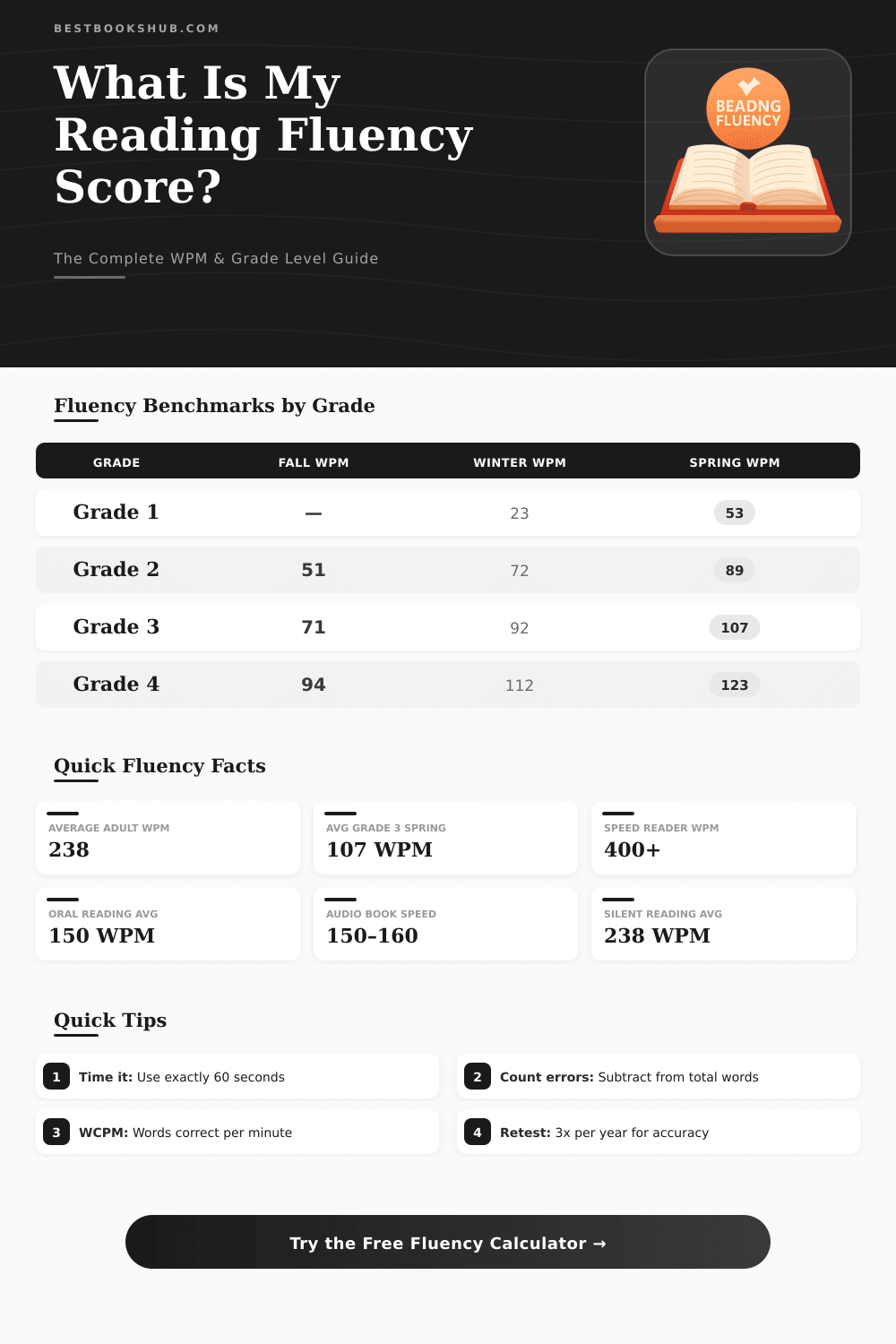
| Grade | Fall WPM | Winter WPM | Spring WPM | Fluency Goal |
|---|---|---|---|---|
| Grade 1 | — | 23 | 53 | ≥53 WCPM |
| Grade 2 | 51 | 72 | 89 | ≥89 WCPM |
| Grade 3 | 71 | 92 | 107 | ≥107 WCPM |
| Grade 4 | 94 | 112 | 123 | ≥123 WCPM |
| Grade 5 | 110 | 127 | 139 | ≥139 WCPM |
| Grade 6 | 127 | 140 | 150 | ≥150 WCPM |
| Grade 7 | 128 | 136 | 150 | ≥150 WCPM |
| Grade 8 | 133 | 146 | 151 | ≥151 WCPM |
| Adult | — | — | 200–238 | ≥200 WCPM |
| Rating | % of Benchmark | Description | Recommended Action |
|---|---|---|---|
| 🟢 Advanced | ≥120% | Well above grade level | Enrichment / challenge texts |
| 🟢 Proficient | 100–119% | At or above benchmark | Maintain current instruction |
| 🟡 Developing | 80–99% | Approaching benchmark | Monitor & support |
| 🟠 Emerging | 60–79% | Below benchmark | Targeted intervention |
| 🔴 Intensive | <60% | Significantly below | Intensive daily support |
| Accuracy % | Reading Level | Errors per 100 Words | Instruction Zone |
|---|---|---|---|
| 98–100% | Independent | 0–2 errors | Self-selected reading |
| 95–97% | Instructional | 3–5 errors | Guided reading |
| 90–94% | Frustrational | 6–10 errors | Teacher-supported |
| Below 90% | Too Difficult | >10 errors | Choose easier text |
| Reader Speed | WPM | Mins per Page (250 words) | 200-page book time |
|---|---|---|---|
| Slow / Developing | 100 WPM | 2.5 min/page | ~8.3 hours |
| Average Student | 150 WPM | 1.7 min/page | ~5.6 hours |
| Average Adult | 238 WPM | 1.05 min/page | ~3.5 hours |
| Fast Reader | 300 WPM | 0.83 min/page | ~2.8 hours |
| Speed Reader | 450 WPM | 0.56 min/page | ~1.9 hours |
Reading Fluency is the skill to read text smoothly, quickly and with right tone. It works as a tie between word recognition and the understanding of the content, what makes it key for each person that learns to read. If readers manage to process words automatically their minds can focus on the real sense of the text.
DISCLOSURE: This post may contain affiliate links, meaning when you click the links and make a purchase, I receive a commission. As an Amazon Associate I earn from qualifying purchases.
Readers with good flow read correctly and easily, while they well understand the content. Those students that have troubles with the basic mechanics of reading, find these skills difficult to learn. Strong skills of oral flow are tied to good results in various parts of leraning to read.
Reading Fluency: What It Is and How to Improve
Four main elements form Reading Fluency: accuracy, automaticity, good rhythm and prosody. Prosody simply means reading with the right expression and pauses. If children read easily, it is easier for them to seize the meaning of what they read.
They read out loud in a smooth and natural way.
Reading Fluency is strongly tied to the understanding of reading. Students that read easily usually well understand what they read. Easy reading also helps to build confidence to address longer or more hard texts.
This confidence is especially important when the reading materials become harder threw the years.
One good method is repeated reading. Usually it is enough if students read text four times to improve the flow. The teacher first shows how to read the text, and later the students read it.
Everyday reading of the same text backs accuracy, flow and understanding at the same time. Students need chances to practise out loud reading with thefeedback of the teacher.
The flow depends on many basic skills that must be automatic before. Elements like sounds, syllables and grammar all must become second nature at the stage where one practises the flow. It is a mix of so many causes that it involves.
Reading Fluency forms a set part of literacy. Students reach a maximum level, and here one can end with extra teaching of flow. In higher grade levels it is more likely that some students do not need extra work on flow.
Readers with good flow most commonly feel glad, proud and motivated about their literacy. As their confidence grows, they more like to read and keep the improvement. That creates a positive circle that feeds itself.
Poetry helps a lot to build Reading Fluency thanks to its natural flow and rhythm, what is especially useful for young readers. Work on flow that includes repeated readings of hard text is a basic method to back the learning support.