📚 Reading Goal Calculator
Calculate exactly how many books you can read this year based on your speed, schedule & book length
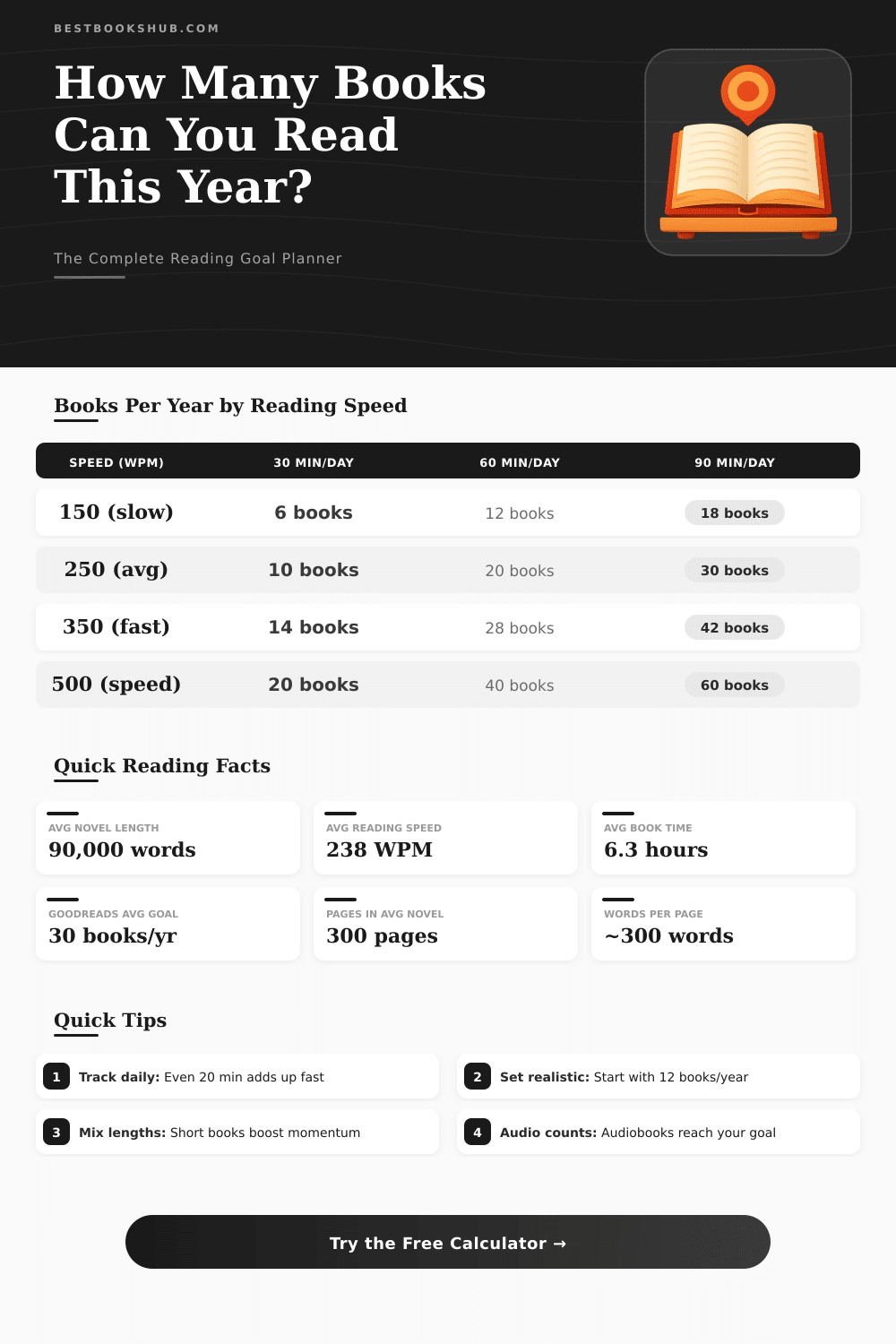
| Reading Speed | 20 min/day | 30 min/day | 45 min/day | 60 min/day |
|---|---|---|---|---|
| 150 WPM (slow) | 4 books | 6 books | 9 books | 12 books |
| 200 WPM | 6 books | 9 books | 13 books | 17 books |
| 250 WPM (avg) | 7 books | 11 books | 16 books | 21 books |
| 300 WPM | 8 books | 13 books | 19 books | 25 books |
| 350 WPM (fast) | 10 books | 15 books | 22 books | 30 books |
| 500 WPM (speed) | 14 books | 21 books | 32 books | 42 books |
| Format | Word Count | Est. Pages | Hrs at 250 WPM |
|---|---|---|---|
| Flash Fiction | 1,000 – 1,500 | 4 – 6 | 0.1 hrs |
| Short Story | 1,500 – 10,000 | 6 – 40 | 0.7 hrs |
| Novella | 20,000 – 50,000 | 80 – 200 | 2.7 hrs |
| Short Novel | 50,000 – 70,000 | 200 – 280 | 4.0 hrs |
| Standard Novel | 70,000 – 100,000 | 280 – 400 | 6.3 hrs |
| Long Novel | 100,000 – 150,000 | 400 – 600 | 8.3 hrs |
| Epic Novel | 150,000+ | 600+ | 10.0+ hrs |
| Non-Fiction | 50,000 – 80,000 | 200 – 320 | 4.4 hrs |
| Book Length | 150 WPM | 250 WPM | 350 WPM | 500 WPM |
|---|---|---|---|---|
| 50,000 words | 5.6 hrs | 3.3 hrs | 2.4 hrs | 1.7 hrs |
| 75,000 words | 8.3 hrs | 5.0 hrs | 3.6 hrs | 2.5 hrs |
| 90,000 words | 10.0 hrs | 6.0 hrs | 4.3 hrs | 3.0 hrs |
| 120,000 words | 13.3 hrs | 8.0 hrs | 5.7 hrs | 4.0 hrs |
| 150,000 words | 16.7 hrs | 10.0 hrs | 7.1 hrs | 5.0 hrs |
| Goal Level | Books / Year | Daily Mins Needed | Notes |
|---|---|---|---|
| Beginner | 6 – 12 | 15 – 20 min | Great starting point |
| Casual | 12 – 20 | 20 – 30 min | Goodreads avg goal |
| Moderate | 20 – 36 | 30 – 45 min | Most book clubs aim here |
| Avid | 36 – 52 | 45 – 60 min | 1+ books per week |
| Power Reader | 52 – 100 | 60 – 90 min | CEO / leader level |
| Speed Reader | 100+ | 90+ min | Trained technique needed |
Time yourself reading a known word-count passage for 1 minute. Divide words read by time. Most adults read 200–300 WPM for fiction and slightly slower for dense non-fiction.
Reading 20 minutes every single day (7 days) adds up to 121 hours per year — enough to finish 20+ standard novels at an average reading pace. Streaks matter more than speed.
A reading target simply is stuff that you set for your reading habits. It can be some books, a certain amount of pages or fixed time for reading. New readers commonly choose to finish a set of pages or books each day, week, month or year.
DISCLOSURE: This post may contain affiliate links, meaning when you click the links and make a purchase, I receive a commission. As an Amazon Associate I earn from qualifying purchases.
On the other hand, you simply can choose a time daily and stay at it. Whatever works in your life. Such targets genuinely alter how you read and think
How to Set Simple Reading Goals
For the most of folks a real everyday target lands between 15 and 20 minutes, or maybe 10 to 20 pages depending on what does not feel heavy. Starting with 20 minutes a day is a good base. Even only ending a chapter before sleep works well, commonly only 10 minutes or less, according to the book.
Many folks swear by 10 pages daily. Here is the key: most days you will read more than that, but a low bar makes it easy to push those 10 minutes before sleep, which stiks as a habit.
There are many ways to form a reading target. The traditional way is to set a total number of books for the year. Reading trackers almost always urge that you set it in January.
Some aim for 24 books yearly, because that amount well helps mental health. Others go higher, 52 or even more than 100. For big numbers audiobooks and short books will be your best aids.
Thematic challenges can surprisingly entertain. Maybe you read a book from every state or province, or follow the alphabet finding titles for every letter. You could search for authors with the same first name or every month choose a land and a book from there, this well opens new ideas and viewpoints.
There is even a challenge to trace 26 different authors, one for every letter from A to Z.
But not all targets deal with numbers. Read more poetry, buy only at independent bookshops, take everything from the library or start a blog for reviews of finished books, these are good targets. Even simply giving up books that do not please, instead of forcing yourself to end them, is a good notion.
Note what you read genuinely matters. Use reading apps. Programs like StoryGraph or Bookly are very practical.
Even a simple list on the refrigerator suffices. StoryGraph shows what books you ended, total pages, what genres dominate, what formats you like and how many fiction against nonfiction. Bookly helps to set an annual target and controls progress, including percentage for every book.
LibraryThing catalogs your collection online and gives charts with data. Goodreads has a yearly reading challenge, although it counts only marked finished books and requires precise dates.
Stay motivated about reading and enjoy it is not always easy. Life gets busy. Distractions pile up.
Hence clear and viable reading goals genuinely help you stay ontheway.