📖 Reading planning lab
Reading goal feasibility calculator
Compare a reading goal against your available days, session time, book length, pace, difficulty, buffer, and consistency risk before the plan turns into wishful math.
Choose whether the goal is measured by books, pages, or a current deadline. Then set the time you can actually protect during a normal week.
| Reading type | Typical pages/hour | Best use | Feasibility note |
|---|---|---|---|
| Study or annotation | 10-20 | Textbooks, research, close reading | Use a larger buffer because notes add hidden time. |
| Dense fiction or classics | 20-35 | Older prose, complex novels, rereads | Feasible goals need fewer pages per week. |
| Comfortable trade book | 35-50 | Modern fiction and accessible nonfiction | Good default when you do not track pace yet. |
| Fast light reading | 50-70 | Familiar genres, clear prose, rereads | Works well for book-count goals with short sessions. |
| Audiobook equivalent | 70-110 | Listening plans converted to page progress | Stable commute or walk time matters more than speed. |
| Goal | Page load | Thirty-day pace | Schedule fit |
|---|---|---|---|
| One short book | 180-240 pages | 8-11 pages per reading day | Usually feasible with 20 minutes on five days. |
| One standard novel | 300-380 pages | 13-17 pages per reading day | Works with steady weeknight reading. |
| Two trade books | 600-760 pages | 27-34 pages per reading day | Needs 40-60 minute sessions or faster pace. |
| Course reading month | 800-1,200 pages | 36-55 pages per reading day | Tight unless scheduled like study blocks. |
| Classic project | 900+ pages | 40+ pages per reading day | Often needs a longer horizon or fewer parallel books. |
| Reading days/week | 20 min/day | 40 min/day | 60 min/day | What it supports |
|---|---|---|---|---|
| 3 days | 60 min/week | 120 min/week | 180 min/week | Light goals or slow, steady recovery plans. |
| 4 days | 80 min/week | 160 min/week | 240 min/week | One normal book monthly for many readers. |
| 5 days | 100 min/week | 200 min/week | 300 min/week | Strong base for book clubs and annual goals. |
| 6 days | 120 min/week | 240 min/week | 360 min/week | Good for bigger stacks if the plan has buffer. |
| 7 days | 140 min/week | 280 min/week | 420 min/week | High capacity, but only if daily rhythm is realistic. |
| Preset | Workload | Time horizon | Feasibility pressure |
|---|---|---|---|
| One Book Month | 320 pages | 30 days | Low if reading happens four or five days weekly. |
| 50 Books Year | 16,000 pages | 365 days | Moderate because consistency matters more than one sprint. |
| Class Reading Load | 1,050 pages | 60 days | High if notes and rereads are not counted. |
| Vacation Stack | 900 pages | 14 days | Tight unless long sessions are part of the trip. |
| Slump Restart | 180 pages | 30 days | Best kept deliberately easy and low pressure. |
DISCLOSURE: This post may contain affiliate links, meaning when you click the links and make a purchase, I receive a commission. As an Amazon Associate I earn from qualifying purchases.
If you’ve ever had one of those New Year’s resolutions that starts out strong but ends up quiet, you’re not alone. Life gets busy, week 3 rolls around and suddenly you’ve fallen 200 pages behind your goal to read 30 books this year. If I’m being honest, it’s usually less than you don’t actualy enjoy reading, and more that you didn’t account for real life.
Most people approach their reading goals as if they were an art project. They trust that inspiration will find a way. This isn’t how you should approach a goal. Goals should be approached like logistics. Your goal is a contract between your calendar and your ambition. Most contracts collapse when they neglect being tired after work, being sick, or having weekend days off.
How to Use the Reading Goal Calculator
How do you bridge that gap? How do you get yourself to look at the math before you commit? That’s where this little tool comes in (above). Whether you’re into non-fiction or fiction, it doesn’t care. All it cares about is whether you have time to cover those pages on your shelf.
First, you select a goal type; that tells the system what you want to track: Raw page count? Book completion? Race to a deadline such as book club? Then choose the scope: One heavy history book over six months? Two novels within the next month? Different animals altogether.
Next, the calculator wants to know how many pages you typically read per book. Not all books is equal. That thin trade paperback might clock in at around two hundred fifty pages. Some of today’s epics go beyond eight hundred. Mess with that and you’re going to mess up your plan.
Then there’s the schedule section, and that’s where well-intentioned plans typically goes down in flames. Here you enter number of days per week that you’re capable of dedicating to reading. How about it? Be honest. Are you going to read on travel days? On nights when you’re exhausted? Do you promise yourself seven days? If so, you’ve promised too much. Most of us would of been better off with five. That way we build some rest into our plan by default.
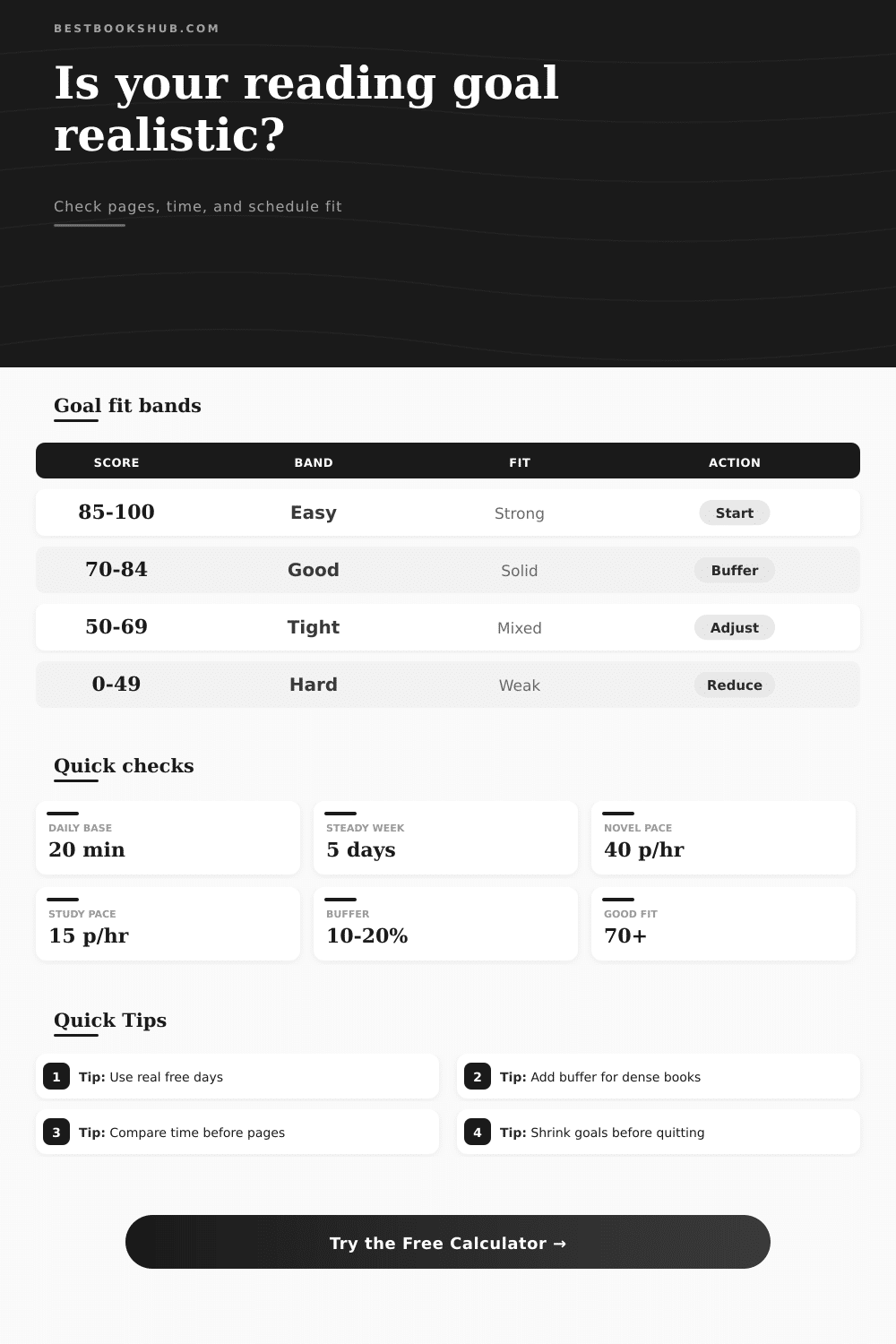
Next you enter the number of minutes you’ll spend during each session. If you do this regularly, twenty minutes is incredibly powerful. Small, yes but it adds up to over ninety hours a year.
The calculator takes that figure and multiplies it by your reading pace to determine whether workload matches your ability. There’s also pace, which folks misestimate. Chances are, you believe you can get through forty pages per hour. Have you ever timed yourself? For fiction, yes. Nonfiction moves slower. Textbooks move even slower. Adjust for challenge. Toss in a bit of extra time for the nights when life intervenes. Because it will. It always does.
Laziness will prevent you from picking up your book some evenings. A last-minute work project will throw off your schedule. Your kids might wake up with flu. Plan to miss some nights. The buffer helps here too. This is critical.
The source does not state how much of a goal you will have completed by month five. What it yields is a number (your feasibility score) and a graphic representation of how much space there might be to fit things in. If the score is below 50, it is probably too ambitious for your given timetable. It is not an impossibility. But it is something that requires changing one of the variables. Decrease the page count? Stretch the due date? Add more hours each day?
The reference tables on this page compares common reading goals, like a full semester of schoolwork or a one-book-a-month challenge, to help you put your own challenge into perspective.
All told: The messy middle of the year does not kill a good reading plan. It doesn’t snap; it bends. So use the calculator above to find the sweet spot between ambition and availability. When you see yourself in the green zone, forget the numbers and let go. Let’s face it: When reading isn’t a chore, it isn’t reading at all, it’s an escape from everything else on your to-do list, which is exactly as it should be.