Book Goal Tracker
Reading Habit Streak Calculator
Measure a current reading streak, allowed grace days, missed days, daily page and minute pace, streak risk, and projected book finish date.
▣ Reading streak presets
▣ Streak and book inputs
▣ Reading habit spec grid
▣ Reading pace reference
| Reading pace | Pages per day | Minutes per day | Best streak use |
|---|---|---|---|
| Minimum saver | 5-8 pages | 10-15 min | Protects the streak on crowded days |
| Light daily habit | 10-18 pages | 15-25 min | Good for nonfiction or slow novels |
| Steady reader | 20-35 pages | 30-50 min | Finishes most books in one to three weeks |
| Deep session | 40-70 pages | 60-100 min | Works for deadline pushes and club reading |
▣ Streak risk comparison
| Risk band | 30-day pattern | Grace status | Recommended adjustment |
|---|---|---|---|
| Locked | 0 misses or one planned miss | At least two unused | Keep current pages and minutes |
| Stable | 1-2 misses | One unused | Add a short reserve session this week |
| Thin | 3-4 misses | None or nearly none | Lower minimums and schedule early reading |
| Broken | Long recent gap | Grace exceeded | Restart streak count from the next read day |
▣ Book finish planning table
| Book remaining | 15 pages/day | 25 pages/day | 40 pages/day |
|---|---|---|---|
| 100 pages left | 7 reading days | 4 reading days | 3 reading days |
| 200 pages left | 14 reading days | 8 reading days | 5 reading days |
| 350 pages left | 24 reading days | 14 reading days | 9 reading days |
| 500 pages left | 34 reading days | 20 reading days | 13 reading days |
▣ Reading log method grid
| Method | Counts as read when | Streak strength | Where it helps |
|---|---|---|---|
| Minute minimum | Minimum minutes are met | Flexible | Busy days, audiobooks, rereads |
| Page minimum | Minimum pages are met | Concrete | Print books and study reading |
| Daily check-in | Any meaningful reading happens | Motivational | Habit recovery and new readers |
| Deadline pace | Pages keep finish date on track | Strict | Book clubs, classes, review copies |
▣ Streak calculation tips
DISCLOSURE: This post may contain affiliate links, meaning when you click the links and make a purchase, I receive a commission. As an Amazon Associate I earn from qualifying purchases.
Starting a reading streak isn’t just an act of intellectual ambition. It’s a form of behavioral engineering. The goal is to trick yourself into thinking that cracking open a book means “being a reader” instead of “fulfilling an obligation.”
And that’s why you frequently begin another novel with great determination and then see it gathering dust on your nightstand at page fifty. Life get in the way. Your initial enthusiasm fades. The habit simply melts away, quiet as a whisper.
How to Build a Reading Habit That Lasts
You’ll notice the calculator run the numbers for you. But you have to define what “success” means. Because most people make this mistake: They set an unrealistic (too high) number of pages per day on Day One. In their minds, every night is like a peaceful Sunday afternoon when in fact it’s never more like that.
You want to design your streak so that if you have a bad week you won’t break the chain. So set the bar low enough that even on the craziest night of the week, you can check off the box. When given the choice between getting to the end of the chapter and maintaining the chain, choose the latter, since momentum beat volume during the beginning.
And that’s when you get to know your grace days. Here you can enter the number of “misses” you’re willing to have over any given period (in my case, a month). This is not an exercise in laziness, but rather an acceptance of reality: there will be times when you are ill, traveling, or facing an unexpected deadline.
Allow yourself two grace days? You’re admitting that shit happens, but it doesn’t spell total failure. One miss is fine. Without grace, that single slip sends you into a spiral of failure-thinking. This leads to complete abandonment of the habit. With grace, it’s simply another pothole on the road so you take the jolt and continue onward.
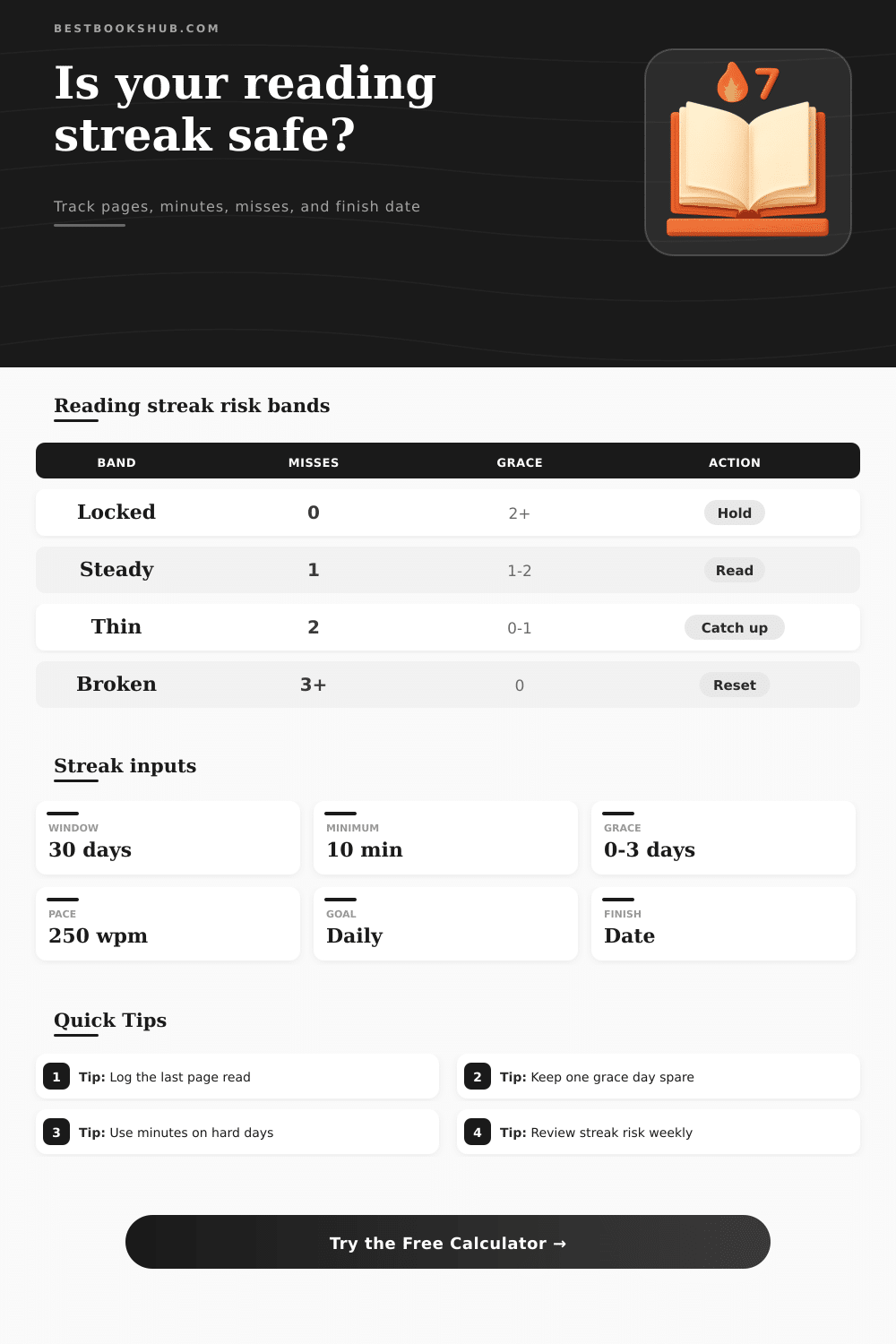
The page shows the risk bands in a clear table with what happens to your streak once you go past each of these safety net. Finally, our intuition trips us up on pacing. Some days, we’ll power through a hundred pages; others, we won’t touch a book at all. Because of this variability, we’re never sure how long it will take to finish a book.
Your “typical” pages per session plus your “minimum” minutes allows you to establish a base line that takes into account variation. From there, the calculator estimates your expected completion date based off your average time between reading sessions (it assumes you read about as much during each one). It can tell you if your planned reading pace matches with your desired end date, or if you’ve set yourself up for a last-minute panic-fest.
Do you know you only have three days left and still have forty pages to go? That’s very different than knowing you’ve got two-hundred pages and not a clue what to do next. The idea here is to treat reading like it’s another routine in your day. Just like you wouldn’t wake up one morning and go running for five miles if you haven’t moved off the couch in months, you begin at a walk for 10 minutes instead. Same goes for books: that’s why the calculator asks you to choose between Deep Session Pace and Minimum Saver Pace.
While both have their place, they’re not the same thing. If you’ve got deadlines (e.g., you need to read something for book club, or school) then you’ll want a higher page count; if you’re really busy, a lower-minute number will help keep the habit going. So this approach calls for some awareness of what you can handle at a given moment, time to mix things up?
What’s realy powerful is how consistent it makes you. Every day when you check the box, you get a little shot of dopamine that says, “Good job! Keep doing what you’re doing!” Eventually, it turns into something that doesn’t feel like work. It becomes part of your identity. Reading isn’t something you want to do. It’s something you do. That’s the psychological win.
And because there’s a number associated with each reading session (streak breakdown), it allows you to remove all the guesswork about how you’re doing. There’s no subjectivity when it comes to looking at your data. You know exactly where the friction points are.
All of this adds up to what matters most: Reading isn’t about checking off another book on your list, it’s about building a relationship with reading that survives whatever distraction comes along. Begin with the tiny steps. Add the buffer. Let the calculator work out the numbers while you make the commitment. If you keep the streak going, the rest will of come after.