📓 Reading log totals
Reading Log Total Calculator
Total your reading entries, minutes, pages, books, average session length, streak, monthly pace, yearly projection, and goal progress from one compact log.
Load a realistic reading log shape, then adjust the entries, minutes, pages, books, streak, missed days, goals, and the 14-slot page grid.
DISCLOSURE: This post may contain affiliate links, meaning when you click the links and make a purchase, I receive a commission. As an Amazon Associate I earn from qualifying purchases.
Enter page totals for recent reading slots. Empty slots count as missed or unlogged days, while filled slots become entries for the grid summary.
| Reading log field | Formula role | Watch for | Best use |
|---|---|---|---|
| Entries | Minutes / entries and pages / entries | Mixed daily and session records | Average session size |
| Minutes | Pages per hour and total time | Forgetting short sessions | Time-based habit tracking |
| Pages | Monthly and yearly pace | Page counts from different formats | Long-book progress |
| Books | Finished-book goal progress | Counting started books too early | Annual challenge totals |
| Streak | Consistency score and status | Changing the streak rule | Daily habit review |
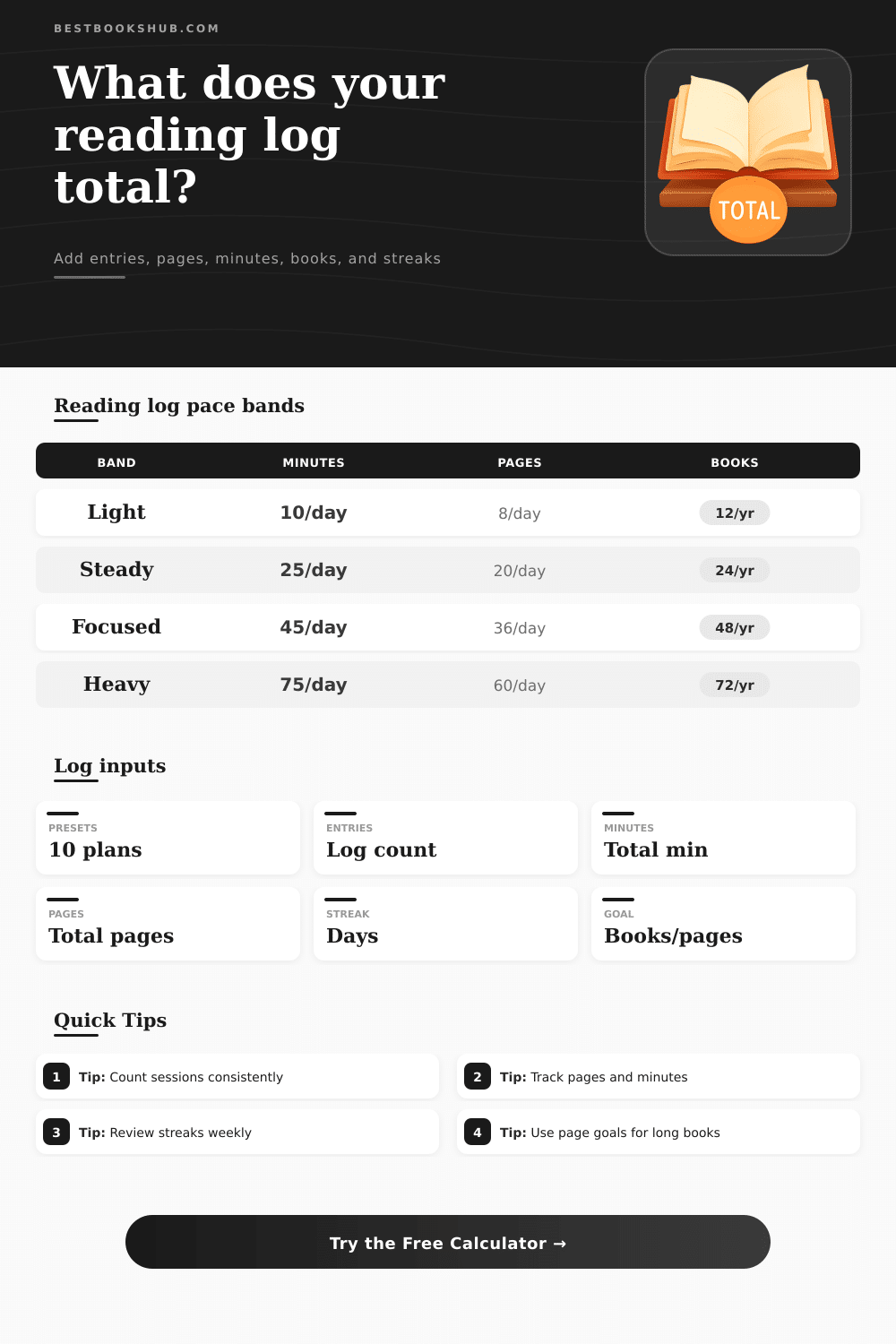
| Pace band | Pages per day | Minutes per day | Annual pages | Annual books at 320 pg |
|---|---|---|---|---|
| Light maintenance | 8 to 12 | 10 to 18 | 2,920 to 4,380 | 9 to 14 |
| Steady habit | 18 to 28 | 25 to 40 | 6,570 to 10,220 | 21 to 32 |
| Focused reader | 35 to 55 | 45 to 70 | 12,775 to 20,075 | 40 to 63 |
| Heavy reading year | 65 or more | 80 or more | 23,725 or more | 74 or more |
| Average session | Typical log signal | What it means | Planning note |
|---|---|---|---|
| Under 15 minutes | Short check-ins | Habit is active, volume may be low | Raise pages slowly |
| 15 to 30 minutes | Manageable daily rhythm | Good for most book goals | Protect the time slot |
| 31 to 60 minutes | Focused sessions | Strong monthly totals | Watch missed-day clusters |
| Over 60 minutes | Deep blocks | Excellent volume if sustainable | Use rest days deliberately |
| Goal type | Best metric | When books mislead | When pages mislead |
|---|---|---|---|
| Book challenge | Books finished | Novellas inflate pace | Very long books look slow |
| Study reading | Minutes plus pages | Chapters vary in density | Notes add time |
| Series project | Pages and books | Uneven volumes distort totals | Graphic pages vary widely |
| Daily habit | Entries and streak | Short books finish quickly | One page can still count |
If you’ve ever read a lengthy novel, you might be like me: You’re so proud when you’re done … then look at your reading log and realize it’s been three weeks since you started. On one hand, you’ve got all those pages under your belt. Great job! On the other hand, you have not crossed many books off your list. Completion doesn’t always goes hand-in-hand with volume. That’s where the tension between quantity and quality is resolved.
A reading log total calculator treats books, pages, minutes, they’re all views of the same habit. Does this mean you’re reading more? Or simply faster? But first: what does an entry mean? For most people, it represent one sitting or one day’s worth of reading. And here’s the thing: It doesn’t matter what the number is; it just matters that you’re consistent with definition.
Why Page Counts Matter More Than Book Goals
For instance, say you make an entry for every time you take out your phone and look at a book for five minutes. Although you might end up spending a lot of time, that would lower average amount of time per session. The tool calculates the average by using your total number of minutes divided by the number of entries you’ve made, and that average is what counts. People miss this point. They think they have X number of hours logged, so they must be doing well. But they don’t realize that attention span is diluted when it’s spread out into little pieces throughout the day. One solid chunk of time (e.g., 20 minutes) shows something different than four small chunks (e.g., 5 minutes each).
When it comes to the nitty gritty, though, real action happens on the pages. Epic fiction (more than six-hundred pages) and dense non-fiction is particularly heavy hitters. While finishing those thick texts is very satisfying, it can be misleading depending on how long your books tend to run. If you’re crushing through a dozen novellas, you might end up with a “successful” year, whereas another reader may be bogged down in a couple hefty historical biographies and feel as if he flopped. By closing the gap between completion and accomplishment, the calculator predicts what kind of pace you’ll maintain throughout the year, based off of number of pages you log each day. Instead of estimating on wishful thinking, it predicts realistically using whatever you’ve logged over a particular period of time. That way, when July rolls around and readers have realized that their lofty fifty-book goal doesn’t add up mathematically given their reading habits, they won’t crash and burn.
The other thing is the streaks, which are psychologically meaningful beyond the raw numbers. Once you have a long streak, it feels unbreakable… right up until life gets in the way and you break it. Your streak is accounted for in the tool (alongside any skipped days) when it calculates your consistency score. Regularity trumps quantity, even though we don’t think about reading as being perfect. You might read an hour each Sunday, but not during the week. You may read heavily, but weakly as a habit. The page has some reference tables to help explain that. How do various pace bands translates into annual output? You can see just what it takes to get to those heavy reader tiers and also keep more light-but-still-sustainable rhythm.
We’re in a completionist culture. Most readers obsess about finishing their books. Social media lists and book challenges reward the checkmark, not the enjoyment or even the comprehension. But there’s something honest about number of pages: they don’t care if you finish the book. They just care that you’ve engaged with it. Tracking both book goals and page goals protects you from the anxiety of those unread books.
The calculator above does all the math for you, so you don’t have to worry about converting and calculating coefficients. You can plug in the inputs and length of your window, and it will show you that progress isn’t binary. Either you’re making progress…or you aren’t. Whether you reach chapter twenty-four doesn’t matter. But really: A good reading log is whatever fits your real-life habits, not the other way around.
Do you commute with some quick reads? Great! Let that show up in your data. Binge-read all weekend? Record it! Whatever your habit is, make sure your input matches it. Want to record “missing” days if you skip a day or two? Go ahead! Craving a big spike? Log that too!
The point isn’t to game the leaderboard. The point is to learn about your relationship to these stories. Stick with whatever definition of “entry” works for you. Trust the page number when the book number make you sad. And use those estimates to help you find your sweet spot, the pace at which you can keep enjoying what you’re doing.
You don’t have to read more to be a better reader. You just have to know what you’re already doing, so you can do it and love it guilt-free. That knowledge is worth more then hitting some made-up annual target.