📚 readathon pacing lab
Reading Marathon Planner Calculator
Turn page goals, reading speed, breaks, stamina, and start time into a realistic marathon reading schedule.
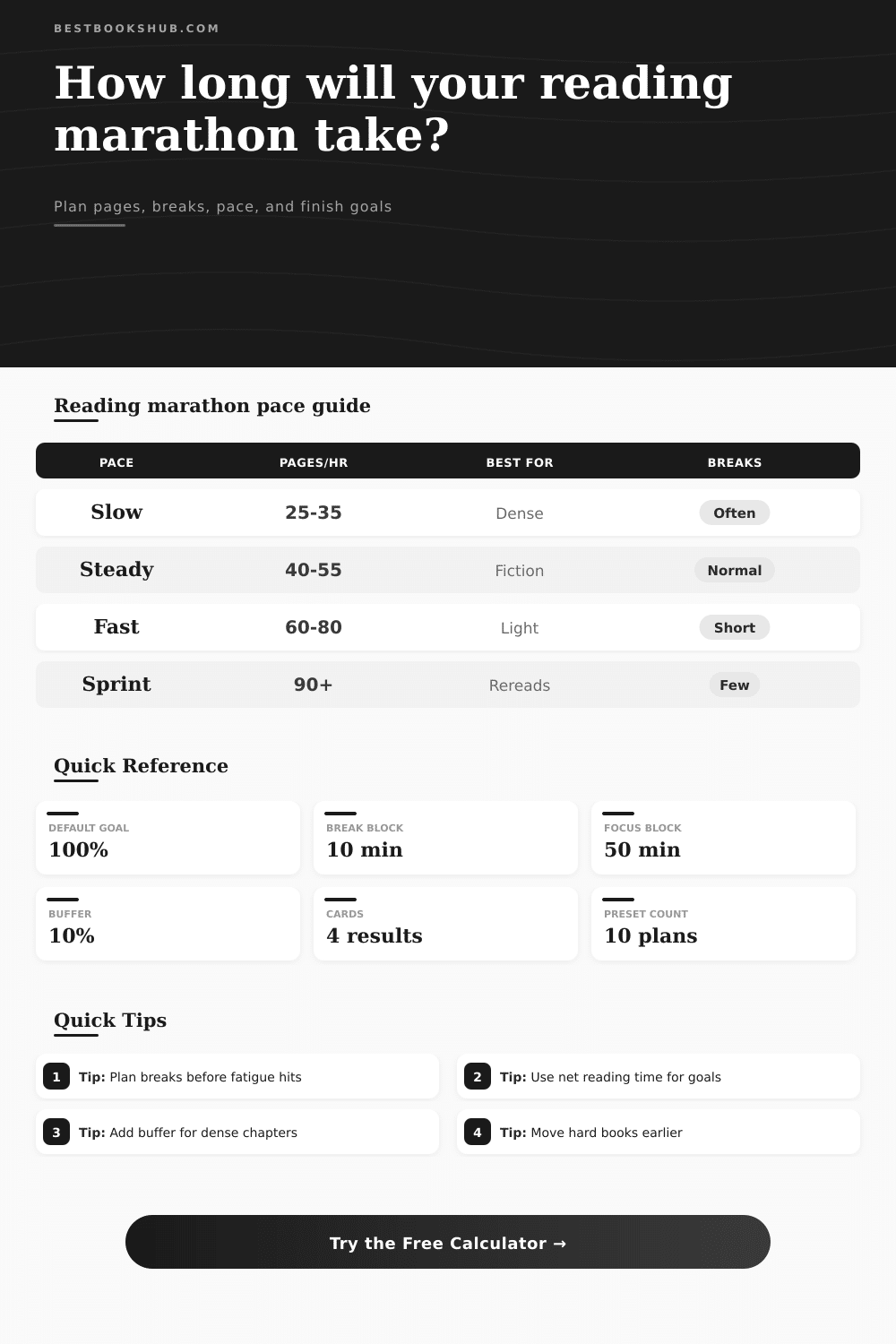
| Format | Typical pace | Best block size | Planner adjustment |
|---|---|---|---|
| Dense nonfiction or academic chapters | 25 to 40 pages per hour | 25 to 40 minutes | Add a 15% to 20% buffer and use longer breaks. |
| Novel or narrative nonfiction | 45 to 65 pages per hour | 50 to 75 minutes | A 10% buffer usually covers chapter transitions. |
| YA, middle grade, or short chapters | 60 to 85 pages per hour | 50 to 90 minutes | Use shorter breaks if momentum stays high. |
| Graphic novel, manga, or reread | 90 to 140 pages per hour | 40 to 75 minutes | Use page goals carefully because visual density varies. |
| Mixed stack | 40 to 70 pages per hour | 50 minutes | Put dense books first and leave lighter pages late. |
| Named format | Window | Common target | Planning note |
|---|---|---|---|
| Dewey's 24 Hour Readathon | 24 hours | 400 to 900 pages | Plan sleep or a hard stop before the final quarter. |
| 24in48 Readathon | 48 hours | 24 reading hours | Spread net reading across two days instead of one push. |
| Bout of Books | 7 days | Daily page goals | Divide the total stack into weekday and weekend blocks. |
| Tome Topple | 14 days | Long books | Use a slower pace because oversized books are often dense. |
| The Reading Rush | 7 days | Challenge stack | Leave open slots for prompts that take longer than expected. |
| Focus block | Break pattern | Useful for | Pages at 52/hr |
|---|---|---|---|
| 25 minutes | 5 minute break | Low energy, dense books, note taking | About 22 pages per block |
| 40 minutes | 10 minute break | Weeknight sessions and mixed stacks | About 35 pages per block |
| 50 minutes | 10 minute break | Balanced readathon pacing | About 43 pages per block |
| 75 minutes | 15 minute break | Long chapters and immersive novels | About 65 pages per block |
| 90 minutes | 20 minute break | Experienced marathon readers | About 78 pages per block |
| Stack type | Pages | Steady reading time | Suggested window |
|---|---|---|---|
| One short novel plus extras | 240 pages | About 4.6 hours | 6 hour mini marathon |
| Two average novels | 640 pages | About 12.3 hours | 24 hour readathon |
| Three-book weekend stack | 960 pages | About 18.5 hours | 24in48 style weekend |
| One large tome | 850 pages | About 16.3 hours | 7 to 14 day event |
| Mixed challenge stack | 1,500 pages | About 28.8 hours | Two week challenge |
Readathon targets sound cleaner as hours, but pages are finished during active reading blocks. Breaks belong in the calendar estimate, not the pace estimate.
DISCLOSURE: This post may contain affiliate links, meaning when you click the links and make a purchase, I receive a commission. As an Amazon Associate I earn from qualifying purchases.
If the stack mixes dense nonfiction and easy fiction, schedule the slower book first. The same page count gets harder after several blocks.
So maybe it’s the Dewey Readathon or perhaps you’re working through your tough reading list for the week and are going to use a long weekend to get some mileage done. The thing is, we all want to know how many hours that translates into in order to pound the words out and read story, but then we imagine an ideal day. Our best day ever, with no distractions, good coffee, and a page-turner of a book.
In terms of numbers, this is a dangerous optimism. That’s where the reading marathon planner calculator comes in. It do all the math so you don’t have to, converting your number of pages into a manageable schedule.
How to Plan Your Reading Marathon
In doing this, it makes you face reality: there’s a gap between calendar time and active reading time. Active time is actual minutes you spend with book in front of your face, flipping through pages. Calendar time is when you take a bathroom break, when you stop for a snack, when you zone out on the ceiling trying to understand that last sentence. Most readathons flop not because we aren’t aware of calendar time, but because we confuse one for the other. We believe we can sit down and read for 10 hours. But our bodies needs 15 calendar hours to accomplish the same amount of work, in comfort.
First, define your stack. Enter either total number of pages or average number of books (which matters, because breaking up books kills momentum). A light fiction book flies past you vs. A dense academic one that realy slows you down. If you have a combination, the calculator help you dial in your pace setting to match that.
Here’s where most people go wrong. They choose a fast pace because they want to be done quick. But if you have a bunch of heavy nonfiction in there, that high pace will fall apart at hour three. The reference table on the page explain it well, connecting density and genre to pace.
The next step is your pacing strategy. How long are your blocks of work? How long is your break? (There’s a sweet spot for most grown-ups, a fifty-minute focus block, then a ten-minute break.) Stay in the zone but don’t burn out. Sprint faster if you’re re-reading favorites, maybe taking fewer breaks. Go for longer blocks if you’re diving deep into history or philosophy.
The calculator also takes stamina into account. Fresh and focused? Just got off a twelve-hour shift? Choose a more cautious stamina adjustment, which will save your sanity when energy dip. The trick to becoming a good marathon reader is this buffer. When the light gets bad or you hit a confusing chapter, you have some wiggle room. This doesn’t mean you’re being pessimistic if you add in ten to fifteen percent extra time. It means you’re being realistic.
If you don’t plan for slowness and fall behind five pages per hour, that turns into a two-hour deficit by midnight. And when you feel that pressure, you’ll start to get tired. This makes you slow down your reading, this creates a vicious cycle. By planning for slowness, you’re actualy helping yourself to read faster because you’re not fighting an impossible schedule.
You’ll get back a breakdown of the number of blocks needed to finish, as well as the finish time (for example). Check out estimated clock time. Do you see “stay up ’til 3 AM” in there? That could impact your stamina for the following day. Tweak the start time / cut down on the number of pages per day till the numbers appears human. Some presets are also included for popular events, such as the 24in48 readathon. These are better places to tweak an existing plan than to start from scratch.
In conclusion: Reading is an act of focus. It’s physical work for your eyes. It makes your back sore. It requires breaks for your mind to understand narrative arcs. You will burn out by racing against an invisible clock. Enjoy the stories by treating it as a logistical exercise. Let the calculator create a reading plan based off your physiology, rather than your willpower. At the end of the book-a-thon, you’ll be exactly where you wanted to be in terms of books-read but without resenting every second spent doing so. That mix of planning and improvisation is how you make a hectic weekend into a fulfilling time of reading.