📚 Nook space planner
Reading nook square footage calculator
Estimate the floor area a reading nook needs by measuring the footprint, seat depth, book storage, side surfaces, rug allowance, and comfortable walking clearance.
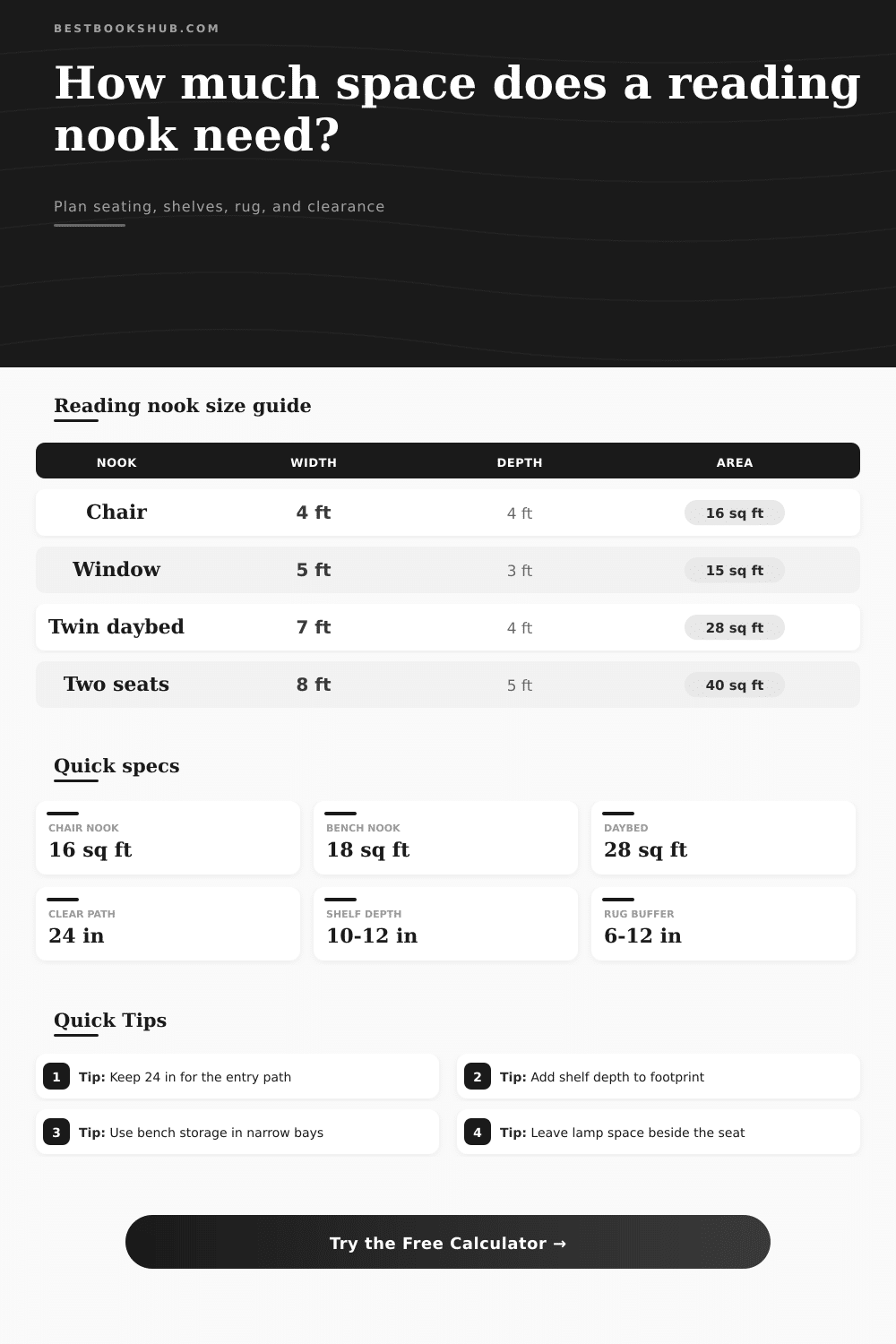
| Nook type | Typical clear width | Typical depth | Comfortable area |
|---|---|---|---|
| Compact chair corner | 42-48 in | 42-54 in | 14-18 sq ft |
| Window bench nook | 48-72 in | 30-42 in | 14-24 sq ft |
| Kids floor cushion corner | 48-60 in | 48-60 in | 16-25 sq ft |
| Built-in alcove seat | 54-84 in | 42-60 in | 20-35 sq ft |
| Daybed reading nook | 78-90 in | 48-60 in | 28-42 sq ft |
| Two-chair reading corner | 84-108 in | 60-72 in | 36-54 sq ft |
| Furniture element | Common size | Footprint rule | Planning note |
|---|---|---|---|
| Reading chair | 30-36 in wide | Width x depth | Add front clearance before counting comfort. |
| Bench cushion | 18-24 in deep | Seat run x depth | Efficient for narrow window bays. |
| Lounge chair | 30-36 in deep | Seat plus ottoman if used | Needs more knee clearance. |
| Bookcase | 10-12 in deep | Shelf width x depth | Vertical height adds capacity, not floor area. |
| Side table | 16-22 in round | Diameter footprint | Leave space for lamp and cup reach. |
| Small rug | 3x5 to 5x7 ft | Seat plus border | Use as comfort area, not required area. |
| Book format | Avg spine width | Avg weight | Best shelf depth |
|---|---|---|---|
| Trade paperback | 0.75 in | 0.8 lb | 8-10 in |
| Hardcover | 1.20 in | 1.6 lb | 10-12 in |
| Mixed home library | 1.00 in | 1.1 lb | 10-12 in |
| Textbook | 1.45 in | 3.0 lb | 11-13 in |
| Children's books | 0.50 in | 0.5 lb | 8-10 in |
| Graphic novels | 0.45 in | 0.9 lb | 10-12 in |
| Art books | 1.25 in | 3.8 lb | 13-16 in |
| Preset layout | Footprint | Book storage | Best fit signal |
|---|---|---|---|
| Chair Corner | 5 x 4 ft | 90 paperbacks | Good single-reader corner |
| Window Bench | 6 x 3.5 ft | 70 mixed books | Efficient narrow bay |
| Daybed Nook | 7 x 4.5 ft | 120 mixed books | Comfortable lounge footprint |
| Two-Chair Nook | 8.5 x 6 ft | 160 hardcovers | Shared reading space |
| Library Wall | 9 x 5 ft | 240 mixed books | Storage-forward nook |
DISCLOSURE: This post may contain affiliate links, meaning when you click the links and make a purchase, I receive a commission. As an Amazon Associate I earn from qualifying purchases.
A reading nook sounds like its just a comfy chair with a lamp, but realy it’s a geometry problem: a physical footprint that has to be solved before anything is comfortabley. That ideal corner of light where everything is perfectly placed for a quiet sense of settling in, well, that’s what usually derails all the plans.
It is easy to forget how much space a chair actualy takes up. When you consider the room needed to stand up or grab a book without knocking over a lamp, it all add up pretty quickly.
How to Plan Your Reading Nook
This calculator will do the math if you input the measurements (saving you any guesses on whether the wonky little alcove could possibly contain both chair-and-storage without making you feel like you’re in a tunnel). So here’s the trick: You need to understand what you’re measuring.
Maybe your average-size reading chair would appear cramped if you were looking at it alone, but you need room in front of it for it to be functional. And if you shove a seat into some narrow nook without leaving at least two feet in front of it for your knees and legs, all of a sudden that nook isn’t a haven. It feel more like a prison. Each time you go to sit down to read, you’ll have to pull the thing out, lean forward weirdly or just give up and go somewhere else, which is why you got a dedicated spot to begin with.
See? People make that mistake: they measure the pieces of furnitures, not how you move through them. This one takes that into account, adding entry clearance to the footprint of the seat so that when it suggest a certain amount of square footage, it figures in the air surrounding you, not just the bit of fabric underneath you.
But then there’s storage: Even if a bookcase stretches all the way to the ceiling, it still occupy floor space. Along a six-foot wall, a bookcase that is ten inches deep consumes five square feet of precious space, regardless of its height. That’s significant, since each inch of shelf depth reduce the amount of space where you can place a side table or walk. Every fraction of an inch makes a difference if your library is built into a narrow window bay.
In a small space, you can’t typically have both: more books, or more room to breathe. Use the calculator to play around with different shelf depths and book types. You can see exactly how much floor space your library will take up, allowing you to find a balance between storage and comfort.
Finally, consider lighting and surface space. That’s where your pair of glasses, cup of tea, and reading lamp go! Your nook might look nice on paper, but without considering its footprint, it’ll feel cluttered with a side table.
You also don’t want to forget about the rug; which often gets overlooked in favor of other items. Extending the rug several inches (six to 12) past the seat tells your brain, “this is a different place.” It establishes mental boundaries that makes the space feel more secure and intimate.
Before you buy any furniture, check the math. First measure the actual floor area that’s workable. Do not include sloping ceiling areas that don’t work well when sitting, or doors that swing in. Next enter the measurements at the planning tool to see how your plan measures up against real life. Does it say you’re too tight? Tweak one of the inputs, maybe switch out the lounge chair for a bench, or reduce the depth of the bookshelf.
Keep tweaking until you get it right: give up space on things you don’t need as much to make room for the things you do. More than any amount of carefully chosen décor, however, making a real reading nook is all about honoring the laws of how one physically sits to read. If you get the proportions correct, it becomes invisible. You should of checked that first. The shelves fade out and the wall vanishes, and you lose yourself in the book. Then the space truly comes alive.