📚 Deadline reading lab
Reading Pace Comparison Calculator
Compare Reader A, Reader B, and a target pace using pages per day, WPM, session length, book length, current progress, deadline days, and catch-up requirements.
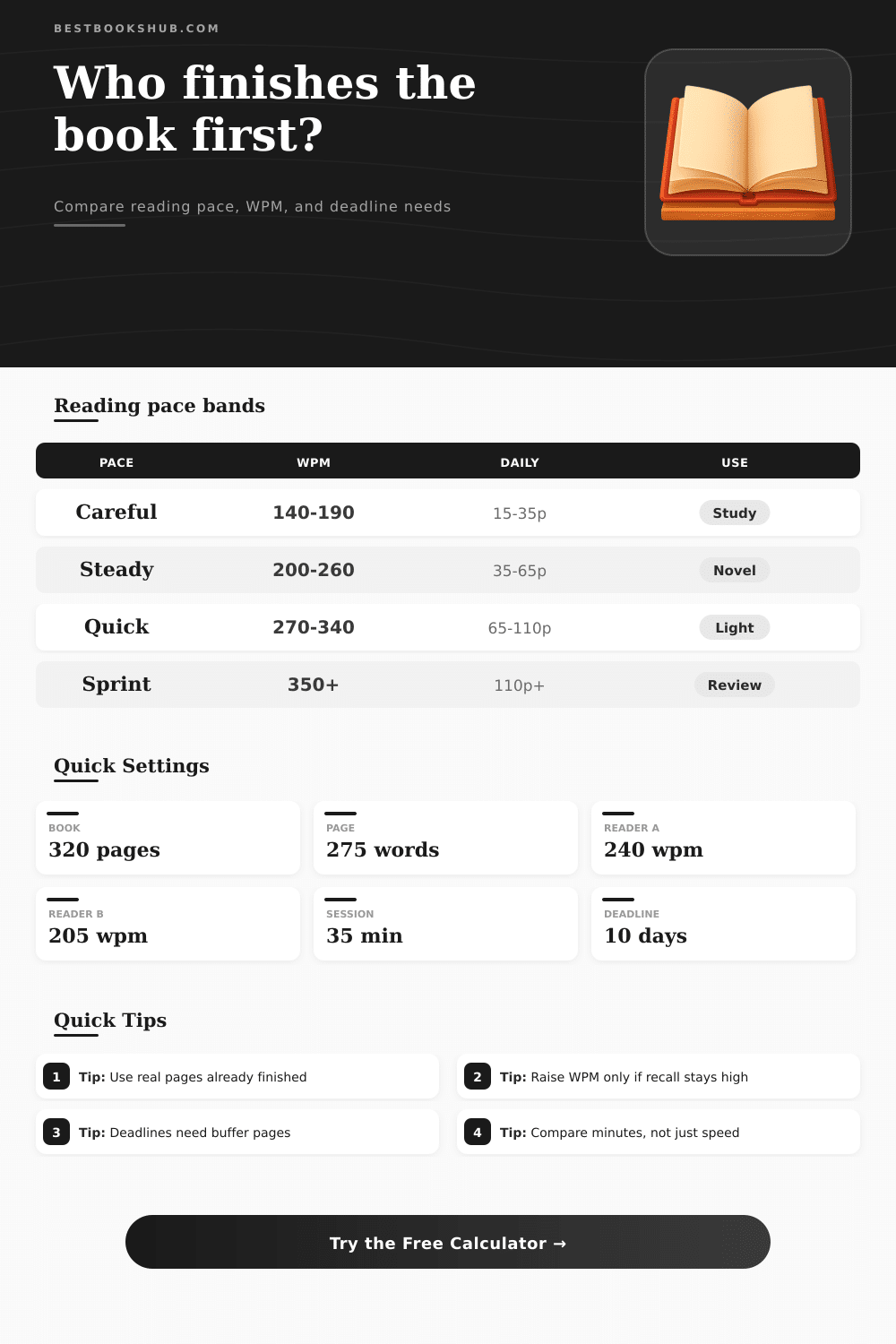
| Pace band | WPM range | Typical pages per 30 minutes | Best fit |
|---|---|---|---|
| Careful annotation pace | 140 to 190 WPM | 15 to 21 pages at 275 words/page | Study chapters, dense nonfiction, quoted passages |
| Steady recreational pace | 200 to 260 WPM | 22 to 28 pages at 275 words/page | Novels, memoir, narrative nonfiction |
| Quick fluent pace | 270 to 340 WPM | 29 to 37 pages at 275 words/page | Familiar prose, rereads, lighter sections |
| Review or skim pace | 350 to 500 WPM | 38 to 55 pages at 275 words/page | Recap reading, previewing, reference scanning |
| Book profile | Common page range | Words per page estimate | Pace caution |
|---|---|---|---|
| Middle grade classroom read | 160 to 260 pages | 180 to 230 words/page | Shorter pages can make page pace look high. |
| Commercial fiction paperback | 280 to 420 pages | 250 to 300 words/page | A steady WPM estimate is usually enough. |
| Literary novel | 240 to 520 pages | 280 to 340 words/page | Sentence density may lower useful focus. |
| Textbook or study chapters | 120 to 800 pages | 350 to 500 words/page | Notes and problem sets require a larger buffer. |
| Graphic novel or comics | 96 to 240 pages | 60 to 130 words/page | Page counts rise fast because text per page is low. |
| Daily pattern | Minutes/day | At 220 WPM, 275 words/page | Planning note |
|---|---|---|---|
| One short lunch session | 20 minutes | 16 pages/day before focus adjustment | Works for low-pressure steady progress. |
| Morning plus evening | 50 minutes | 40 pages/day before focus adjustment | Good for book club deadlines. |
| Study block with notes | 75 minutes | 60 pages/day before focus adjustment | Use lower focus or a larger buffer for notes. |
| Weekend sprint block | 120 minutes | 96 pages/day before focus adjustment | Check fatigue; late pages may slow down. |
| Scenario | Remaining pages | Days left | Needed pages/day |
|---|---|---|---|
| Relaxed buddy read | 240 pages | 14 days | 18.9 with 10% buffer |
| Book club countdown | 310 pages | 10 days | 34.1 with 10% buffer |
| Exam chapter sprint | 180 pages | 5 days | 39.6 with 10% buffer |
| Recovery week | 260 pages | 6 days | 57.2 with 10% buffer and one missed day |
DISCLOSURE: This post may contain affiliate links, meaning when you click the links and make a purchase, I receive a commission. As an Amazon Associate I earn from qualifying purchases.
This was prepared for Book Club Night. If you’re not ready for it, your book club night is going to stink. It will be you and a group of friends talking through one character’s trouble. Everyone else will have read the entire thing but you are only up to page forty. Panic sets in. What does that say about your reading speed? Or is it your time management?
Those are the problems that result from arithmetic, but most people don’t use data; they goes with their gut feeling. It’s not always as simple as pure speed. Someone who reads quickly may fail to hit their goal if they spends only 20-minutes per day with their nose in a book. On the other hand, someone who takes longer can spend an hour doing so, yet still get more pages done.
Why Use a Reading Speed Calculator
The context matters. It’s a lot easier to burn through a light thriller than it is to power through a dense academic text which changes things. Most of us think our reading rate will be consistent no matter what we pick up. But this isn’t necessarily true. After recording how long you like to sit down with a book (and its length), the calculator do the math for you. No more wondering if you’ll meet your deadline in time.
The input is important. One place to start is with words per minute. However, that number isn’t meaningful unless you know what kind of book you’re reading and roughly how many word are on each page of your specific edition. Some books has plenty of white space; others contain very few words per page. For example, if you plug into the calculator a “standard” number of words-per-page based off a page full of white space, it’ll guess too high how much you can get done. You think, “I’m going to read thirty pages today,” but then text’s font makes it stretch across more pages, leaving you with only twenty actual pages to read. This matters. The tool prompts you for this information to avoid making that sort of calculation.
Reading speed is also influenced by focus. For long periods, people don’t tend to read with maximum efficiency. You’ll stop to re-read a confusing paragraph or look up a name. To reflect these slow-downs, the calculator has a focus percentage. This means that if you set this to one hundred percent, you’re assuming that there are no distractions and you retain everything perfectly (an unrealistic assumption). Bring this down to ninety percent and you’re being realistic and leaving some wiggle-room for times where prose gets hard or you get distracted from thought.
Life happens, and it’s important to have buffers around deadlines. Sometimes you’re going to take a day off, sometimes you’ll be too tired to finish reading after work. When this happens, enter those missed days into your planner. This will adjust the daily pace of your other active days. It prevents a relaxed schedule from turning into an impossible Friday night marathon just because you took Tuesday off.
Various types of books require different amounts of caution, as seen in the reference table; novels has less buffer space than textbooks. Why? A novel doesn’t slow you down nearly as much then taking notes in a textbook does. Readers aren’t competing. They’re not even really being compared; this is all about managing expectations. When there’s going to be a read-along, understanding each other’s places allows you to establish reasonable check-ins that will keep things fair. You’ll see who can trot along at their own pace without feeling guilty and who has to bust out a sprint to reach the finish line. With the numbers in hand, you can see how much time separates the finish lines, depending on how often they meet up and where they are now.
There’s no shame in lagging behind, frame it as a logistical problem, not something you did wrong. Running the numbers before opening the cover is one way to think of pace-reading as project management. Your “project” is finishing a book, and your “resources” are the amount of time available. By planning it out, you eliminate that uncertainty. Instead of wondering whether or not you’ll finish on time, you know exactly how many pages you’re reading every night. This replaces the stress of uncertainty with clarity. You have a defined goal for what you need to accomplish every day. And that’s where pace-reading gets its power.