📖 Reading Speed Calculator
Measure your WPM, estimate book reading time, and discover how your speed compares to others
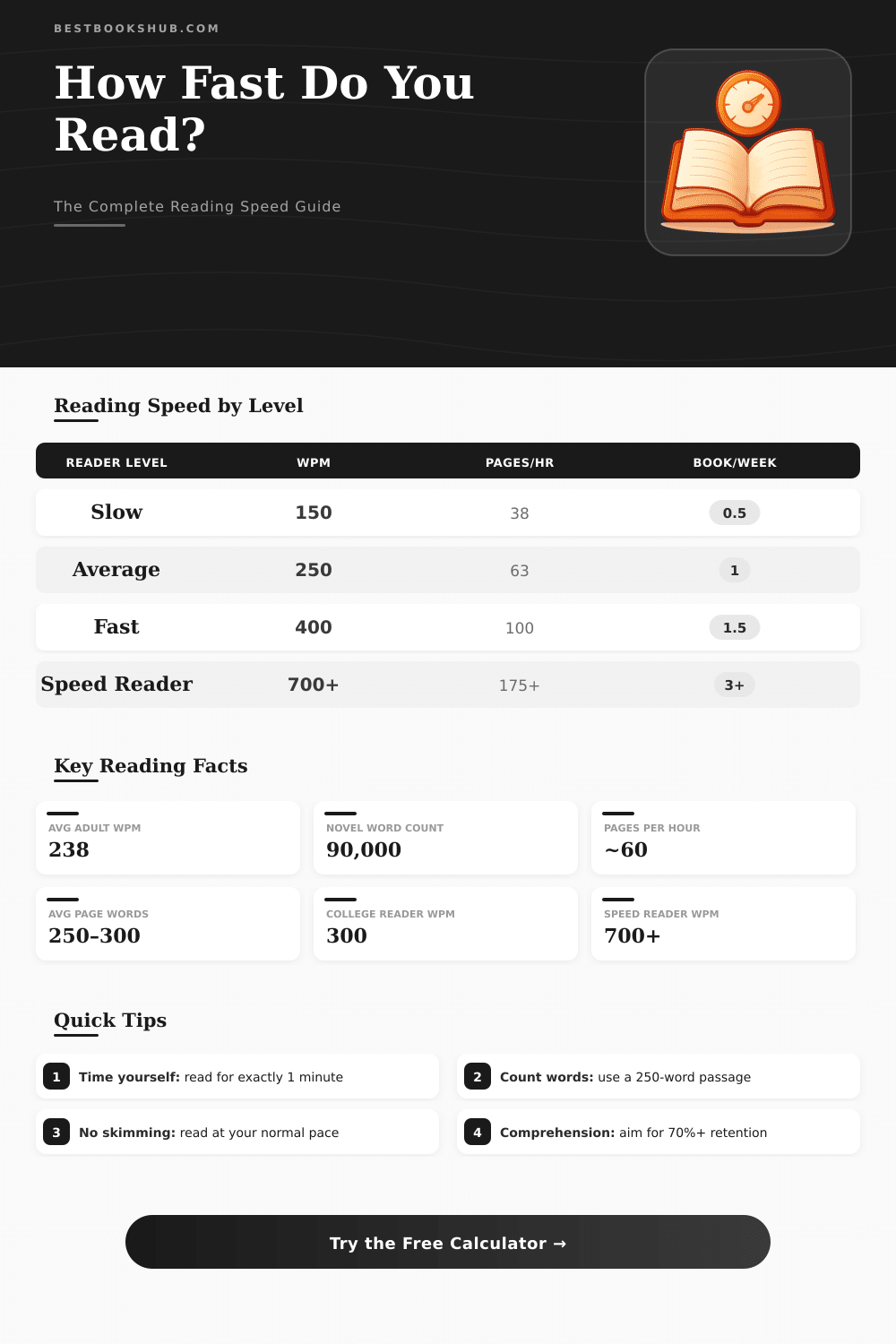
| Reader Level | WPM Range | Pages/Hour | Avg Novel Time | Comprehension |
|---|---|---|---|---|
| Child (Beginner) | 80 – 150 | 20 – 38 | 10 – 19 hrs | High (focused) |
| Middle School | 150 – 200 | 38 – 50 | 8 – 10 hrs | High |
| High School | 200 – 250 | 50 – 63 | 6 – 8 hrs | Good |
| Average Adult | 238 – 260 | 60 – 65 | 5.7 – 6.3 hrs | Good |
| College Student | 280 – 350 | 70 – 88 | 4.3 – 5.4 hrs | Good |
| Avid Reader | 350 – 500 | 88 – 125 | 3 – 4.3 hrs | Good |
| Speed Reader | 500 – 1000 | 125 – 250 | 1.5 – 3 hrs | Reduced |
| Expert Speed | 1000 – 1500 | 250 – 375 | 1 – 1.5 hrs | Low |
| Book | Word Count | Pages | Time @ 150 WPM | Time @ 238 WPM | Time @ 400 WPM |
|---|---|---|---|---|---|
| The Great Gatsby | 47,094 | 180 | 5.2 hrs | 3.3 hrs | 1.96 hrs |
| Harry Potter (Book 1) | 77,325 | 309 | 8.6 hrs | 5.4 hrs | 3.2 hrs |
| To Kill a Mockingbird | 100,388 | 281 | 11.2 hrs | 7.0 hrs | 4.2 hrs |
| 1984 (Orwell) | 88,942 | 328 | 9.9 hrs | 6.2 hrs | 3.7 hrs |
| The Hobbit | 95,022 | 310 | 10.6 hrs | 6.7 hrs | 3.96 hrs |
| War and Peace | 580,000 | 1,225 | 64.4 hrs | 40.7 hrs | 24.2 hrs |
| Avg News Article | 800 | 3 | 5.3 min | 3.4 min | 2 min |
| Avg Blog Post | 1,500 | 5 | 10 min | 6.3 min | 3.75 min |
| Format / Book Type | Words/Page | Pages @ 90K Words | Metric (chars/page) |
|---|---|---|---|
| Mass Market Paperback | 250 – 300 | 300 – 360 | 1,250 – 1,500 |
| Trade Paperback | 275 – 325 | 277 – 327 | 1,375 – 1,625 |
| Hardcover Novel | 275 – 350 | 257 – 327 | 1,375 – 1,750 |
| Academic Textbook | 400 – 600 | 150 – 225 | 2,000 – 3,000 |
| Children’s Picture Book | 30 – 100 | N/A | 150 – 500 |
| Digital E-reader (avg) | 200 – 280 | 321 – 450 | 1,000 – 1,400 |
| News Article (web) | 600 – 900 | N/A | 3,000 – 4,500 |
| Session Length | Words Read @ 150WPM | Words Read @ 238WPM | Words Read @ 400WPM |
|---|---|---|---|
| 15 minutes | 2,250 | 3,570 | 6,000 |
| 30 minutes | 4,500 | 7,140 | 12,000 |
| 45 minutes | 6,750 | 10,710 | 18,000 |
| 1 hour | 9,000 | 14,280 | 24,000 |
| 90 minutes | 13,500 | 21,420 | 36,000 |
| 2 hours | 18,000 | 28,560 | 48,000 |
The pace folks read varies from person to person Most adults read between 200 and 300 words each minute, which is about what you would expect of a pupil in the sixth grade. The normal range of reading speeds extends from 150 to 400 words each minute. If you plan to go to college, you will likely need to read around 350 to 450 words to have a bit of room to breathe.
DISCLOSURE: This post may contain affiliate links, meaning when you click the links and make a purchase, I receive a commission. As an Amazon Associate I earn from qualifying purchases.
People who are not native English speakers usually read more slowly, around 150 to 200 words each minute in general texts.
Reading Speed and How to Read Faster
Fast reading is commonly misunderstood, but it simply means to read quickly while you indeed understand the content, it is not just skimming. While an ordinary person reads 300 words each minute, trained readers can move thmeselves two, three, or even four times more quickly. Such techniques usually include “chunking” (group words together) and reduction of the internal voice.
There are many programs to learn that, whether by books, video courses, software or personal seminars.
Interestingly, narrators of audiobooks read only around 120 to 150 words each minute. That is actually much slower than what most folks do their sell.
Here is a tiny trick that could help: take a guide, pencil, pen, or anything useful, and move it under every word while you read. Start with your normal pace, and later slowly rush the move of the guide until the words start to blur. The main thing?
Let your eyes do the work. Only your eyes should move across the page.
People discuss silencing of the internal voice to read more quickly, but honestly, that is wrong. Fast reading is not about killing that voice, but about rushing it. When investigators observed expert fast readers, they saw that they still subvocalize.
They only did that in a flash. Real fast reading is about balance between pace and understanding. If you push the pace too hard, the understanding suffers, especially with details.
A wiser target would be to increase your speed by 10 or 20 percent each month, but only if you keep the same level of understanding. Aim to keep at least 80 percent understanding, because that is important for study materials. If you notice that you no longer understand, slow down a bit until you feel safe again.
Also the material matters. You naturally read more quickly when you already know the theme. News articles you can skim quite quickly, but longer texts or opinions deserve more time and attention.
It is very good to pause to think while you read. Reading breaks into two categories: learning and pure enjoyment. Reading to learn requires more focus than simple reading.
With a bit of practice, you can double your speed in a surprisingly short time. Online tests can measure your pace and understanding, giving you immediate results.