📖 Page count reading lab
Reading time by page count calculator
Estimate reading time from page count, page density, reading speed, notes, rereads, breaks, and daily schedule so a chapter or full book becomes a clear plan.
| Page type | Words per page | At 250 WPM | Common use |
|---|---|---|---|
| Large print or airy layout | 200 to 240 | 63 to 75 pages/hour | Relaxed fiction, accessible editions, and quick rereads |
| Trade fiction | 250 to 300 | 50 to 60 pages/hour | Modern novels, memoirs, and book club reads |
| Narrative nonfiction | 300 to 350 | 43 to 50 pages/hour | Popular history, essays, and idea-driven nonfiction |
| Dense classic | 330 to 420 | 36 to 45 pages/hour | Older editions, literary prose, and compact paperbacks |
| Textbook or course book | 450 to 650 | 23 to 33 pages/hour | Study reading before adding notes or exercises |
| Graphic novel or manga | 50 to 140 | 107 to 300 pages/hour | Visual narratives, comics, manga, and panel-heavy books |
| Assignment | Pages | Typical setup | Estimated time |
|---|---|---|---|
| Evening novel section | 60 pages | Trade fiction, casual pace, light notes | About 1 hr 20 min |
| Book club week | 280 pages | Trade fiction, discussion retention, 10% buffer | About 7 to 8 hours |
| Dense classic reading | 120 pages | Classic density, focused pace, reread passages | About 5 to 6 hours |
| Textbook chapter block | 45 pages | Textbook density, notes, breaks, study purpose | About 4 to 5 hours |
| Research packet | 70 pages | Academic pages, annotation, citation-level review | About 9 to 11 hours |
| Manuscript proof pass | 210 pages | 250 words/page, close read, correction notes | About 10 to 12 hours |
| Goal window | Total pages | Pages per day | Useful daily block |
|---|---|---|---|
| Short chapter tonight | 35 pages | 35 pages/day | 45 to 75 minutes depending on density |
| Novel in one week | 320 pages | 46 pages/day | 50 to 70 minutes for normal fiction |
| Classic in two weeks | 420 pages | 30 pages/day | 55 to 85 minutes for dense prose |
| Textbook unit in five days | 90 pages | 18 pages/day | 75 to 110 minutes with notes |
| Research packet in three days | 60 pages | 20 pages/day | 100 to 150 minutes with annotation |
| Mode | Typical WPM | Page count effect | Best use |
|---|---|---|---|
| Skim or survey | 400 to 600 | Fast pages, shallow retention | Previewing headings, summaries, or familiar chapters |
| Average leisure | 230 to 280 | Good default for novels | Fiction, memoir, and comfortable nonfiction |
| Focused nonfiction | 180 to 230 | Slower but steadier comprehension | Argument-heavy chapters and idea-driven books |
| Study reading | 120 to 180 | Often half normal page pace | Textbooks, tests, and note-taking assignments |
| Proofread or close read | 90 to 140 | Slowest page count conversion | Manuscripts, thesis chapters, and line-level review |
DISCLOSURE: This post may contain affiliate links, meaning when you click the links and make a purchase, I receive a commission. As an Amazon Associate I earn from qualifying purchases.
Take a thick hardcover in your hands. Read the spine. Look at page count. You feel anxious because you want to read this thing by Friday. But it doesn’t feel like a doable number of pages, its too many.
Here’s the problem: Pages lie. They tell us we’re getting an even amount of weight across each chapter or story. They conceal how much meat there is on each page. One page in a graphic novel may take only thirty seconds to get through as you flip around scanning panels, another page in a scholarly journal may require ten minutes of slow-going unpacking.
Why Page Counts Are Misleading and How to Plan Better
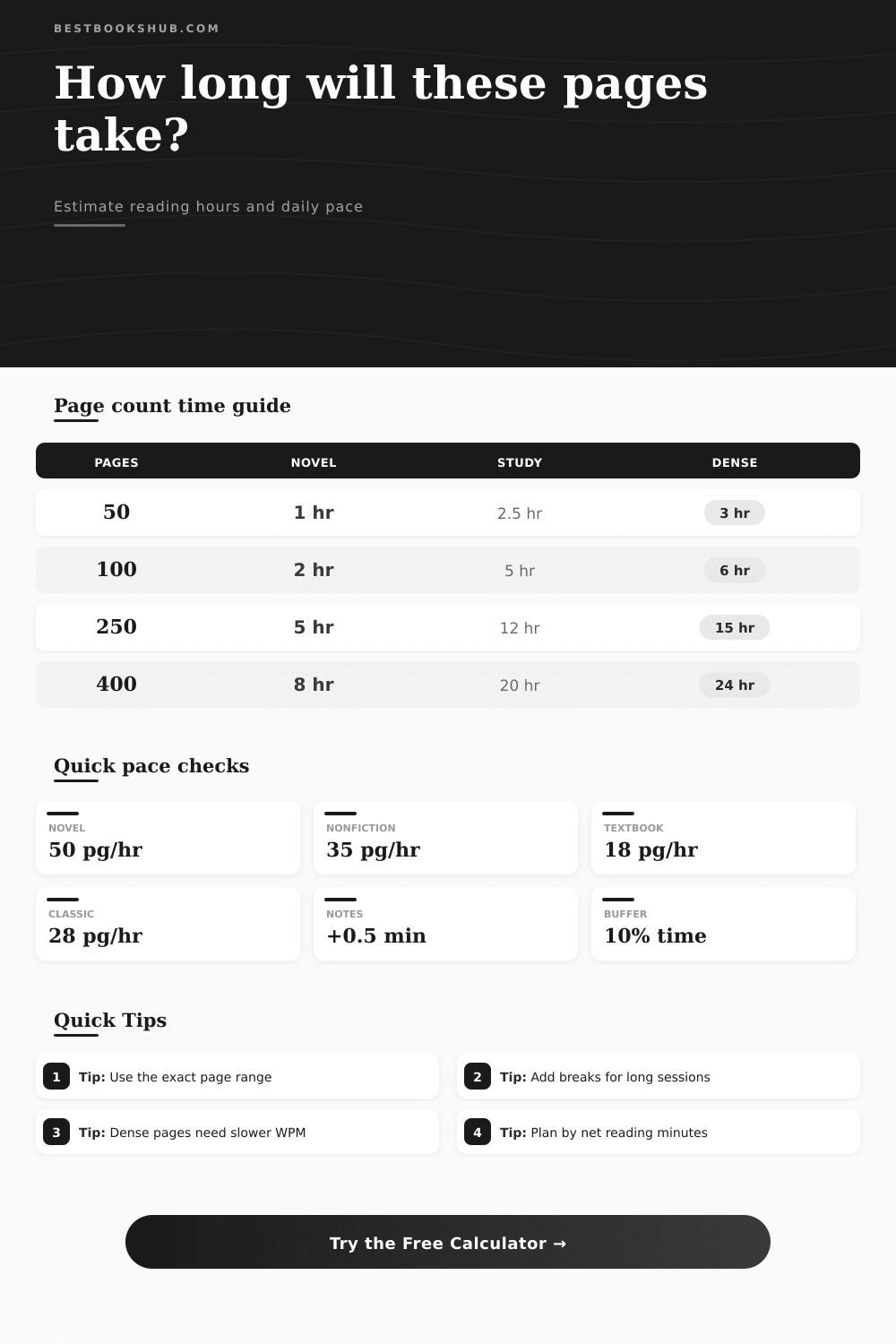
Plug in those exact figures into the calculator above, and it will crunch the numbers so you don’t have to guess if your plan is merely optimistic or actualy realistic. Keep in mind that every page contains a different number of words. This changes based off layout, margin width, and font size. In a big-print book, you may find two hundred twenty-five words per page. You move up to a classic paperback using tighter spacing, and you’re looking at three-hundred-sixty-plus words. Try opening a textbook, and you’ll see five-hundred-fifty plus words crammed onto each spread (alongside diagrams). The website allows you to specify the density category of your physical book, ensuring that estimated time reflects the true mental effort, instead of mere quantity of sheets.
Most people wrongly believe that all pages is created equal. Even reading speed is misleading when taken out of context. Sure, you can casually test yourself and say that you average x words per minute, but it all depends on context. Maybe you’re used to reading fiction novels; maybe you can skim them and still follow along at three hundred twenty words per minute. Now try reading a technical manual with the same pace. Comprehension will be much worseer. That’s why the calculator includes settings for your specific purposes and difficulty level. Do you need to annotate quotes for future discussion? You’ll spend longer on each page then if you were simply getting the gist of an article.
It’s also smart to include some breathing room for breaks; sustained focus decline after around forty-five minutes. The reason most reading plans don’t work is that they neglect the reality of day-to-day friction. You decide to read for two hours each night, yet dinner takes longer than expected and you’re exhausted. To help, the tool breaks out total time in terms of specific, daily page goals according to how much time you have. For instance, if you’ve got just twenty minutes on the way home from work, it will tell you precisely how many pages you’ll be able to plough through before you pull up.
That allows you to avoid thinking about reading as an all-or-nothing task, something that tends to cause people to give up halfway through. Instead, you begin with tiny increments, not daunting hour-long blocks. The other nice thing about having a finish line in sight? It’s tangible. When there’s a limited number of days until it’s finished, the project have a sense of reality to it. You’re not looking at a pile of paper with no end in sight. You have a schedule and a pace.
If you don’t want to do all the detail inputs, those reference tables on the page gives you some quick benchmarks based off genre. You tweak the settings, and suddenly you have a plan that fits your actual life. Vague intention becomes specific action. But in the end it’s all about attention management, not page-flipping. When you accept that this book will be dense, and you understand your time constraints, you take away some of the pressure from the activity of reading itself. You no longer wonder if you’re going slow enough. You stop worrying about whether you are reading too slow and start trusting your own pace. A roadmap makes the bumps in the road ahead feel less scary. Get the book, read how many pages there is, then follow the numbers until you reach the final sentence, without burning out along the way.