WPM Reading Planner
Reading Time from WPM Calculator
Estimate how long any book excerpt, chapter, article, manuscript, or study packet will take from word count, reading speed, comprehension load, notes, rereads, breaks, and daily availability.
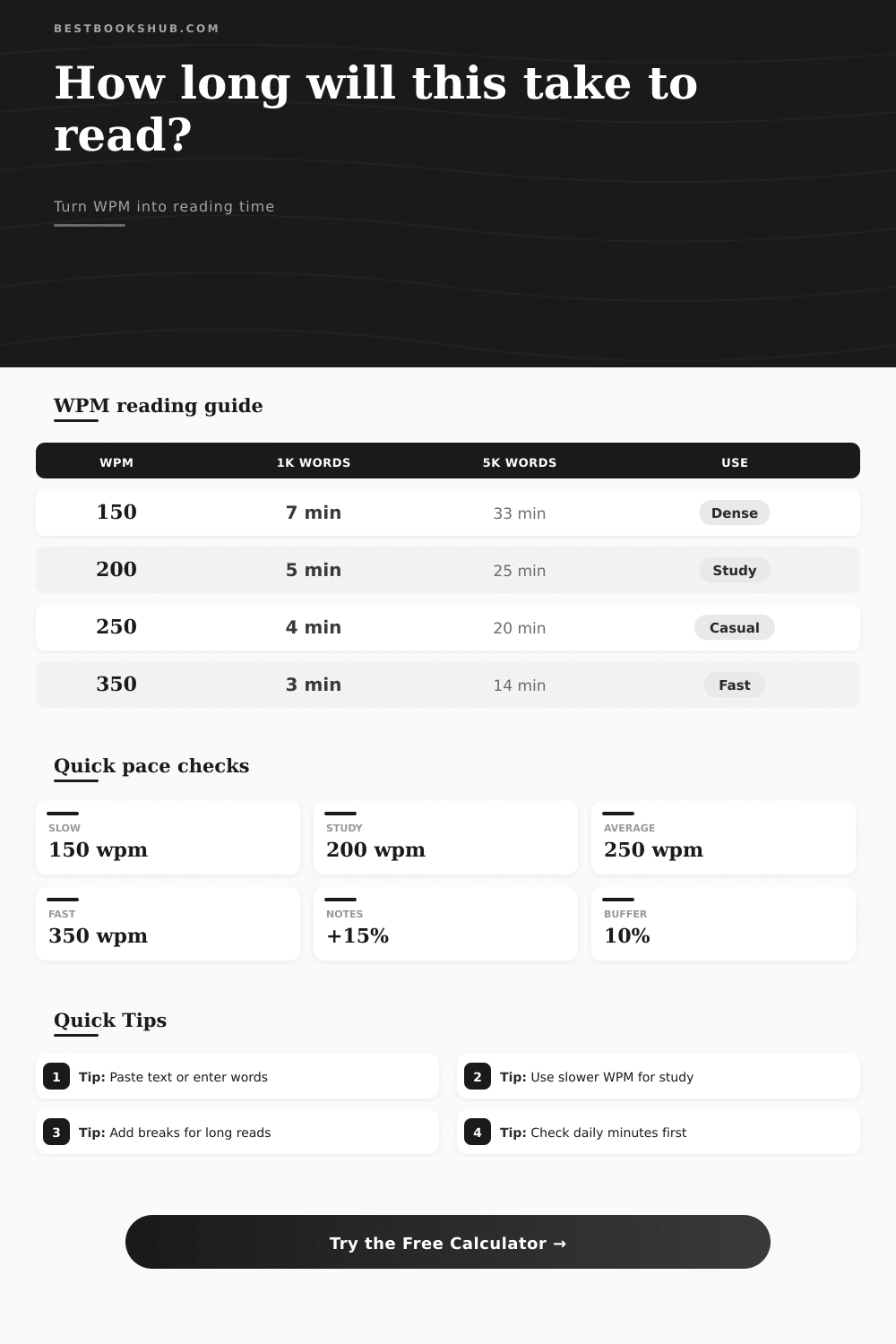
Paste text for an automatic word count or enter a known word count directly. The calculator uses words divided by adjusted WPM, then adds rereading, notes, breaks, and schedule buffers.
| Reading mode | Typical WPM | Time for 10,000 words | Best use |
|---|---|---|---|
| Careful oral reading | 130 to 180 | 56 to 77 minutes | Read-aloud practice, narration checks, dense wording. |
| Slow study reading | 150 to 220 | 45 to 67 minutes | Textbooks, annotation, technical or unfamiliar topics. |
| Average silent reading | 220 to 300 | 33 to 45 minutes | Fiction, memoir, general nonfiction, familiar subjects. |
| Fast comfortable reading | 300 to 450 | 22 to 33 minutes | Light material, rereads, overview passes, review packets. |
| Skim or preview pass | 450 to 700 | 14 to 22 minutes | Headline scanning, structure review, index or source triage. |
| Material type | Default factor | Notes load | Why it changes time |
|---|---|---|---|
| Fiction or memoir | 1.00x | Light | Narrative continuity usually supports a steady pace. |
| General nonfiction | 1.12x | Medium | Concepts, examples, and definitions often need extra processing. |
| Academic article | 1.40x | Medium-high | Arguments, citations, figures, and terminology slow the pass. |
| Textbook or manual | 1.55x | High | Problem solving, cross-references, and retention raise time. |
| Legal or policy text | 1.70x | High | Definitions, exceptions, and exact wording reward slow reading. |
| Poetry or verse | 1.85x | Variable | Lineation, sound, ambiguity, and rereads dominate pace. |
| Proofreading pass | 2.00x | High | Accuracy checks require slower attention than normal reading. |
| Skim or preview | 0.65x | Light | Intentional scanning reduces detail and speeds first contact. |
| Reading item | Typical words | At 250 WPM | With study load |
|---|---|---|---|
| Short blog article | 900 words | 4 minutes | 5 to 7 minutes |
| Long-form article | 2,500 words | 10 minutes | 13 to 18 minutes |
| Novel chapter | 4,000 words | 16 minutes | 20 to 27 minutes |
| Academic paper | 8,000 words | 32 minutes | 55 to 80 minutes |
| Book club section | 25,000 words | 1 hr 40 min | 2 hr 10 min to 3 hr |
| Full manuscript | 80,000 words | 5 hr 20 min | 8 hr to 12 hr+ |
DISCLOSURE: This post may contain affiliate links, meaning when you click the links and make a purchase, I receive a commission. As an Amazon Associate I earn from qualifying purchases.
Your reading speed isn’t measured by words per minute; it’s not a static quantity at all. It varies based off the material being read. Raw word count is a pretty lousy indicator of time cost, since what you actualy spend your mind on… The meaning, the nuance, the context, differ greatly between types of content. One thousand words of light fiction could be processed with one-third the mental effort required for one thousand words of policy/legal text.
However, failure to plan for reality is where things become difficult. Looking at an 80k word manuscript, you may think “oh, I’ll read this in five hours,” without factoring in friction. What’s friction? It means having to stop, make notes, and have to re-read complicated section. It also means recognizing your body need to get up and move once per hour. Unless you compensate for that, your plan will fall apart.
Why Your Reading Speed Changes
That’s why we created the tool above. It closes the gap between raw words and a realistic reading time by assuming a baseline speed based on how much you’re reading, then accounting for breaks and annotations. Think about what kind of content you’re dealing with. If it’s a textbook, you have to be an active reader, since you’re not only consuming info but questioning it as well.
To account for this, the calculator use a complexity factor that decreases your actual reading speed, meaning that it understands that narrative fiction doesn’t require as much thinking power than, say, a legal document or academic paper. When you’re reading for pleasure, you can go along at two hundred fifty words per minute; when you hit the technical definitions, you slow down to a hundred and fifty. Noting this difference will save you from the frustration of feeling like you can’t keep up if you mistakenly assume a study guide is a beach read.
Finally, there’s the buffer for the schedule. Perfect conditions don’t often exist; many readers miss deadlines because they think that everything will go perfectly when really interruptions occur and people gets tired. You can include a buffer on your estimated times by adding in a percentage, which I consider your insurance policy against things going off schedule. It might be just 10%, but that could be the difference between finishing a chapter and still having some time left or rushing through the last few pages completely wiped out.
In other words, this turns reading from a race against the clock into a managed workflow. What’s nice about this is that instead of simply spitting out an overall number… How long will it take? It splits up the work into word count per day and time per day. That allows you to build habits: rather than thinking “oh yeah, I should of get back on track and write 4k words in the next week,” with some abstraction, now you can think “okay, there are only two mornings left before noon and I need to spend thirty minutes each morning reading. Do I have time for that in my schedule?
All this means that the point of becoming more efficient at reading isn’t to move your eyeballs across words any quicker; it’s to adjust your own expectations to the limitations of your attention and what the text requires of you. It’s to treat reading time as variable, not constant, so you don’t guess when you’ll be done but schedule yourself to do so. The difference between starting to read and finishing is that you move from estimating your time to scheduling it.